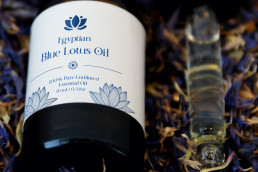
If you live with a cat and you are considering using blue lotus oil in your home, this article is written specifically for you. The short answer to whether blue lotus oil is safe for cats is no: like most essential oils and absolutes, it should not be applied to cats, diffused heavily in enclosed spaces where cats cannot leave, or left accessible for them to lick from a bottle or a freshly oiled surface. The longer answer, which is what most cat owners actually need, involves understanding why cats are uniquely vulnerable, what level of exposure is genuinely risky versus merely cautious, and how you can still enjoy blue lotus oil in a household that includes a feline.
Table of Contents
- Why Cats Are Different: The Liver Problem
- What Counts as Exposure for a Cat
- Skin contact
- Ingestion
- Inhalation
- Is Blue Lotus Oil Safe for Cats in Any Form?
- What Symptoms of Essential Oil Toxicity Look Like in Cats
- Diffusing Blue Lotus Oil in a Cat Household: A Practical Protocol
- Topical Use on Yourself in a Cat Household
- When Blue Lotus Oil Is Not the Right Choice for Your Household
- Safer Alternatives for Cat-Inclusive Scent Rituals
- Frequently Asked Questions
- Where to Go From Here
- Bring Blue Lotus Into Your Home Thoughtfully
It is written and clinically reviewed by Antonio Breshears, ND, CCA, a Bastyr-trained naturopathic doctor and certified clinical aromatherapist. For broader context on the oil itself, its chemistry, and general safety considerations, readers may find the complete guide to blue lotus oil a useful companion piece alongside this cat-specific safety article.
Why Cats Are Different: The Liver Problem
Cats are not small dogs, and they are definitely not small humans. Their liver biochemistry is genuinely unusual among mammals, and this is the single most important thing to understand before bringing any essential oil, blue lotus included, into a household with a cat.
Most mammals detoxify aromatic compounds (the terpenes, phenols, ketones and other volatile molecules that give essential oils their scent and activity) through a liver enzyme pathway called glucuronidation. This is the pathway that handles roughly half the compounds that enter the body via food, skin, or breath. Cats have a marked deficiency in the specific enzyme, UDP-glucuronosyltransferase, that drives this pathway. What this means in practical terms is that compounds which a human liver clears within hours can linger in a cat’s system for days, accumulate with repeated exposure, and reach toxic thresholds at doses that would be unremarkable for a dog, a horse, or a person.
This is why paracetamol (acetaminophen) is lethal to cats at doses that are safe for humans; it is also why essential oils as a category require extra caution in feline households. Blue lotus oil, whether as a solvent-extracted absolute or a rare true steam distillation, contains a complex mixture of aromatic alkaloids (nuciferine, aporphine) and residual volatiles that a cat’s liver is poorly equipped to process.
What Counts as Exposure for a Cat
When people ask whether an essential oil is safe around cats, they often assume exposure means “the cat drinks it”. In reality, cats can be exposed through three quite different routes, and each carries a different level of risk.
Skin contact
This is the highest-risk route. Cats groom themselves constantly. If oil transfers from your skin to their fur, during stroking, lap-sitting, or simply brushing past you, they will almost certainly ingest it within hours. Topical application of blue lotus oil directly onto a cat is never appropriate, and even indirect skin-to-fur transfer from a recently oiled human can be a meaningful dose for a small animal.
Ingestion
Direct ingestion, licking a spilled drop, chewing a rollerball, or drinking diffuser water, is the most dramatic route but in practice the least common if bottles are stored sensibly. Blue lotus oil is a concentrated aromatic extract; a few drops swallowed by a four-kilogram cat is a substantial dose.
Inhalation
This is where households get into grey territory. A diffuser running for twenty minutes in a large, well-ventilated room that the cat can freely leave is a very different exposure from a closed bedroom running a nebulising diffuser for eight hours while the cat sleeps on the bed. The first is generally considered low-risk by most veterinary aromatherapy consensus; the second is not.
Is Blue Lotus Oil Safe for Cats in Any Form?
To answer the core question directly: there is no form of blue lotus oil application that is affirmatively safe for cats in the way, say, a damp cloth is safe. What exists instead is a spectrum of risk, and sensible households operate at the low end of it.
Blue lotus oil should never be:
- Applied topically to a cat, for any reason, at any dilution.
- Added to a cat’s food, water, or treats.
- Used in a closed room where the cat cannot leave.
- Left in an accessible bottle, rollerball, or open dish.
- Applied to your own skin immediately before prolonged cuddling with a cat.
Blue lotus oil can, with reasonable care, be used:
- On your own skin in rooms the cat does not frequent, with enough time (several hours) before contact for the oil to absorb and volatilise.
- In a diffuser in a well-ventilated, open-plan space for limited periods (twenty to thirty minutes), with the cat free to leave and fresh air available.
- In personal rituals such as meditation or sleep routines where the cat is not in the same enclosed space.
This is not a permissive stance dressed up as caution. It reflects the genuine reality that humans and cats have shared scented homes for centuries, and that the question is not “zero exposure” but “exposure that stays well below the cat’s biological tolerance”.
What Symptoms of Essential Oil Toxicity Look Like in Cats
If you suspect a cat has been meaningfully exposed, whether through a spill, a grooming event after skin contact, or prolonged inhalation in an unventilated room, the symptoms to watch for develop over hours, not seconds. Essential oil toxicity in cats is rarely an instant collapse; it is usually a gradual change in behaviour and physiology.
Early signs include drooling, pawing at the face, licking lips repeatedly, or vomiting. As exposure progresses, you may see unsteady walking, tremors, lethargy, weakness, or a reluctance to move. Respiratory signs (rapid breathing, wheezing, coughing) can appear with inhalation exposure. In severe cases, liver involvement becomes apparent over twenty-four to seventy-two hours as jaundice, profound lethargy, or loss of appetite.
If any of these signs appear after a suspected exposure, contact a veterinarian promptly. Do not wait to see whether it resolves on its own, and do not attempt to induce vomiting at home unless explicitly instructed by a vet. Bring the bottle of oil, or a photograph of the label, so the veterinary team knows what they are dealing with.
Diffusing Blue Lotus Oil in a Cat Household: A Practical Protocol
If you have decided, with eyes open, that you want to diffuse blue lotus oil occasionally in a home that includes a cat, the following protocol reflects what most veterinary aromatherapists would consider a low-risk approach.
Use the smallest effective dose. Two drops in a standard ultrasonic diffuser in an open-plan room is more than sufficient for a human to enjoy the scent. There is no benefit to loading the diffuser with eight drops; it does not make the experience better, and it meaningfully increases the ambient load on any animal in the room.
Run the diffuser for short, defined periods. Twenty to thirty minutes, once or twice a day, is a reasonable upper bound. Avoid continuous diffusion, and especially avoid running a diffuser overnight in a bedroom where the cat sleeps.
Ensure the cat can always leave. The single most important environmental factor is free movement. If the cat can walk into another room, breathe fresh air, and return only if they choose to, the exposure stays self-limiting. Cats generally know when a scent is unpleasant or overwhelming to them, and they will vote with their feet if given the option.
Ventilate afterwards. Open a window for a few minutes once the diffuser stops. This clears residual aromatic molecules from the air and returns the room to baseline well before your cat returns to any resting spots in that space.
Keep the bottle sealed and elevated. Store blue lotus oil somewhere a cat cannot reach: not on a low shelf, not on a bedside table, not in an open bathroom cabinet. The bottles are small and curious cats can knock them off surfaces.
Topical Use on Yourself in a Cat Household
Personal use of blue lotus oil on your own skin is one of the most common scenarios, and it is also where people make the most mistakes. The key principle is time and location.
Apply blue lotus oil (at a sensible dilution of one to two percent in a carrier such as jojoba) to areas that will not be in direct contact with your cat: the inside of your wrists before bed, your temples, the back of your neck. Avoid applying to your forearms, chest, or lap if these are the parts of you a cat typically curls against.
Allow time to absorb. Fifteen to thirty minutes is usually enough for the oil to sink into skin and for most of the volatile fraction to disperse. Avoid picking up the cat or allowing it to groom you in the first hour after application.
Wash your hands after handling any bottle, rollerball, or neat oil. This is a boring habit but it removes the most common source of accidental transfer.
When Blue Lotus Oil Is Not the Right Choice for Your Household
There are specific scenarios where I would advise against keeping any essential oil, blue lotus included, in the home at all. These include:
- Households with cats that have known liver disease, feline hepatic lipidosis history, or ongoing hepatic medication.
- Households with kittens under six months, whose livers are still developing.
- Households with cats that have respiratory conditions such as feline asthma, where even mild aromatic load may trigger bronchospasm.
- Small studio flats or one-room living situations where the cat cannot meaningfully leave the diffused space.
- Households where the cat has exhibited unusual behaviour around scented products in the past (excessive avoidance, sneezing, watery eyes, hiding).
In these cases, the benefit you gain from blue lotus oil is not worth the risk you impose on the animal. Candles, hydrosols (used on yourself, not on the cat), or simply fresh flowers offer fragrance alternatives that do not rely on concentrated volatile compounds.
Safer Alternatives for Cat-Inclusive Scent Rituals
If blue lotus oil does not fit comfortably into your household, the experience it offers, a moment of aromatic stillness, a shift into parasympathetic calm, a sensory pause before sleep, can be approximated through approaches that carry less risk to your cat.
Hydrosols (the aromatic waters left after steam distillation) are far more dilute than essential oils and are generally considered much safer around cats. A fine mist of rose hydrosol or orange blossom hydrosol on a linen pillowcase (not on the cat, and not on surfaces the cat sleeps on) offers a gentle floral presence.
Dried blue lotus flowers, placed in a shallow bowl on a high shelf, offer a very faint honeyed scent without the volatile load of an extracted oil, and they look beautiful.
Scented candles made with high-quality natural fragrances, burned briefly in a ventilated room, deliver atmosphere without the sustained aromatic exposure of a diffuser.
None of these replicates the specific olfactory experience of blue lotus absolute, but they offer overlapping benefits and sit well within a cat-safe household.
Frequently Asked Questions
Is blue lotus oil safe for cats in any amount?
No form of blue lotus oil is affirmatively safe for direct feline use. It should never be applied to a cat, added to food or water, or allowed to be ingested. Incidental inhalation of small amounts in a ventilated room that the cat can leave freely is generally low-risk, but this is tolerance, not safety.
Can I diffuse blue lotus oil if I have a cat?
Yes, with care. Use two drops or fewer, diffuse for twenty to thirty minutes at a time in an open space, ensure the cat can leave the room, and ventilate afterwards. Avoid overnight diffusion in enclosed bedrooms.
What happens if my cat licks blue lotus oil off my skin?
A small lick of oil that has been applied to human skin and partly absorbed is usually not an acute emergency, but it is not nothing either. Monitor the cat for drooling, vomiting, lethargy, or unsteadiness over the following twenty-four hours, and contact a vet if any of these appear.
My cat walked into a room where I was diffusing blue lotus. Should I worry?
Probably not, if the exposure was brief and the room was ventilated. Cats self-regulate aromatic exposure well when given the option to leave. Watch for changes in behaviour over the next few hours, but a single brief passage through a diffused room is very unlikely to cause harm.
Is blue lotus oil more or less dangerous than other essential oils for cats?
Blue lotus oil sits roughly in the middle of the risk spectrum for cats. It is less acutely toxic than known high-risk oils such as tea tree, pennyroyal, wintergreen, or citrus oils with high limonene content, but it is more of a concern than hydrosols or very dilute preparations. Treat it with the same caution you would treat any moderate-risk essential oil.
Can I put blue lotus oil on my cat for anxiety or skin issues?
No. Under no circumstances apply blue lotus oil, or any essential oil, topically to a cat. If your cat has anxiety or a skin condition, speak to a veterinarian. Cat-specific solutions exist (including veterinary-formulated pheromone products) that do not carry the hepatic risks of essential oils.
What should I do if I spill blue lotus oil near my cat?
Remove the cat from the area immediately. Clean the spill thoroughly with soap and water (not just a dry wipe, which spreads rather than removes oil). Ventilate the room. Check the cat’s paws and coat for any oil transfer; if present, wash the affected area gently with a small amount of mild pet-safe shampoo and warm water. Monitor the cat and call a vet if any symptoms appear.
Are some blue lotus products safer around cats than others?
A true hydrosol of blue lotus (the aromatic water from distillation) is meaningfully more dilute and therefore lower-risk than the absolute or essential oil. Dried flowers offer the lowest risk profile of all. If you specifically want blue lotus in a cat household, these lower-concentration forms are worth considering.
Can blue lotus oil exposure cause long-term harm to cats?
Repeated, low-level exposure over months, for example, constant diffusion in a small flat, can theoretically burden a cat’s liver over time. Acute exposures that resolve without symptoms are unlikely to cause lasting harm, but chronic low-dose exposure is poorly studied and worth avoiding as a precaution.
Where can I learn more about blue lotus oil safety generally?
For a broader overview of the oil’s chemistry, general safety profile, and use considerations, the complete guide to blue lotus oil covers the material in depth.
Where to Go From Here
Sharing a home with a cat does not mean abandoning the sensory pleasure of blue lotus oil; it means being thoughtful about where, when, and how you use it. The goal is a household where the animal is safe and the human still enjoys the scent, and this is entirely achievable with small adjustments: storage out of reach, short diffusion sessions in ventilated rooms, topical application on areas the cat does not contact, and honest awareness of the animal’s behaviour and health status. If at any point you find yourself weighing your ritual against your cat’s wellbeing, the cat wins. That is the simple rule, and it protects both of you over the long term.

Antonio Breshears
Antonio Breshears is a renowned expert in holistic medicine and beauty, with over 25 years of research experience dedicated to uncovering the secrets of nature's most powerful remedies. Holding a degree in Naturopathic Medicine, Antonio's passion for healing and well-being has driven him to explore the intricate connections between mind, body, and spirit.
Over the years, Antonio has become a respected authority in the field, helping countless individuals discover the transformative power of plant-based therapies, including essential oils, herbs, and natural supplements. He has authored numerous articles and publications, sharing his wealth of knowledge with a global audience seeking to improve their overall health and well-being.
Antonio's expertise extends to the realm of beauty, where he has developed innovative, all-natural skincare solutions that harness the potency of botanical ingredients. His formulations embody his deep understanding of the healing properties found in nature, providing holistic alternatives for those seeking a more balanced approach to self-care.
With his extensive background and dedication to the field, Antonio Breshears is a trusted voice and guiding light in the world of holistic medicine and beauty. Through his work at Pure Blue Lotus Oil, Antonio continues to inspire and educate, empowering others to unlock the true potential of nature's gifts for a healthier, more radiant life.