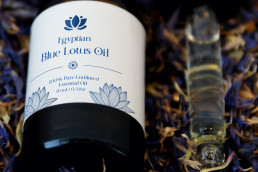
Blue lotus has one of the longest continuous cultural histories of any aromatic plant in the Western tradition. The flower appears in Egyptian tomb art from roughly the Old Kingdom, in Greek and Roman texts of the late Classical period, in medieval Islamic pharmacology, and in modern ethnobotanical and aromatic literature. This pillar sets out what is reasonably established about that history, where the evidence is firmer, and where the popular accounts outpace the scholarship. It is written to be honest about the limits of historical reconstruction while still conveying the genuine depth of the tradition.
Table of Contents
- The Plant Itself
- Predynastic and Early Dynastic Egypt
- Nefertem and the Cosmological Role
- Funerary Use
- Banquets and Ritual Consumption
- Scented Oil and Ritual Anointing
- Spread Beyond Egypt
- Decline and Medieval Obscurity
- Early Modern and Nineteenth-Century Rediscovery
- Twentieth-Century Ethnobotanical Research
- Contemporary Egyptian and Nubian Practice
- Modern Aromatic and Contemplative Use
- Parallel Traditions Worth Distinguishing
- Frequently Asked Questions
- Where to Go From Here
- An Ancient Aromatic, Honestly Made
It is written and clinically reviewed by Antonio Breshears, ND, CCA, a Bastyr-trained naturopathic doctor and certified clinical aromatherapist. For the broader context on the oil and its contemporary use, our complete guide to blue lotus oil is the parent reference.
The Plant Itself
Nymphaea caerulea is a water lily native to the Nile basin and widely distributed across northern, eastern, and southern Africa. It grows in still or slow-moving fresh water; the flowers open in the morning and close at night across a flowering period of several days. The colour is a striking sky-blue with a yellow centre, and the scent of the opened flower is a light floral with marine and green notes that the absolute extraction captures and concentrates.
The species is sometimes confused with the sacred lotus (Nelumbo nucifera), which belongs to a different plant family and is associated with quite distinct cultural traditions in India and East Asia. The two are referred to interchangeably as “blue lotus” in some contemporary texts; for precision, the aromatic and cultural history discussed in this article concerns Nymphaea caerulea specifically, and the related Nymphaea lotus (the white Egyptian lotus) which often appears alongside it in Egyptian sources.
Predynastic and Early Dynastic Egypt
The earliest archaeological evidence for blue lotus in Egyptian use dates to the predynastic period (before approximately 3100 BCE), with flower remnants found in burial contexts. By the Old Kingdom (roughly 2700 to 2200 BCE), the flower appears in carved and painted form in tombs and on temple walls, establishing its position in Egyptian symbolic and ceremonial life.
The iconographic use is remarkable for its consistency. The flower appears held by the deceased, offered to the gods, floating in water at banquet scenes, entwined in columns and capitals, and woven into headdresses. Over the full span of dynastic Egyptian art, the blue lotus remains one of the most frequently depicted plants; only the papyrus rivals it in cultural prominence.
Nefertem and the Cosmological Role
The god Nefertem is the figure most directly associated with the blue lotus in Egyptian religion. Depicted as a young man with a blue lotus on his head, or as a lotus itself emerging from primordial waters, Nefertem held a portfolio that combined the sensual and the sacred: he was the god of perfume, of healing, and of the aesthetic-contemplative dimensions of religious practice. In the Memphite theological tradition, he was the son of Ptah and Sekhmet.
The broader cosmological role of the lotus was tied to Egyptian creation narratives. Several versions describe the first land rising from the primordial waters as a lotus, opening at dawn to reveal the sun-god emerging. The daily closing and opening of the flower enacted the pattern: a daily repetition of creation, the sun sinking into the waters at night and rising again in the morning. This is the conceptual basis for the flower’s funerary prominence: the deceased, like the sun, would pass through the waters of night and re-emerge.
Our pillar on blue lotus oil in meditation and yoga practice covers the contemplative inheritance of this cosmology into modern use.
Funerary Use
The flower appears in almost every known context of Egyptian funerary art. In tomb paintings and reliefs, the deceased holds the lotus to the nose in the iconic gesture associated with rebirth; bouquets of blue and white lotus flowers accompany the deceased on the journey through the underworld. Coffins from several dynastic periods feature the flower in painted decoration, and lotus-shaped drinking vessels, unguent jars, and other funerary goods have been recovered from excavations across the country.
Whether the flower was primarily symbolic in these uses or also active (in the sense of releasing its aromatic and possibly psychoactive compounds) is a question modern scholarship continues to investigate. The association between the flower and the continuation of life after death is, at least, securely established as symbolic; the aromatic and pharmacological dimensions are reasonably inferred from the parallel uses in banquet and ritual contexts.
Banquets and Ritual Consumption
The most discussed aspect of Egyptian blue lotus use, and the one where popular accounts most often outpace the firm scholarship, concerns the ritual and recreational use at banquets. The iconographic evidence is clear: banquet scenes from the New Kingdom (roughly 1550 to 1070 BCE) depict participants holding blue lotus flowers, with flowers placed in wine cups and pressed to the nose during drinking.
That blue lotus was infused into wine is reasonably well attested, though the specific preparation methods and concentrations are not securely known. The flower’s alkaloids (aporphine and nuciferine, discussed in our chemistry pillar) are partially soluble in alcohol, so a wine infusion would extract some of their content; whether the Egyptians were deliberately targeting this pharmacological effect or whether they understood the flower primarily as an aesthetic and aromatic addition is harder to establish from the available evidence.
The contextual prominence of the flower at banquets was clearly more than decorative. The combination of wine, music, perfumed oil, and the blue lotus itself appears repeatedly in ceremonial and social contexts, and is embedded enough in Egyptian cultural practice that removing any single element would have left the others less meaningful. The flower carried the threshold between ordinary life, religious observance, and the liminal state that wine, music, and ritual together created.
Scented Oil and Ritual Anointing
A use distinct from the wine-infusion tradition and arguably more directly ancestral to modern blue lotus oil practice. Egyptian ritual anointing with scented oils is well attested: temple statues were anointed daily in certain cults, priests anointed themselves before ritual duties, and the deceased were prepared with scented unguents as part of funerary practice. Blue lotus was one of several aromatic plants that entered these oils, alongside others including myrrh, frankincense, and various floral extracts.
The specific formulation of ancient Egyptian anointing oils is a technical question that has been partially answered by residue analysis of unguent jars. The evidence suggests that blue lotus was a component of some, but not all, Egyptian scented oils, and that its role was more common in royal, priestly, and funerary contexts than in daily domestic use. This is consistent with the broader pattern: the flower carried a liminal-sacred character that made it appropriate for threshold moments rather than everyday life.
Spread Beyond Egypt
Egyptian cultural influence radiated across the eastern Mediterranean through Bronze Age and later trade networks. Blue lotus appears in Phoenician, Mycenaean, and early Greek iconographic contexts, though not with the central prominence it held in Egypt itself. The flower became part of the wider Mediterranean repertoire of religious and ceremonial plants, alongside more locally important species such as crocus, narcissus, and rose.
Classical Greek writers including Herodotus and Theophrastus mention the Egyptian lotus, and Roman sources including Pliny the Elder discuss it as an exotic plant of interest. The Roman interest was more botanical and exotic-trade than religious; the flower had lost its cosmological centrality outside Egypt but retained its status as an object of high-status trade.
Islamic pharmacological tradition, which absorbed and extended Greek botanical knowledge from the 8th century onwards, preserved mentions of the Egyptian lotus in texts by writers such as Ibn Sina (Avicenna) and al-Biruni. These traditions treated the flower as a medicinal plant with mild sedative and cooling properties, which is broadly consistent with both the ancient use and the modern understanding.
Decline and Medieval Obscurity
The flower’s prominence in Mediterranean cultural life declined substantially through the medieval period. Several factors contributed: the end of Egyptian independence and the successive Roman, Byzantine, and Islamic administrations changed the cultural contexts in which the flower had been embedded; changes in irrigation and Nile hydrology reduced the natural habitats in which Nymphaea caerulea flourished; and the Christianisation of the Mediterranean world displaced the religious frameworks that had made the flower meaningful.
Through the long medieval period, blue lotus survived in local Egyptian and Nubian herbal tradition, in pharmacological texts of the Islamic world, and as a botanical curiosity in European herbals that drew on Classical sources. Its prominent cultural role had diminished but the knowledge of the plant did not disappear.
Early Modern and Nineteenth-Century Rediscovery
European interest in Egyptian antiquity, and with it the blue lotus, revived substantially in the eighteenth and nineteenth centuries. Napoleon’s Egyptian campaign of 1798 to 1801 produced the monumental Description de l’Égypte, which catalogued extensive archaeological and natural-historical material including detailed observations of the blue lotus. The decipherment of hieroglyphs in the 1820s opened the textual record of Egyptian religion to European scholarship, and the flower’s cosmological and ritual roles became subjects of sustained academic interest.
Botanical and pharmacological investigation followed. Nineteenth-century chemists identified some of the flower’s active compounds (though accurate characterisation of the full alkaloid profile came considerably later), and aromatic producers in France and elsewhere began offering blue lotus absolute as a perfumery material. The modern commercial trade in blue lotus oil effectively begins in this period.
Twentieth-Century Ethnobotanical Research
Through the twentieth century, ethnobotanical and pharmacological research on blue lotus accumulated gradually. Researchers including William Emboden published influential work in the 1970s and 1980s drawing attention to the pharmacological properties of the alkaloid fraction and reconstructing the likely Egyptian use context. This research fed into both the contemporary ethnobotanical understanding and the popular awareness that has grown across the last several decades.
It also fed, less helpfully, into a wave of popular accounts that have emphasised the psychoactive dimensions of the tradition at the expense of the broader symbolic, ritual, and aesthetic contexts in which the flower was used. This popular emphasis has contributed to the legal restrictions covered in our article on blue lotus oil safety, side effects and precautions; a more balanced reading of the tradition would acknowledge the sensual and pharmacological dimensions without making them central.
Contemporary Egyptian and Nubian Practice
Traditional herbal practice in contemporary Egypt and Nubia continues to use blue lotus, primarily as a mild sedative and sleep aid, in infusions and occasionally in topical preparations. The traditional knowledge has not been continuous with the ancient ritual use (the continuity was broken in the medieval period), but the pharmacological core of the practice is similar, which reflects the underlying consistency of what the plant actually does.
Egyptian agriculture and horticulture today produce the plant at modest scale for the aromatic and herbal trades, and Egyptian blue lotus absolute (along with similar products from other sources) is the form most readily available in the international market. Our article on blue lotus oil from Egypt covers the sourcing dimension in detail.
Modern Aromatic and Contemplative Use
The contemporary aromatic use of blue lotus is broadly a recovery and extension of strands of the ancient tradition. The sleep and dream-work applications covered in our sleep and dreams pillar draw on the Egyptian funerary and dream-incubation traditions. The contemplative applications covered in our meditation and yoga pillar draw on the Egyptian ritual-anointing practice, adapted for modern contemplative frameworks. The aphrodisiac and intimate uses covered in our aphrodisiac article draw on the banquet and Nefertem traditions.
What is new in the modern context is the availability of the oil as a concentrated extract, the range of applications to which it is put outside any single religious or cultural framework, and the integration of the oil into a broader contemporary aromatic and wellness practice. The modern use honours the ancient tradition without replicating it; the contexts are substantially different, and the oil is put to work in ways that would not have been familiar to its original users. This is unavoidable and acceptable, provided the tradition is acknowledged and the more overwrought contemporary claims are treated with appropriate scepticism.
Parallel Traditions Worth Distinguishing
Three traditions often confused with or conflated with blue lotus history deserve brief distinction.
Sacred lotus (Nelumbo nucifera) is the lotus of Indian religious iconography, central to Hindu, Buddhist, and Jain symbolism. It is a different plant family, a different scent profile, and a different set of cultural associations. Shared imagery (flower emerging from water, symbol of purity and awakening) is real, but the two traditions developed independently.
Mesoamerican water lily (Nymphaea ampla) appears in Mayan religious iconography in ways that parallel the Egyptian blue lotus remarkably. The parallel is intriguing and has produced a modest academic literature on possible shared functions; see our article on blue lotus in Mayan culture for the specific detail. The plants are different species but closely related.
European water lilies (Nymphaea alba, Nuphar lutea) have their own folklore and herbal uses, distinct from the Egyptian blue lotus tradition. These are sometimes sold as “blue lotus” or “water lily” in contexts where the species identity is obscured; for any therapeutic use, species identification matters.
Frequently Asked Questions
How long has blue lotus been used?
Archaeological evidence for blue lotus use in Egyptian contexts dates to the predynastic period, before approximately 3100 BCE. The flower has therefore been in continuous cultural use for roughly five thousand years, though the specific uses have varied substantially across that period.
Did the ancient Egyptians use blue lotus to get high?
The evidence supports ritual and ceremonial use that included pharmacological effects (particularly in wine infusion at banquets), but framing this as “getting high” in the modern recreational sense imposes a framework that does not fit the source context. The Egyptian use was embedded in religious, social, and ceremonial practice in ways that modern recreational use is not.
Is blue lotus in the Bible or other religious texts?
Blue lotus does not appear prominently in the Hebrew Bible or the New Testament. It is mentioned in some ancient Greek and Roman sources (Herodotus, Theophrastus, Pliny the Elder) and in Islamic pharmacological texts of the medieval period. The specific sacred role of the flower is primarily Egyptian.
What is Nefertem?
Nefertem is the Egyptian god most directly associated with the blue lotus. Depicted as a young man with a lotus on his head, he was the deity of perfume, healing, and the aesthetic-sensual dimensions of religious practice. He held a significant position in the Memphite theological tradition.
Is the blue lotus in Egyptian art the same as the sacred lotus?
No. The Egyptian blue lotus is Nymphaea caerulea, a water lily native to the Nile basin. The sacred lotus of Indian tradition is Nelumbo nucifera, a different plant family from a different cultural tradition. Shared imagery is a matter of parallel development rather than common origin.
When did blue lotus come back into Western use?
European interest revived substantially with Napoleon’s Egyptian campaign (1798 to 1801) and subsequent scholarship on Egyptian antiquity. Commercial production of blue lotus absolute in France and elsewhere begins in the nineteenth century. Contemporary therapeutic and aromatic use builds on ethnobotanical research primarily from the latter half of the twentieth century.
Why is blue lotus illegal in some places?
A small number of jurisdictions have scheduled blue lotus as a controlled substance in response to emphasis on its psychoactive properties. These classifications are relatively recent (twentieth and twenty-first century) and do not reflect a long-standing legal tradition. The full current detail is in our safety article.
Was blue lotus used in embalming?
Blue lotus was part of the broader Egyptian funerary practice, placed on and around the body and included in tomb goods. Whether it was specifically a component of embalming preparations is less clear; Egyptian embalming used resins, natron, and various aromatic plants, and blue lotus may have contributed in some preparations without being a primary embalming agent.
Do Egyptians still use blue lotus today?
Yes, in traditional herbal practice (primarily as a mild sedative and sleep aid) and in modest commercial cultivation for the aromatic trade. The contemporary use is not continuous with the ancient ritual tradition but does draw on the same underlying pharmacology.
Is the modern use of blue lotus historically authentic?
Partially. Modern aromatic and therapeutic use draws on genuine strands of the ancient tradition (sleep support, contemplative practice, intimate and ritual use) but applies them in substantially different cultural contexts. This is normal for any continuing cultural tradition; strict historical reconstruction is not possible and arguably not desirable.
Where to Go From Here
For the modern applications that build on this tradition, see our pillars on blue lotus oil health and wellness benefits, sleep and dreams, and meditation and yoga practice. For the specific historical and geographic cluster articles, see blue lotus oil from Egypt and blue lotus in Mayan culture. For the chemistry and mechanism side, the chemical composition and therapeutic properties pillar. Everything on this site is hosted at Pure Blue Lotus Oil.

Antonio Breshears
Antonio Breshears is a renowned expert in holistic medicine and beauty, with over 25 years of research experience dedicated to uncovering the secrets of nature's most powerful remedies. Holding a degree in Naturopathic Medicine, Antonio's passion for healing and well-being has driven him to explore the intricate connections between mind, body, and spirit.
Over the years, Antonio has become a respected authority in the field, helping countless individuals discover the transformative power of plant-based therapies, including essential oils, herbs, and natural supplements. He has authored numerous articles and publications, sharing his wealth of knowledge with a global audience seeking to improve their overall health and well-being.
Antonio's expertise extends to the realm of beauty, where he has developed innovative, all-natural skincare solutions that harness the potency of botanical ingredients. His formulations embody his deep understanding of the healing properties found in nature, providing holistic alternatives for those seeking a more balanced approach to self-care.
With his extensive background and dedication to the field, Antonio Breshears is a trusted voice and guiding light in the world of holistic medicine and beauty. Through his work at Pure Blue Lotus Oil, Antonio continues to inspire and educate, empowering others to unlock the true potential of nature's gifts for a healthier, more radiant life.