Table of Contents
- TLDR
- Why Blending Matters (And Why Blue Lotus Is Worth Building Around)
- Understanding Notes: The Framework Behind Every Good Blend
- Quick-Reference: Aroma Families That Pair With Blue Lotus
- Dilution and Safety: The Numbers You Need
- Standard Dilution Rates
- Critical Safety Notes
- Choosing Your Carrier Oil
- Blue Lotus Blend Recipes by Purpose
- Deep Sleep Blend
- Focus and Clarity Blend
- Meditation and Grounding Blend
- Romance Blend
- Calming Body Massage Blend
- Skincare Facial Serum
- Energizing Morning Diffuser Blend
- How to Build Your Own Blends: Step by Step
- Step 1: Choose Your Purpose
- Step 2: Select 3 to 5 Oils
- Step 3: Test on a Scent Strip First
- Step 4: Start Small
- Step 5: Let the Blend Marry
- Step 6: Adjust and Record
- Essential Oil Types: What You Are Actually Buying
- Quality Markers: What to Check Before You Buy
- GC/MS Reports
- Certificate of Analysis (COA)
- Botanical Name on the Label
- MSDS/SDS Documentation
- The “Therapeutic Grade” Myth
- Application Methods: How to Use Your Blends
- Diffuser
- Roller Bottles
- Massage
- Bath
- Compress
- Storage and Shelf Life
- Advanced Blending: Chemical Stacking
- Putting It All Together
- Frequently Asked Questions
TLDR
Essential oil blends are intentional combinations of two or more oils designed for specific purposes like sleep, focus, meditation, or romance. This guide gives you ready-to-use recipes with exact drop counts, safe dilution ratios, and step-by-step instructions for building your own blends at home or in a professional setting. Blue Lotus (Nymphaea caerulea) serves as the anchor oil throughout, paired with complementary oils for every major use case. Whether you are a diffuser-and-roller-bottle enthusiast or a spa formulator, you will walk away with blends you can make tonight.
Why Blending Matters (And Why Blue Lotus Is Worth Building Around)
The aromatherapy segment of the essential oils market is worth roughly $8.9 billion, according to Grand View Research, and essential oil blends sit at the center of that growth. But the real reason blending matters is simpler than market figures: a single oil is good, but the right combination of oils can produce effects that no individual oil achieves on its own.
Aromatherapists call this “synergy,” a term that gets overused but describes something real. Clinical aromatherapist Amy N. Anthony of NYC Aromatica points out that blending two oils at the wrong ratio can actually produce antagonism, where the combined effect is weaker than either oil alone. The flip side is equally true: the right pairing at the right ratio creates something genuinely greater than the sum of its parts.
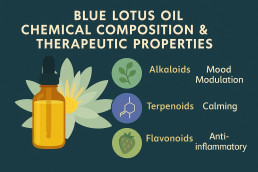
Blue Lotus makes a particularly good foundation oil for blending. It functions as a middle-to-base note with an unusual combination of floral sweetness and aquatic depth, which means it bridges lighter top notes and heavier base notes without dominating. Its chemical composition, rich in sesquiterpenes, gives it calming properties that support sleep, meditation, and romance blends alike. For a full library of combinations, explore Blue Lotus essential oil blends and combinations.
Understanding Notes: The Framework Behind Every Good Blend
Before jumping into recipes, you need one concept: note classification. Every essential oil evaporates at a different rate, and blenders group them into three tiers.
Note | Evaporation Time | Character | Examples |
|---|---|---|---|
Top | 1 to 2 hours | Bright, sharp, first impression | Lemon, bergamot, grapefruit, peppermint |
Middle | 2 to 4 hours | Warm, rounded, the “heart” | Lavender, geranium, Blue Lotus, rosemary |
Base | 4+ hours | Deep, rich, anchoring | Sandalwood, vetiver, frankincense, patchouli |
A balanced blend needs all three layers. The standard starting framework is 30% top notes, 50% middle notes, and 20% base notes. This is not a rigid rule, but it gives you a blend that unfolds over time rather than hitting all at once or fading too quickly.
Blue Lotus sits in the middle-to-base range, which makes it unusually versatile. It can serve as the heart of a blend or as a bridge to deeper base notes like sandalwood and vetiver. Every recipe below is built around this principle.
Quick-Reference: Aroma Families That Pair With Blue Lotus
Instead of memorizing individual oil pairings, think in terms of aroma families. Blue Lotus belongs to the floral family but has aquatic and earthy undertones that give it reach into woody and resinous territory.
Aroma Family | Pairing Quality With Blue Lotus | Best Oils to Try |
|---|---|---|
Floral | Natural harmony, deepens the heart | Lavender, ylang-ylang, jasmine, rose |
Citrus | Bright lift, balances Blue Lotus depth | Bergamot, sweet orange, grapefruit |
Woody/Earthy | Grounding anchor, extends longevity | Sandalwood, cedarwood, vetiver |
Resinous | Spiritual warmth, meditation support | Frankincense, myrrh, benzoin |
Herbaceous | Clean contrast, adds focus element | Rosemary, clary sage, marjoram |
Spicy | Warmth and complexity, romantic blends | Black pepper, ginger, cardamom |
Dilution and Safety: The Numbers You Need
Safe blending comes down to numbers, not guesswork. The Tisserand Institute puts it plainly: “It’s not enough to simply say ‘dilute before use on the skin,’ this is insufficient information.”
Standard Dilution Rates
Application | Dilution Rate | Drops of EO per 10 mL Carrier |
|---|---|---|
Facial skincare | 1% | 2 to 3 drops |
Body application | 2 to 3% | 4 to 6 drops |
Massage | 3 to 5% | 6 to 10 drops |
Bath (with emulsifier) | 5 to 8% | 10 to 16 drops |
For Blue Lotus specifically, the guide on topical application and dilution ratios provides detailed recommendations by use case.
Critical Safety Notes
Always patch test. Apply a small amount of your diluted blend to the inner forearm and wait 24 hours before broader use.
Never apply undiluted essential oils to skin. Repeated exposure at full concentration can cause sensitization, a permanent immune response that makes you reactive even at low dilutions.
Use an emulsifier for bath blends. Essential oils float on water undiluted. Polysorbate 20 or a dedicated bath dispersant keeps oils safely distributed.
Watch citrus oils in leave-on products. Cold-pressed bergamot, lemon, and lime contain phototoxic compounds. Keep bergamot at or below 0.4% in anything that stays on skin exposed to sunlight.
For comprehensive precautions relevant to Blue Lotus, see Blue Lotus oil safety, side effects, and precautions.
Choosing Your Carrier Oil
Carrier oils “carry” essential oils onto the skin and reduce irritation risk. Your choice of carrier affects how the blend feels, absorbs, and lasts.
Carrier Oil | Skin Feel | Best For |
|---|---|---|
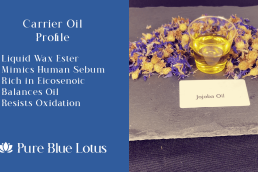
Jojoba | Light, non-greasy, close to skin’s sebum | Facial blends, all skin types |
Sweet almond | Medium, slightly nutty | Massage, body blends |
Fractionated coconut | Very light, no scent | Roll-ons, when you want the EO scent to dominate |
Argan | Rich, nourishing | Dry skin, luxury facial serums |
Grapeseed | Light, mildly astringent | Oily or combination skin |
For Blue Lotus pairings specifically, see the guide on carrier oil pairings.
Blue Lotus Blend Recipes by Purpose
Here are ready-to-use recipes organized by intention. Each includes exact drop counts for both diffuser use and topical application (in a 10 mL roller bottle). Adjust proportions up or down, but keep the ratios consistent.
Deep Sleep Blend
Sleep blends lean on sedative chemical profiles, oils high in esters and sesquiterpenes. This blend is warm, enveloping, and deliberately base-note heavy.
Diffuser Recipe (ultrasonic, standard room)
Blue Lotus: 2 drops
Roman chamomile: 2 drops
Vetiver: 1 drop
Lavender: 2 drops
10 mL Roller Bottle (2% dilution in jojoba)
Blue Lotus: 2 drops
Roman chamomile: 2 drops
Vetiver: 1 drop
Lavender: 1 drop
Fill remainder with jojoba oil
Apply to wrists, temples, and the soles of feet 20 minutes before bed. Practitioners on aromatherapy forums consistently recommend applying sleep blends before you start your wind-down routine, not the moment you hit the pillow, so the scent has time to settle in.
Focus and Clarity Blend
This blend uses herbaceous and citrus top notes for alertness, with Blue Lotus providing just enough grounding warmth to prevent that “too sharp” feeling some focus blends create.
Diffuser Recipe
Rosemary (ct. cineole): 2 drops
Lemon: 2 drops
Blue Lotus: 1 drop
Frankincense: 1 drop
10 mL Roller Bottle (2% dilution in fractionated coconut)
Rosemary: 2 drops
Lemon: 1 drop
Blue Lotus: 1 drop
Peppermint: 1 drop
Frankincense: 1 drop
Fill remainder with fractionated coconut oil
Apply to wrists and behind the ears during study sessions or creative work. A note on rosemary chemotypes: rosemary ct. cineole is the standard clarity oil, while rosemary ct. camphor is more intense and best avoided in roller blends due to skin sensitivity.
Meditation and Grounding Blend
Blue Lotus has a long history in meditation and yoga practices. This blend centers resinous and woody oils around Blue Lotus for a contemplative, grounding atmosphere.
Diffuser Recipe
Blue Lotus: 3 drops
Frankincense: 2 drops
Sandalwood: 1 drop
Cedarwood: 1 drop
10 mml Roller Bottle (2% dilution in jojoba)
Blue Lotus: 2 drops
Frankincense: 2 drops
Sandalwood: 1 drop
Myrrh: 1 drop
Fill remainder with jojoba oil
Apply to pulse points and the center of the chest before sitting. Start the diffuser 5 minutes before you begin your practice so the scent fills the space. For specific diffuser techniques including timing and drop counts by room size, see the guide on Blue Lotus aromatherapy diffuser techniques.
Romance Blend
Floral and spicy families combine here for warmth, richness, and complexity. This blend is middle-and-base-note forward, designed to linger.
Diffuser Recipe
Blue Lotus: 2 drops
Ylang-ylang: 2 drops
Ginger: 1 drop
Sandalwood: 1 drop
10 mL Roller Bottle (2% dilution in argan)
Blue Lotus: 2 drops
Ylang-ylang: 1 drop
Jasmine absolute: 1 drop
Black pepper: 1 drop
Sandalwood: 1 drop
Fill remainder with argan oil
A tip from fragrance communities: go easy on ylang-ylang. It is powerful and can overwhelm a blend quickly. Start with fewer drops than you think you need, and increase after the blend has married (more on this below).
Calming Body Massage Blend
A 3% dilution in sweet almond oil, designed for a full-body massage that promotes relaxation without sleepiness.
For 30 mL of carrier oil (about 1 oz)
Blue Lotus: 4 drops
Lavender: 5 drops
Bergamot (furanocoumarin-free): 4 drops
Cedarwood: 3 drops
Sweet almond oil: 30 mL
If using regular cold-pressed bergamot (not FCF/furanocoumarin-free), avoid sun exposure on treated skin for 12 to 18 hours after application.
Skincare Facial Serum
A 1% dilution in a lightweight carrier, suitable for nightly use.
For 10 mL
Blue Lotus: 1 drop
Frankincense: 1 drop
Jojoba oil: fill to 10 mL
This minimalist blend lets Blue Lotus’s skin-supportive properties come through without overloading the skin. Frankincense complements it with well-documented skin-renewing qualities. Keep facial blends simple: two to three essential oils is enough for the face.
Energizing Morning Diffuser Blend
Citrus-forward and bright, this one is designed to dissipate quickly and leave a clean, alert impression.
Diffuser Recipe
Sweet orange: 3 drops
Grapefruit: 2 drops
Peppermint: 1 drop
Blue Lotus: 1 drop
The single drop of Blue Lotus adds a soft floral depth that keeps this from smelling like a cleaning product, a common complaint about purely citrus diffuser blends.
How to Build Your Own Blends: Step by Step
These recipes are starting points. Once you are comfortable, you will want to create custom blends. Here is the process.
Step 1: Choose Your Purpose
Pick one intention. Trying to make a blend that is simultaneously energizing and sleep-inducing will produce something that does neither well.
Step 2: Select 3 to 5 Oils
More is not better. As one aromatherapy educator noted on a practitioner forum, the best synergies use a small number of well-chosen oils rather than a kitchen-sink approach. Pick oils that support your intention from complementary aroma families:
One or two middle notes (the heart)
One top note (the first impression)
One base note (the anchor)
Step 3: Test on a Scent Strip First
Before committing oil to a blend bottle, dip separate scent strips (or coffee filter strips) and hold them together. Fan them under your nose. This lets you preview how the combination smells without wasting product.
Step 4: Start Small
Mix in drops, not milliliters. A test batch of 5 to 10 total drops is enough to evaluate a new combination.
Step 5: Let the Blend Marry
After combining oils, cap the bottle tightly and let it sit in a cool, dark place for 24 to 48 hours. This resting period, called “marrying” or maturation, allows individual oils to integrate chemically and aromatically. Practitioners on soapmaking forums and fragrance communities consistently report that blends smell noticeably different after marrying. An oil that seems too sharp right after mixing may mellow and round out after a day or two. Always judge the final scent after this period, not before.
Step 6: Adjust and Record
Keep notes. Write down exactly how many drops of each oil you used. If the blend needs more brightness, add a drop of citrus. If it needs grounding, add a drop of base note. Once you find a ratio you love, scale it up.
Essential Oil Types: What You Are Actually Buying
One of the biggest sources of confusion in essential oil blends is the difference between oil types. Knowing what you are purchasing prevents expensive mistakes.
Essential oil is a concentrated, volatile aromatic compound extracted from plant material through steam distillation or cold pressing. This is what most people mean when they say “essential oil.”
Absolute is an aromatic extract obtained through solvent extraction rather than distillation. Aromatics International defines absolutes as “plant substances extracted using chemical solvents that are later removed as part of the production process.” Absolutes tend to be thicker, more intensely scented, and closer to the plant’s natural aroma. This distinction matters for Blue Lotus specifically: in the wider industry, Blue Lotus (Nymphaea caerulea) is most commonly available as an absolute. For details on how Blue Lotus oil is produced, see the guide on Blue Lotus oil extraction and production.
Fragrance oil is a synthetic or partially synthetic aromatic compound designed to mimic a scent. Community discussions on Reddit and aromatherapy forums flag this as the single most common point of confusion for new buyers: a bottle labeled “Blue Lotus fragrance oil” is a completely different product from Blue Lotus essential oil or absolute. Fragrance oils have no therapeutic properties and should not be used in aromatherapy applications.
CO2 extract uses pressurized carbon dioxide as a solvent at lower temperatures than steam distillation, often capturing a broader range of the plant’s original chemistry.
Hydrosol is the aromatic water remaining after steam distillation. Much gentler than essential oils, hydrosols work well for sensitive skin applications or as room sprays.
Quality Markers: What to Check Before You Buy
Premium florals like Blue Lotus, rose, and jasmine are expensive to produce, which means the incentive to adulterate is strong. Here is what to look for.
GC/MS Reports
Gas chromatography/mass spectrometry is the gold standard for verifying what is actually in a bottle. Aromatics International describes it as “a device used by analytic chemists to determine the precise make-up of a given substance.” A GC/MS report breaks down the percentages of every chemical compound in the oil. If a supplier cannot produce one, that is a red flag.
Certificate of Analysis (COA)
A document from a laboratory confirming the identity, purity, and composition of a specific batch. Reputable suppliers issue COAs per batch, not just per product.
Botanical Name on the Label
Common names are vague. “Lavender” could mean four different species with different chemistry and safety profiles. As Essence of Thyme emphasizes, Latin binomials are “very important in aromatherapy because they distinguish similar-sounding plants and essential oils from one another.” Blue Lotus is Nymphaea caerulea. If a label says “Blue Lotus” without the Latin name, you cannot be certain what plant was used.
MSDS/SDS Documentation
A standardized safety document required for commercial use and professional formulation. Any supplier selling to formulators, spas, or retailers should provide current SDS documentation.
The “Therapeutic Grade” Myth
No government body, no independent organization, and no industry standard defines or certifies “therapeutic grade” essential oils. It is a marketing term created by individual companies. Practitioners on Reddit flag this constantly as one of the most misleading claims in the industry. The real quality markers are GC/MS reports, COAs, and transparent sourcing, not a self-awarded grade.
Learn how to identify authentic products in the guide on spotting authentic Blue Lotus oil vs. synthetic alternatives.
Application Methods: How to Use Your Blends
Diffuser
Ultrasonic diffusers (the most common type for home use) work with water and create a fine mist. Nebulizing diffusers atomize undiluted oil without water for a stronger scent. Passive diffusers (reed diffusers, clay pendants) require no electricity.
General drop guidelines for ultrasonic diffusers:
Small room (up to 200 sq ft): 3 to 5 drops total
Medium room (200 to 400 sq ft): 5 to 8 drops total
Large room (400+ sq ft): 8 to 12 drops total
Run in 30-minute intervals rather than continuously. This gives your olfactory system time to reset and actually keeps the scent more noticeable than running it nonstop. For specific techniques, see Blue Lotus aromatherapy diffuser techniques.
Roller Bottles
Fill a 10 mL roller bottle with your chosen carrier oil, leaving a small gap. Add 4 to 6 drops of essential oil for a 2 to 3% dilution. Apply to pulse points: wrists, temples, behind the ears, the base of the throat.
Massage
Mix essential oils into a carrier oil at 3 to 5% dilution. For a standard 30 mL (1 oz) massage blend, that is 9 to 15 drops total. Sweet almond and grapeseed are popular carrier choices for massage because of their slip and absorption rate.
Bath
Combine 5 to 8 drops of essential oil with a teaspoon of emulsifier (polysorbate 20 works well) or mix into a tablespoon of carrier oil, then add to running bath water. Never drop essential oils directly into the tub.
Compress
Add 3 to 5 drops of essential oil to a bowl of hot or cold water. Soak a cloth, wring it out, and apply to the body for localized relief.
Storage and Shelf Life
Essential oils degrade through oxidation. As Aromatics International explains, “oxidization can cause skin irritation as well as sensitization. This process begins when the oil is distilled; therefore, shelf life is determined by distillation date and not when the oil is purchased.”
Oil Category | Approximate Shelf Life |
|---|---|
Citrus oils (lemon, orange) | 1 to 2 years |
Frankincense | About 3 years |
Lavender | About 6 years |
Patchouli | Up to 20 years |
Store blends in dark glass bottles, away from heat and direct light, and cap tightly after each use. Refrigeration extends life for most oils. If a blend’s scent has shifted (sharper, more acidic, or flat), or the consistency has changed, it is time to make a fresh batch.
Advanced Blending: Chemical Stacking
For formulators and experienced blenders who want to go deeper, there is a technique called “chemical stacking.” Instead of choosing oils only by scent, you select three to five oils dominated by similar chemical families to reinforce a specific therapeutic effect. Based on data from New Directions Aromatics:
For calming blends, stack oils high in esters (Roman chamomile, jasmine, lavender) and sesquiterpenes (Blue Lotus, chamomile, patchouli, myrrh)
For energizing blends, lean on monoterpenes (citrus oils, pine, eucalyptus) and alcohols (geranium, rosewood)
For respiratory support, combine oxides (eucalyptus, rosemary ct. cineole) with monoterpenes
This chemical logic is what separates a true synergy from a casual mix. As New Directions Aromatics explains, synergy describes “multiple components of a system coming together to produce an overarching effect that cannot be reduced to the simple adding up of each individual effect.”
Putting It All Together
Blue Lotus Oil offers purpose-built blends across several of the categories covered here, including Ember (romance), Midnight (sleep), and Clarity (focus). These pre-formulated options are ideal if you want curated results without DIY complexity. Explore the full range of Blue Lotus essential oil blends, all featuring pure Blue Lotus oil as the central ingredient.
For those who prefer to formulate their own, the recipes above are tested starting points. Begin with the blend that matches your most pressing need, keep your ratios simple, let the blend marry, and adjust from there. Blending is part science, part intuition, and the only way to develop that intuition is to start mixing.
Frequently Asked Questions
What is the easiest Blue Lotus blend to start with?
The meditation diffuser blend (3 drops Blue Lotus, 2 drops frankincense, 1 drop sandalwood, 1 drop cedarwood) is the most forgiving starting point. It uses common oils, the ratios are simple, and the scent profile is hard to get wrong. If you prefer a topical application, the facial serum (1 drop Blue Lotus, 1 drop frankincense in 10 mL jojoba) requires only two essential oils.
How many oils should I include in a blend?
Three to five is the sweet spot for most blends. Going beyond five oils makes it difficult to control the scent profile and increases the chance of unexpected interactions. Start with three oils until you are comfortable with how each one behaves.
What does the 30-50-20 blending ratio mean?
It is a guideline for balancing a blend’s note structure: 30% top notes (bright, fast-evaporating), 50% middle notes (the heart of the blend), and 20% base notes (deep, long-lasting). In a 10-drop blend, that would be 3 drops top, 5 drops middle, 2 drops base.
Is “therapeutic grade” a real certification?
No. No regulatory body certifies essential oils as “therapeutic grade.” The term was created by individual companies for marketing purposes. The real indicators of quality are batch-specific GC/MS reports, Certificates of Analysis, and transparent sourcing information.
How long should I let an essential oil blend marry before using it?
Most aromatherapists recommend 24 to 48 hours in a sealed dark glass bottle. Some complex blends, especially those intended for perfumery, benefit from a week or more. The marrying period allows the individual oils to integrate, often changing the scent profile significantly.
Can I add essential oils directly to bath water?
Not without an emulsifier. Essential oils do not dissolve in water. Without an emulsifier (like polysorbate 20), the undiluted oil floats on the surface and can cause skin irritation or sensitization. Always mix essential oils with an emulsifier or a carrier oil before adding to bath water.
What is the difference between an essential oil and a fragrance oil?
Essential oils are extracted from plant material and contain the plant’s natural chemical compounds. Fragrance oils are synthetic or partially synthetic and designed to mimic a scent. Fragrance oils have no therapeutic properties and should not be used in aromatherapy applications. Always check the label and ingredient list before purchasing.
Why does the botanical name on an essential oil label matter?
Common names are ambiguous. “Lavender” could refer to four different species with very different safety profiles and chemical compositions. The botanical name (Latin binomial) is the only way to confirm exactly which plant the oil came from. For Blue Lotus, the correct botanical name is Nymphaea caerulea.

Antonio Breshears
Antonio Breshears is a renowned expert in holistic medicine and beauty, with over 25 years of research experience dedicated to uncovering the secrets of nature's most powerful remedies. Holding a degree in Naturopathic Medicine, Antonio's passion for healing and well-being has driven him to explore the intricate connections between mind, body, and spirit.
Over the years, Antonio has become a respected authority in the field, helping countless individuals discover the transformative power of plant-based therapies, including essential oils, herbs, and natural supplements. He has authored numerous articles and publications, sharing his wealth of knowledge with a global audience seeking to improve their overall health and well-being.
Antonio's expertise extends to the realm of beauty, where he has developed innovative, all-natural skincare solutions that harness the potency of botanical ingredients. His formulations embody his deep understanding of the healing properties found in nature, providing holistic alternatives for those seeking a more balanced approach to self-care.
With his extensive background and dedication to the field, Antonio Breshears is a trusted voice and guiding light in the world of holistic medicine and beauty. Through his work at Pure Blue Lotus Oil, Antonio continues to inspire and educate, empowering others to unlock the true potential of nature's gifts for a healthier, more radiant life.
Related Guides
COA Required for Cosmetic Batch Record Blue Lotus Oil: 2026
COA Required for Cosmetic Batch Record Blue Lotus Oil—what to verify: identity,…