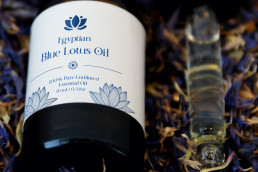
If you are searching for blue lotus oil in New York, whether you live in Manhattan, Brooklyn, Queens, the Hudson Valley, or upstate near Albany or Buffalo, the good news is that the oil is legal to purchase, possess, and use throughout the state. The more complicated news is that most of what you will find in local apothecaries, witchy-leaning shops, and online listings targeting New York buyers is either heavily diluted, mislabelled, or not Nymphaea caerulea at all. This guide walks you through where to actually buy authentic Egyptian blue lotus oil as a New York resident, what the market looks like across the city and state, and how to verify you are getting the real thing.
Table of Contents
- Is Blue Lotus Oil Legal in New York?
- The New York City Apothecary Landscape
- Manhattan
- Brooklyn
- Queens and The Bronx
- Upstate New York and the Hudson Valley
- Buying Blue Lotus Oil Online as a New York Resident
- How to Verify You Are Buying Authentic Blue Lotus Oil
- Check the Botanical Name
- Check the Extraction Method
- Check the Price
- Check the Scent
- What to Expect When You Receive It
- When Blue Lotus Oil Is Not the Right Choice
- Complementary Purchases Worth Considering
- Frequently Asked Questions
- Where to Go From Here
- Authentic Blue Lotus, Shipped to New York
It is written and clinically reviewed by Antonio Breshears, ND, CCA, a Bastyr-trained naturopathic doctor and certified clinical aromatherapist. For broader context on the oil itself, its chemistry, and how it is produced, readers should pair this guide with The Complete Guide to Blue Lotus Oil, which covers the material in much greater depth.
Is Blue Lotus Oil Legal in New York?
Yes. New York State has no specific statute or regulation restricting the sale, possession, or use of Nymphaea caerulea in any form, including essential oil, absolute, dried flower, or tincture. Unlike Louisiana, which has a state-level restriction on several ornamental and ethnobotanical plants, New York treats blue lotus the way it treats most uncommon botanicals: as a herbal or cosmetic product subject to the usual federal and state rules around labelling and food-versus-cosmetic classification.
This means you can legally order blue lotus oil to a New York address, carry it on domestic flights departing from JFK, LaGuardia, Newark, or any of the regional airports, and use it at home without concern. International shipments should be checked against the destination country’s rules (Russia, Poland, and Latvia restrict it), but nothing about the New York end of the transaction creates a legal issue.
What New York does regulate, through the state Department of Agriculture and Markets and the Department of State’s Division of Consumer Protection, is accurate labelling. A bottle sold as “pure blue lotus essential oil” that turns out to be jojoba oil with fragrance is a consumer protection matter, not a controlled-substance matter. That distinction is worth understanding because it shapes where genuine product actually lives in the New York market.
The New York City Apothecary Landscape
New York City has one of the densest concentrations of speciality apothecaries, perfume houses, and botanical shops in the world. In theory, this should make sourcing blue lotus oil straightforward. In practice, the density of the market is exactly what makes it difficult: there are many shops that stock something labelled blue lotus, and very few that stock genuine Nymphaea caerulea absolute or CO2 extract at therapeutic concentration.
Manhattan
The West Village, East Village, and Lower East Side have a cluster of metaphysical and botanical shops that commonly carry blue lotus preparations. Enfleurage, long established in the West Village, has historically stocked rare florals and is one of the better places to physically smell a sample before buying. Aedes Perfumery and CAP Beauty occasionally stock blue lotus in blended form. SoHo and NoHo perfume houses sometimes carry blue lotus accords, though these are usually perfumer’s reconstructions rather than pure absolute.
What you should be cautious about in Manhattan is the proliferation of “wellness” shops that stock small amber bottles labelled blue lotus at price points that do not match the raw material cost. Genuine blue lotus absolute requires roughly 3,000 to 5,000 flowers per gram of finished material. A 5 ml bottle of genuine absolute at retail rarely sits below the low three figures. If you are seeing 10 ml bottles under fifty dollars in a Union Square apothecary, what you are buying is almost certainly a dilution, a fragrance oil, or a different species.
Brooklyn
Williamsburg, Greenpoint, and Park Slope have a strong herbalist and apothecary scene, and several Brooklyn-based herbalists do source genuine blue lotus, usually in dried flower or tincture form rather than essential oil. Shops like Flower Power Herbs in the East Village and various Brooklyn cooperative herb stores will sometimes have blue lotus tea or tincture, but essential oil or absolute is rarer. If you want flower material for steeping or smudging, Brooklyn is actually a stronger market than Manhattan. If you specifically want aromatic oil, the selection thins considerably.
Queens and The Bronx
Queens has strong Middle Eastern, North African, and South Asian apothecary traditions, particularly in neighbourhoods like Astoria and Jackson Heights. Occasionally a small shop will carry blue lotus sourced through Egyptian import channels, and the provenance can be genuinely good, but verification is difficult without labelling standards. The Bronx market is smaller for this specific oil.
Upstate New York and the Hudson Valley
The Hudson Valley has developed, over the last decade, into a meaningful wellness corridor with apothecaries in Beacon, Hudson, Kingston, Rhinebeck, and Woodstock. Many of these shops take herbalism seriously and will happily discuss sourcing with you. However, the same constraint applies: blue lotus absolute is expensive raw material and is rarely carried in true concentration by a small regional shop. What you will often find is blue lotus tea, flower petals, or occasionally a blended anointing oil at 1 to 5 percent dilution in jojoba.
Further upstate, Albany, Syracuse, Rochester, and Buffalo have smaller apothecary scenes where blue lotus oil is rarely stocked physically. In these areas, online ordering is almost always the better route.
Buying Blue Lotus Oil Online as a New York Resident
For most New Yorkers, regardless of borough or region, the practical answer is that the best quality blue lotus oil will be ordered online and shipped to your address. This is true in Manhattan as much as in Ithaca. The reason is straightforward: the genuine product is produced in Egypt, extracted by a small number of specialists, and distributed through a narrow international channel. Brick-and-mortar retail in any US city, including New York, rarely justifies holding therapeutic-grade inventory at the price point required.
When ordering online to a New York address, the practical considerations are:
- Shipping times: Most reputable sellers ship within two to five business days to New York addresses. International shipments from Egyptian or European suppliers can take ten to twenty days and may route through JFK customs.
- Temperature: New York summers get hot, particularly in brownstone apartments without strong air conditioning. Blue lotus absolute is reasonably heat-tolerant but prolonged exposure in a hot mailbox degrades the top notes. If ordering in July or August, try to be home for delivery.
- Packaging: Authentic sellers ship in dark amber or cobalt glass, usually in padded or foam-insulated packaging.
How to Verify You Are Buying Authentic Blue Lotus Oil
Because the New York market has more mislabelled product than authentic product, verification matters more than convenience. Regardless of whether you buy from a West Village apothecary, a Brooklyn herbalist, or an online supplier shipping to your New York address, the same checks apply.
Check the Botanical Name
The label or product page must say Nymphaea caerulea, which is the Egyptian blue water lily. If it says Nelumbo nucifera, that is sacred lotus (pink or white lotus), a completely different plant. If it says only “blue lotus” without a botanical name, ask. If the seller cannot tell you which species, assume the worst.
Check the Extraction Method
Genuine blue lotus oil is typically sold as a solvent-extracted absolute, a supercritical CO2 extract, or (rarely) a true steam-distilled essential oil. Each has a distinct character. What is almost never genuine is a cheap “essential oil” at fragrance-oil pricing. If the seller cannot name the extraction method, that is another red flag.
Check the Price
A rough heuristic for the New York market: if a 5 ml bottle of anything sold as pure blue lotus absolute is under approximately seventy to eighty dollars, it is very likely diluted or adulterated. Genuine 5 ml bottles of absolute typically sit in the low to mid three figures. Diluted anointing oils (1 to 5 percent in jojoba or fractionated coconut) are legitimate products, but they should be clearly labelled as such, and their price should reflect the dilution.
Check the Scent
Authentic blue lotus has a complex aroma: a cooler, slightly aquatic-floral top note, opening into a deep honeyed-floral heart with subtle spice, settling into a warm balsamic-smoky base. It is not a simple floral. If what you smell is a straightforward sweet floral reminiscent of department store perfume, or if it smells sharply of solvent, it is almost certainly either a fragrance oil or a poor-quality extract.
What to Expect When You Receive It
Realistically, a New York buyer ordering genuine blue lotus oil for the first time should expect a small bottle (often 2 to 5 ml for pure absolute, 10 to 30 ml for diluted preparations), a deep amber or bronze-coloured liquid with noticeable viscosity, and an aroma that takes a few minutes to fully reveal itself on a smelling strip. Pure absolute is often semi-solid at cool temperatures and may need gentle warming in your hands before it flows cleanly.
Shelf life for properly stored absolute is roughly three to four years in dark glass, kept cool and out of direct light. A New York apartment with decent climate control is perfectly suitable. Avoid bathroom storage where humidity and temperature swings are larger than people realise.
When Blue Lotus Oil Is Not the Right Choice
Even with authentic product, there are situations in which blue lotus oil is not the appropriate choice. Pregnancy and breastfeeding are the clearest: there is insufficient safety data and the conservative clinical position is to avoid it. Anyone on dopaminergic medications (for Parkinson’s disease, restless legs, or certain antipsychotic regimens) should discuss use with their prescriber, because the aporphine and nuciferine alkaloids have weak but measurable dopaminergic activity. The same applies to those on MAOIs or strong sedatives.
Blue lotus oil is also not a substitute for clinical care. If you are dealing with serious anxiety, depression, or sleep disturbance, the oil can be a modestly helpful adjunct within a broader plan, not a replacement for evaluation and treatment. New York residents have access to excellent clinical resources across naturopathic, integrative, and conventional medicine, and any of those would be more appropriate than self-managing a significant mental health concern with aromatherapy alone.
Complementary Purchases Worth Considering
If you are building an aromatherapy kit around blue lotus oil, a few supporting purchases are worth making at the same time, most of which are easy to source in the New York market:
- A quality carrier oil: jojoba is the standard choice for absolutes because its shelf life is long and its scent is neutral. Available at most Brooklyn and Manhattan herbalists.
- A cold-mist diffuser: ultrasonic diffusers are widely available; avoid heat-based diffusers, which damage the top notes.
- Empty amber glass bottles and rollerball applicators: for making your own dilutions at 1 to 3 percent, depending on application.
- A small digital scale: useful if you are making precise blends.
Frequently Asked Questions
Is blue lotus oil legal to buy in New York?
Yes. New York has no state-level restriction on Nymphaea caerulea in any form. You can legally purchase, possess, ship, and use blue lotus oil throughout New York State.
Can I find real blue lotus oil in a Manhattan apothecary?
Occasionally. A handful of specialist perfume and botanical shops in the West Village, East Village, and SoHo do stock genuine preparations, though often in small quantities or blended form. Most New Yorkers find that online sourcing from a specialist supplier provides better value and clearer verification of authenticity.
Why is blue lotus oil so expensive?
Because it takes roughly 3,000 to 5,000 flowers to produce a single gram of absolute, and the flowers must be harvested by hand within a narrow window. This is a labour-intensive, low-yield extraction, which is why a genuine 5 ml bottle rarely sits below the low three figures at retail.
Can I bring blue lotus oil on a flight from JFK or LaGuardia?
Yes, for domestic flights within the United States. Standard TSA liquid rules apply (3.4 oz or 100 ml per container in carry-on). International flights depend on the destination country. Russia, Poland, and Latvia have restrictions; check the destination rules before travelling.
What is the difference between blue lotus and sacred lotus?
Nymphaea caerulea (blue lotus, Egyptian water lily) and Nelumbo nucifera (sacred lotus, pink or white lotus) are different plants with different chemistry. Blue lotus contains aporphine and nuciferine alkaloids along with apigenin and related flavonoids. Sacred lotus has a different profile. They are not interchangeable.
Is there a reliable brick-and-mortar store for blue lotus oil in Brooklyn?
Brooklyn has strong herbalist and apothecary shops that carry blue lotus flowers, tea, and tincture more readily than essential oil or absolute. For the oil specifically, online ordering is typically more reliable.
Does New York sales tax apply to blue lotus oil?
It depends on how the product is classified. Cosmetic and fragrance preparations are typically taxable in New York State. Herbal supplements may be exempt from state sales tax in some cases. Online sellers shipping to New York addresses will apply the applicable tax at checkout.
How should I store blue lotus oil in a New York apartment?
In a cool, dark cupboard or drawer, ideally away from kitchen heat and bathroom humidity. A bedroom closet is usually ideal. Dark amber or cobalt glass is essential. Shelf life for properly stored absolute is three to four years.
Are there any New York-based brands producing blue lotus oil?
There are New York-based sellers who bottle and distribute blue lotus oil, but the raw extraction itself happens almost exclusively in Egypt. Any brand claiming to produce the oil in New York is almost certainly blending or rebottling material extracted elsewhere.
Can I return blue lotus oil if I am not satisfied?
This depends entirely on the seller’s policy. Most reputable speciality sellers offer some form of satisfaction guarantee, though opened bottles are often non-returnable for hygiene reasons. Read the return policy before purchasing.
Where to Go From Here
If you are a New York resident ready to buy blue lotus oil, the practical path is clear: verify the species, verify the extraction method, verify the price against raw material reality, and buy from a specialist supplier rather than a general wellness retailer. For deeper background on the chemistry, history, and use of the oil, the complete guide to blue lotus oil is the best place to continue reading. From there, you can move into the more specific topics of dilution, application, and ritual use as your interest directs.

Antonio Breshears
Antonio Breshears is a renowned expert in holistic medicine and beauty, with over 25 years of research experience dedicated to uncovering the secrets of nature's most powerful remedies. Holding a degree in Naturopathic Medicine, Antonio's passion for healing and well-being has driven him to explore the intricate connections between mind, body, and spirit.
Over the years, Antonio has become a respected authority in the field, helping countless individuals discover the transformative power of plant-based therapies, including essential oils, herbs, and natural supplements. He has authored numerous articles and publications, sharing his wealth of knowledge with a global audience seeking to improve their overall health and well-being.
Antonio's expertise extends to the realm of beauty, where he has developed innovative, all-natural skincare solutions that harness the potency of botanical ingredients. His formulations embody his deep understanding of the healing properties found in nature, providing holistic alternatives for those seeking a more balanced approach to self-care.
With his extensive background and dedication to the field, Antonio Breshears is a trusted voice and guiding light in the world of holistic medicine and beauty. Through his work at Pure Blue Lotus Oil, Antonio continues to inspire and educate, empowering others to unlock the true potential of nature's gifts for a healthier, more radiant life.