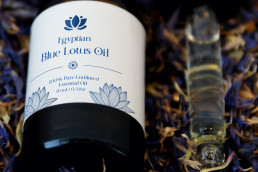
If you have read anything about the chemistry of blue lotus and wondered which of its many compounds actually earn their reputation on the skin, kaempferol is one of the more quietly interesting answers. This article looks at kaempferol blue lotus chemistry specifically through the lens of topical use: what the flavonoid does at the cellular level, how that translates into realistic benefits for ageing, inflamed or stressed skin, and what a sensible dilution and rhythm of application looks like.
Table of Contents
- What Kaempferol Actually Is
- Where Kaempferol Sits in the Blue Lotus Profile
- How Kaempferol Helps the Skin
- Antioxidant Activity
- Anti-Inflammatory Effects
- Collagen Protection
- Barrier Support
- How to Use Blue Lotus Oil for Kaempferol's Skin Benefits
- Dilution and Carrier Choice
- A Simple Evening Protocol
- Common Mistakes
- What to Expect: Realistic Timeframes
- When Blue Lotus Oil Is Not the Right Choice
- Complementary Approaches
- Frequently Asked Questions
- Where to Go From Here
- Skin-Ready Blue Lotus, Honestly Made
It is written and clinically reviewed by Antonio Breshears, ND, CCA, a Bastyr-trained naturopathic doctor and certified clinical aromatherapist. For broader context on the oil’s full chemistry and the other flavonoids and alkaloids that sit alongside kaempferol, readers may find the complete guide to blue lotus oil a useful companion piece.
What Kaempferol Actually Is
Kaempferol is a flavonol, one of the most widely distributed plant polyphenols in nature. You will find it in kale, broccoli, tea, capers, moringa, propolis and, relevant here, in the petals of Nymphaea caerulea, the Egyptian blue water lily. Chemically it is a pale yellow crystalline molecule with hydroxyl groups arranged in a way that lets it donate electrons readily, which is the structural basis for most of what it does biologically.
In the skin, that electron-donating behaviour translates into three reasonably well-attested activities: it quenches reactive oxygen species (the unstable molecules generated by UV exposure, pollution and metabolic stress), it modulates several inflammatory signalling pathways (notably NF-kB and the associated cytokines), and it interferes with enzymes that break down collagen and elastin. None of these actions are unique to kaempferol; quercetin and apigenin, both also present in blue lotus, overlap substantially. What makes kaempferol worth naming specifically is that it tends to be slightly more lipophilic than quercetin, meaning it partitions into the lipid-rich outer layers of the skin a little more willingly, which matters when the delivery vehicle is an oil.
Where Kaempferol Sits in the Blue Lotus Profile
Blue lotus absolute and essential oil contain a family of flavonoids alongside the more famous aporphine alkaloids. Apigenin gets most of the attention because of its interaction with central benzodiazepine receptors, which is relevant for the oil’s calming scent effects. For topical work, though, the flavonol fraction, kaempferol, quercetin and their glycosylated forms, does more of the visible work on the skin surface. Exact concentrations vary by extraction method and growing season, but kaempferol is consistently present in meaningful quantities across well-made solvent extracts and supercritical CO2 preparations.
How Kaempferol Helps the Skin
The honest position is this: kaempferol is a genuinely useful compound for skin that is dealing with oxidative stress, low-grade inflammation, or early signs of photoageing. It is not a retinoid, it does not resurface skin, and it will not erase established wrinkles. What it does, reliably and modestly, is help skin behave more like younger skin under conditions that would otherwise accelerate visible ageing.
Antioxidant Activity
Free radical damage from UV light and environmental pollutants is one of the major drivers of visible skin ageing. Kaempferol neutralises these reactive species directly by donating hydrogen atoms from its hydroxyl groups, and it also upregulates the skin’s own antioxidant defences, including the Nrf2 pathway which governs endogenous antioxidant enzyme production. In practical terms, this means skin treated with kaempferol-containing preparations tends to show less of the cumulative oxidative damage that manifests as dullness, uneven tone and fine lines.
Anti-Inflammatory Effects
Many chronic skin concerns, adult acne, rosacea-adjacent redness, the general low-grade inflammation that accompanies modern life, involve upregulation of NF-kB signalling and pro-inflammatory cytokines such as IL-6 and TNF-alpha. Kaempferol suppresses these pathways at concentrations achievable through regular topical use. This is why blue lotus oil, used appropriately, tends to leave irritated skin calmer rather than more reactive, despite being an aromatic botanical product.
Collagen Protection
Matrix metalloproteinases, particularly MMP-1 and MMP-9, are the enzymes that degrade collagen and elastin in response to UV exposure and inflammation. Kaempferol inhibits these enzymes in cell and skin-equivalent studies. The effect is preventive rather than restorative: kaempferol helps slow the breakdown of existing collagen, but it is not going to rebuild collagen lost a decade ago. For someone in their thirties or forties using it consistently, that preventive angle is genuinely valuable. For someone hoping to reverse significant photoageing, it is a supporting player at best.
Barrier Support
A less headline-worthy but clinically useful action is that kaempferol, alongside the other flavonoids in blue lotus, appears to support the skin barrier indirectly by reducing the inflammatory signalling that degrades it. Skin with a healthy barrier retains water better, reacts less to irritants, and looks plumper and more even. Much of what people report subjectively after a few weeks of consistent blue lotus facial use, “my skin just looks better”, is probably this barrier-level effect.
How to Use Blue Lotus Oil for Kaempferol’s Skin Benefits
To get meaningful kaempferol exposure to the skin, what matters is consistent, correctly diluted topical use over weeks, not a single heroic application. The compound works through accumulation of effect, not through one dramatic event.
Dilution and Carrier Choice
For facial use, dilute blue lotus oil to 1 to 2 percent in a carrier. In millilitres, that is roughly 6 to 12 drops of blue lotus absolute per 30 ml of carrier oil. Go lower, 1 percent, for sensitive or reactive skin; 2 percent is appropriate for more resilient skin or when specifically targeting visible concerns. For body use, 2 to 3 percent is reasonable.
Carrier choice matters more than people realise. For kaempferol delivery you want a carrier that itself supports barrier function and does not oxidise rapidly. Jojoba is the most consistent all-purpose choice because it is structurally close to human sebum and is remarkably stable. Squalane, either olive-derived or sugarcane-derived, is excellent for facial work and absorbs cleanly. Rosehip seed oil is a useful partner because its own carotenoid and tocopherol content works synergistically with blue lotus flavonoids, though it oxidises faster and should be used within six months of opening. Avoid carriers that are already rancid; oxidised carrier will undermine any antioxidant benefit you are hoping to get from the kaempferol.
A Simple Evening Protocol
The most defensible way to use blue lotus oil for its flavonoid benefits is as a nightly facial treatment after cleansing and any water-based serum or hydrosol. Four or five drops of a 1 to 2 percent blend, warmed briefly between the palms and pressed into slightly damp skin, is enough for the whole face and neck. Do this six nights out of seven, give your skin one night off per week, and give the protocol at least eight weeks before judging results.
Common Mistakes
The two mistakes that undermine results are overuse and poor storage. Using the oil undiluted, or at 5 percent rather than 2 percent, does not accelerate benefit; it increases the risk of sensitisation and irritation, which is counterproductive when the whole point is to calm inflammatory signalling. And storing the bottle on a sunny bathroom shelf will oxidise the flavonoids over months, gradually reducing their antioxidant capacity. Dark glass, cool cupboard, lid tight.
What to Expect: Realistic Timeframes
This is where I want to be particularly honest. Kaempferol’s effects on the skin are cumulative and relatively subtle. Here is a reasonable expectation curve.
Week one to two: You may notice the skin feels calmer and better hydrated, largely a carrier-oil and ritual effect, though some of the anti-inflammatory flavonoid action begins contributing by the second week. Do not expect visible change in tone or fine lines yet.
Week three to six: If the protocol is working for your skin, this is usually when people start to notice that their complexion looks a bit more even, that the skin reacts less to minor irritants, and that overall “quality” seems better. Redness from low-grade inflammation often softens in this window.
Week eight to twelve: The more structural benefits, the collagen-protective and photoageing-mitigating effects, begin showing as subtle improvements in skin firmness and a slower apparent rate of visible ageing compared with unprotected skin. This is not dramatic. It is the kind of difference you notice in photographs taken months apart rather than in the mirror the next morning.
If after twelve weeks of consistent correct use you see no perceptible difference, the protocol is probably not right for your skin, or the concern you are trying to address is structural rather than inflammatory and needs a different intervention.
When Blue Lotus Oil Is Not the Right Choice
Kaempferol delivered through blue lotus oil is a reasonable supporting ingredient for many skin situations, but it is not universally appropriate.
If you are pregnant or breastfeeding, blue lotus oil is traditionally avoided regardless of the intended use; the alkaloid fraction has enough uncertainty around it that caution is warranted. For active cystic acne, the oil is not contraindicated, but it is also not going to do much; you need interventions aimed at follicular hyperkeratinisation and bacterial load, which kaempferol does not address. For severe rosacea, established melasma, or any dermatosis your doctor is actively treating, do not substitute this for clinical care; at best it can be a gentle adjunct, and only with your practitioner’s nod.
People with known sensitivity to floral absolutes, jasmine, neroli, ylang ylang, should patch test scrupulously before committing to a protocol. And anyone with reactive skin should start at 1 percent rather than 2 percent and build up only if the skin tolerates it comfortably.
Complementary Approaches
Kaempferol is most useful when it is part of a coherent skin strategy rather than a solo act. The interventions that stack well with it, and that address concerns kaempferol alone cannot, are worth naming.
Daily broad-spectrum sunscreen is not optional if you are pursuing photoageing prevention; no flavonoid, however elegant, compensates for unprotected UV exposure. Topical vitamin C in a water-based serum used in the morning pairs logically with blue lotus oil at night, giving you antioxidant coverage across both major oxidative windows of the day. A retinoid, prescription or over-the-counter, does the structural remodelling work kaempferol does not; the two are complementary, not redundant, though introduce them at separate times rather than layering them immediately to avoid irritation.
Internally, the usual dietary polyphenol sources (green tea, berries, dark leafy greens, good olive oil) contribute meaningfully to the same antioxidant and anti-inflammatory goals you are pursuing topically. And sleep, which is genuinely the most under-rated skin intervention, does more for collagen repair than any product.
Frequently Asked Questions
Is kaempferol the main active compound in blue lotus oil?
No. Blue lotus oil is a complex mixture. The aporphine alkaloids (aporphine and nuciferine) drive most of the psychoactive and mood-shifting effects. The flavonoids, including kaempferol, apigenin and quercetin, drive most of the topical skin benefits. Kaempferol is one of several important topical actives rather than a solo headliner.
How much kaempferol is actually in blue lotus oil?
Concentrations vary by extraction method, growing conditions and processing. Well-made solvent absolutes and supercritical CO2 extracts contain meaningful but not enormous quantities. This is why consistent use matters more than trying to estimate exact milligram exposure from a single application.
Can I just use kale or green tea instead?
For systemic kaempferol exposure, yes, dietary sources contribute significantly. For localised skin effects, though, topical application delivers the compound directly to the tissue where you want it to act, which dietary intake cannot do as efficiently. The two approaches are complementary.
Does the extraction method affect kaempferol content?
Yes. Supercritical CO2 extraction tends to preserve the flavonoid fraction well. Solvent extraction (yielding absolute) also captures flavonoids reasonably, though some degradation is possible depending on process quality. True steam-distilled essential oil, which is rare for blue lotus, carries fewer of the heavier non-volatile flavonoids and is a less efficient delivery vehicle for kaempferol specifically.
Will kaempferol in blue lotus oil fade hyperpigmentation?
Modestly and slowly, at best. Kaempferol has some tyrosinase-inhibiting activity, which is the mechanism relevant to pigmentation. For established melasma or sun spots, dedicated actives such as tranexamic acid, azelaic acid or prescription hydroquinone are far more effective. Think of kaempferol’s role here as preventive, not corrective.
Can I use blue lotus oil around my eyes?
Yes, cautiously and at lower dilutions (1 percent or less), and never so close that the oil migrates into the eye itself. The skin around the eyes is thin and benefits from the anti-inflammatory flavonoid activity, but patch test first and keep application to the orbital bone area rather than the lid.
How do I know if my blue lotus oil still contains active kaempferol?
Properly stored blue lotus absolute has a shelf life of three to four years, and the flavonoid fraction remains meaningfully active across most of that window. Signs that your oil has degraded include a sharp, rancid note overtaking the original honeyed-floral character, a noticeable shift in colour, or a sticky rather than fluid consistency. If the oil still smells coherent and lives in dark glass in a cool place, its flavonoids are likely still doing their job.
Is it safe to combine blue lotus oil with a retinoid?
Broadly yes, but not in the same application. Use the retinoid on the schedule your dermatologist recommends, and use blue lotus oil on alternate nights or as a morning-after buffer once retinisation is established. Applying both at once increases the likelihood of irritation without improving results.
Does kaempferol cause any side effects topically?
Kaempferol itself at typical topical concentrations is well tolerated. Any reaction to blue lotus oil is more likely to come from the aromatic fraction than from the flavonoid content, and the solution is almost always to reduce dilution or frequency rather than to stop entirely.
How long until I should decide whether it is working?
Give the protocol a genuine eight to twelve weeks of consistent, correctly diluted use before judging. Skin renewal cycles take roughly four to six weeks in healthy adults, so any ingredient aimed at quality and tone needs at least two full cycles to reveal its actual effect.
Where to Go From Here
Kaempferol is one of the quiet reasons blue lotus oil earns its place in a thoughtful skincare routine, not because it does anything spectacular on its own, but because it contributes reliably to the antioxidant, anti-inflammatory and collagen-protective goals that define graceful ageing. Paired with sun protection, good sleep, dietary polyphenols and, where appropriate, clinically-validated actives such as retinoids and vitamin C, it earns its keep. For a wider view of the oil’s full chemistry and the other compounds working alongside kaempferol, revisit the complete guide to blue lotus oil linked above. And if you are approaching blue lotus for reasons other than skin, the same guide will point you toward the calming, aromatic and ritual uses that the flavonoids alone do not address.

Antonio Breshears
Antonio Breshears is a renowned expert in holistic medicine and beauty, with over 25 years of research experience dedicated to uncovering the secrets of nature's most powerful remedies. Holding a degree in Naturopathic Medicine, Antonio's passion for healing and well-being has driven him to explore the intricate connections between mind, body, and spirit.
Over the years, Antonio has become a respected authority in the field, helping countless individuals discover the transformative power of plant-based therapies, including essential oils, herbs, and natural supplements. He has authored numerous articles and publications, sharing his wealth of knowledge with a global audience seeking to improve their overall health and well-being.
Antonio's expertise extends to the realm of beauty, where he has developed innovative, all-natural skincare solutions that harness the potency of botanical ingredients. His formulations embody his deep understanding of the healing properties found in nature, providing holistic alternatives for those seeking a more balanced approach to self-care.
With his extensive background and dedication to the field, Antonio Breshears is a trusted voice and guiding light in the world of holistic medicine and beauty. Through his work at Pure Blue Lotus Oil, Antonio continues to inspire and educate, empowering others to unlock the true potential of nature's gifts for a healthier, more radiant life.