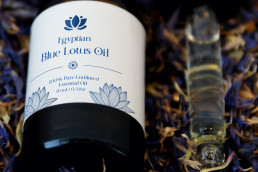
If you have been researching blue lotus oil vs Aromatics International, you are almost certainly weighing two very different purchasing decisions rather than two competing versions of the same product. Aromatics International is a well-regarded American aromatherapy retailer with a broad catalogue and a strong educational ethos; Pure Blue Lotus Oil is a specialist atelier producing a single, carefully made Egyptian Nymphaea caerulea absolute. This article sets out the genuine differences between the two, where each one fits, and how to decide which is appropriate for your purpose.
Table of Contents
- Who Each Brand Actually Is
- Sourcing and Extraction
- Product Range: Specialist vs Generalist
- Price and Value
- Testing, Transparency and Documentation
- Scent Profile in Practice
- Best Use Cases for Each
- Choose Aromatics International if:
- Choose Pure Blue Lotus Oil if:
- Safety and Quality Considerations That Apply to Both
- The Honest Summary
- Frequently Asked Questions
- Where to Go From Here
- Specialist Egyptian Blue Lotus, Done Properly
It is written and clinically reviewed by Antonio Breshears, ND, CCA, a Bastyr-trained naturopathic doctor and certified clinical aromatherapist. For broader background on the material itself, see the complete guide to blue lotus oil, which explains the chemistry, extraction methods and traditional uses that underpin this comparison.
Who Each Brand Actually Is
Aromatics International is a Montana-based aromatherapy company founded in the early 2000s. It is a broad-spectrum supplier, carrying roughly a hundred and fifty different essential oils, absolutes, hydrosols and carrier oils. Their reputation in the aromatherapy community rests on three things: they publish GC/MS reports for every batch, they prioritise small-farm sourcing, and they maintain an educational presence through their Aromahead Institute affiliation. They sell to hobbyists, professional aromatherapists and clinical practitioners alike.
Pure Blue Lotus Oil is a specialist producer, not a general retailer. The focus is singular: Egyptian blue lotus absolute sourced from Nile-region cultivation, extracted with a preference for solvent methods that preserve the full aromatic and phytochemical profile of the flower. The brand exists because the commercial blue lotus market is unusually messy, with fragrance-grade imitations, synthetic dilutions and mislabelled Nymphaea species routinely sold under the same name. A specialist operation can verify every step from flower to bottle in a way a hundred-and-fifty-oil catalogue simply cannot.
Neither approach is wrong. They serve different buyers with different priorities.
Sourcing and Extraction
Blue lotus oil is particularly sensitive to sourcing provenance. The true Egyptian blue water lily, Nymphaea caerulea, is distinct from the white lotus (Nymphaea lotus) and from the pink Asian lotus (Nelumbo nucifera) that often gets sold under the same English label. Only the Egyptian caerulea carries the characteristic alkaloid profile, the aporphine and nuciferine, that underlies the traditional psychoactive and relaxant reputation.
Aromatics International, when they carry blue lotus (stock has varied over the years), typically lists it as an absolute sourced via their distributor network, with a GC/MS report available on the product page. Their transparency is genuine and their testing practice is industry-leading for a multi-line retailer. What they cannot offer, because they are a catalogue business, is direct relationships with the Egyptian growers or hand-oversight of each batch.
Pure Blue Lotus Oil works from a narrower supply chain focused specifically on Nile-region cultivation. The absolute is extracted via solvent methods from roughly three to five thousand flowers per gram of finished product, which is the usual yield range for a correctly produced blue lotus absolute. The scent profile reflects that concentration: a cool floral-aquatic top note, a deep honeyed heart, and a balsamic, faintly smoky base. Any blue lotus oil that smells thin, sharp or one-dimensional is almost certainly adulterated, regardless of the retailer.
Product Range: Specialist vs Generalist
This is the clearest practical difference. If you need lavender, frankincense, blue tansy, helichrysum and blue lotus all from the same order, Aromatics International is the obvious choice. Their range is broad, their prices across the catalogue are reasonable, and their shipping logic is built for mixed orders. A professional aromatherapist building a fifty-oil working kit will likely have an account with them or a similar multi-line supplier.
If blue lotus is specifically the reason you are shopping, the calculation shifts. A specialist house exists to do one thing well, and the depth of attention on a single product, including the sourcing verification, the batch consistency, the packaging choices, and the educational content surrounding the material, tends to exceed what a generalist can sustain across a hundred and fifty SKUs. Neither model is superior in the abstract. They are answers to different questions.
Price and Value
Blue lotus absolute is genuinely expensive to produce, and any blue lotus oil priced below roughly fifteen to twenty pounds per millilitre is either heavily diluted, synthetically reconstructed, or a different species entirely. Both Aromatics International and Pure Blue Lotus Oil price within the legitimate range for the real material, which is worth noting because it rules out the suspicion that one is cutting corners the other is not.
Aromatics International typically prices their blue lotus absolute per millilitre with small-size options (one millilitre, five millilitres) available. Pure Blue Lotus Oil prices a standard retail bottle of the undiluted absolute with the assumption that the buyer intends regular, considered use rather than a one-time trial. Value, then, is less about price per millilitre and more about what you are buying alongside the liquid: a generalist ordering convenience, or a specialist focus.
Testing, Transparency and Documentation
Aromatics International’s most distinctive feature as a retailer is their GC/MS publishing practice. Every batch of every oil has a corresponding chromatography report linked from the product page. For a practitioner who wants to verify that a sample matches its stated chemotype, this is genuinely useful.
A specialist producer approaches documentation differently. Rather than publishing a GC/MS for public download, the verification chain tends to run through direct supplier relationships, internal batch records, and the ability to discuss sourcing specifics with serious buyers on request. Both systems work. The GC/MS-public model suits a retail catalogue where hundreds of customers want quick at-a-glance verification. The direct-relationship model suits a specialist operation where the sourcing story is itself part of the product.
If published GC/MS is a non-negotiable for your practice, Aromatics International’s transparency is a legitimate advantage. If you care more about the integrity of a specific supply chain than about the specific format the documentation takes, a specialist producer will typically satisfy you.
Scent Profile in Practice
The scent of a real blue lotus absolute is unmistakable once you have smelled it properly. It opens cool and faintly aquatic, almost like clean pond water with floral depth beneath. Within a minute or two, a honeyed, slightly narcotic floral heart emerges, which is the phase most people associate with the plant’s traditional reputation. The dry-down is balsamic, faintly smoky, and persistent, lingering on skin for several hours.
A well-produced absolute from either Aromatics International or Pure Blue Lotus Oil should follow this general arc. Differences between batches are real but usually subtle: harvest timing, flower ratio, extraction duration and solvent residue management all shift the balance slightly. A specialist house tends toward more consistent batch-to-batch profile because the same hands make the same product repeatedly. A generalist retailer may carry stock from different distributors over time, which introduces more variation.
Neither is a defect. Consistency matters if you are formulating a perfume and need the same scent across six months of production. Variation matters less if you are using the oil for personal practice and each bottle is experienced on its own terms.
Best Use Cases for Each
Choose Aromatics International if:
- You are building or replenishing a broad aromatherapy kit and want blue lotus alongside twenty other oils in one order.
- Published GC/MS per batch is a professional requirement for your documentation practice.
- You want to trial a very small quantity (one or two millilitres) before committing to regular use.
- You are a student of aromatherapy working through a structured curriculum and want supplier consistency across your materia aromatica.
Choose Pure Blue Lotus Oil if:
- Blue lotus is specifically the reason you are shopping, and you want the depth of a specialist rather than the breadth of a catalogue.
- You value a single, verified Egyptian Nymphaea caerulea supply chain over documentation format.
- You intend to use the oil regularly and want batch-to-batch consistency.
- You want the sourcing, educational content and customer communication all oriented around this one material.
Safety and Quality Considerations That Apply to Both
Regardless of which supplier you choose, certain things hold true for any genuine blue lotus absolute. It should be avoided during pregnancy and breastfeeding, as the alkaloid profile has not been safety-tested in these contexts. Caution is warranted if you are taking dopaminergic medications, monoamine oxidase inhibitors, or heavy sedatives, because the interaction picture is under-studied and the weak dopaminergic activity of aporphine is theoretically relevant.
For topical use, dilution is appropriate: one to two percent in a carrier for facial application, two to three percent for body use, and three percent for targeted work. For diffusion, two to four drops in a standard ultrasonic diffuser is sufficient. The material is potent enough that more is not better; restraint produces better results than enthusiasm.
Blue lotus is also subject to regional legal restriction. It is prohibited or restricted in Russia, Poland, Latvia, and the US state of Louisiana, and Australian import regulation is unusually complex. Both Aromatics International and Pure Blue Lotus Oil will ship only to jurisdictions where the material is legal, so the restriction applies at the destination rather than the source.
The Honest Summary
In the blue lotus oil vs Aromatics International comparison, the most useful frame is not which is better but which is better for what. Aromatics International is a strong generalist with genuine commitment to testing and education, and their blue lotus offering, when in stock, is within the legitimate range of the real material. Pure Blue Lotus Oil is a specialist producer whose entire operation is built around getting one particular material right. A serious user of blue lotus tends toward the specialist over time because the depth of focus becomes noticeable; a serious aromatherapist building a full working kit may keep an Aromatics account for the breadth it offers.
There is no contradiction in buying from both, depending on the week’s need. The framing of “which brand wins” tends to miss the practical truth, which is that buyers have different jobs to do, and different suppliers fit different jobs.
Frequently Asked Questions
Is Aromatics International a trustworthy source of blue lotus oil?
Yes. They are one of the more reputable American multi-line aromatherapy retailers, with published GC/MS reports per batch and a clear sourcing ethic. Stock on specialty items like blue lotus can vary, so availability is worth checking before planning around it.
Is Pure Blue Lotus Oil a legitimate specialist producer?
Yes. The operation is focused specifically on Egyptian Nymphaea caerulea absolute with a verified Nile-region supply chain and batch consistency oriented around a single product rather than a broad catalogue.
Which one is cheaper per millilitre?
Prices move with batch and size, and both sit within the legitimate range for genuine blue lotus absolute. Pricing alone is not a strong basis for choosing between them; fit for purpose matters more.
Which smells better?
Both should produce the characteristic cool-aquatic-to-honeyed-floral-to-balsamic arc of a real Egyptian absolute. Batch variation exists at any retailer. A specialist producer tends toward more consistent batch-to-batch profile simply because the same hands make it each time.
Can I use either for perfumery?
Yes, both are appropriate for natural perfumery work. If batch consistency matters for a production run, a specialist supplier is usually the better bet. For one-off compositions or small-batch work, either will serve.
Does Aromatics International publish GC/MS for every batch?
Yes, that is one of their signature practices as a retailer. If publicly downloadable chromatography reports are a requirement for your documentation, this is a legitimate advantage.
Is the blue lotus from either brand suitable for face and skin use?
Yes, when properly diluted. A one to two percent dilution in a suitable carrier oil is appropriate for facial use. Neat application is not recommended.
Can I diffuse blue lotus from either brand?
Yes. Two to four drops in an ultrasonic diffuser is the standard range. Do not use heat-based diffusion, which degrades the delicate aromatic compounds.
Are there interactions I should know about?
Avoid during pregnancy and breastfeeding. Use caution if you are on dopaminergic medications, MAOIs, or heavy sedatives, because the alkaloid interaction picture is under-studied. If you take daily medication, consult a suitably trained practitioner before regular use.
Can I keep accounts with both?
Of course. Many practitioners buy generalist kits from a multi-line retailer and source their specialist materials, like blue lotus, separately. The two are not in direct competition for the same shelf space.
Where to Go From Here
If you are still orienting yourself to what blue lotus is, what it does, and how to use it responsibly, the complete guide to blue lotus oil covers the botany, chemistry, extraction methods, traditional context and clinical considerations in depth. That is the natural next read before committing to a particular bottle from any supplier. If you have already made that decision and you want a specialist Egyptian absolute, the Pure Blue Lotus Oil product page below is where to go.

Antonio Breshears
Antonio Breshears is a renowned expert in holistic medicine and beauty, with over 25 years of research experience dedicated to uncovering the secrets of nature's most powerful remedies. Holding a degree in Naturopathic Medicine, Antonio's passion for healing and well-being has driven him to explore the intricate connections between mind, body, and spirit.
Over the years, Antonio has become a respected authority in the field, helping countless individuals discover the transformative power of plant-based therapies, including essential oils, herbs, and natural supplements. He has authored numerous articles and publications, sharing his wealth of knowledge with a global audience seeking to improve their overall health and well-being.
Antonio's expertise extends to the realm of beauty, where he has developed innovative, all-natural skincare solutions that harness the potency of botanical ingredients. His formulations embody his deep understanding of the healing properties found in nature, providing holistic alternatives for those seeking a more balanced approach to self-care.
With his extensive background and dedication to the field, Antonio Breshears is a trusted voice and guiding light in the world of holistic medicine and beauty. Through his work at Pure Blue Lotus Oil, Antonio continues to inspire and educate, empowering others to unlock the true potential of nature's gifts for a healthier, more radiant life.