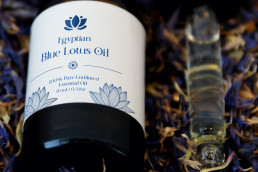
If you have been searching for blue lotus oil vs Aura Cacia comparisons, you are probably trying to work out whether a mainstream natural products brand can give you what a specialist apothecary offers, or whether the price difference between them is justified. This article lays out what each brand is actually selling, where their philosophies diverge, and which choice makes sense depending on what you want from your oil: a gentle everyday aromatic, or a concentrated ritual ingredient made from a notoriously difficult flower.
Table of Contents
- What Aura Cacia Actually Is
- What Pure Blue Lotus Oil Actually Is
- Head to Head: What You Are Actually Buying
- Extraction and Purity
- Scent Profile
- Price Per Active Material
- Philosophical Differences
- When Aura Cacia Is the Better Choice
- When Pure Blue Lotus Oil Is the Better Choice
- How to Decide
- What to Check Regardless of Brand
- Safety Considerations for Both Brands
- Frequently Asked Questions
- Where to Go From Here
- Experience the Real Thing
It is written and clinically reviewed by Antonio Breshears, ND, CCA, a Bastyr-trained naturopathic doctor and certified clinical aromatherapist. If you are new to this flower entirely, the broader complete guide to blue lotus oil is a good place to start before narrowing down which supplier suits your practice.
What Aura Cacia Actually Is
Aura Cacia is one of the best-known essential oil brands in North America. It sits under the Frontier Co-op umbrella, a member-owned cooperative that has been selling botanicals, culinary herbs, and aromatherapy products since the 1970s. You will find Aura Cacia bottles in health food shops, grocery co-ops, and large online retailers. The brand has built a reputation around accessibility, certified organic lines, and a broad single-oil catalogue covering most of the commonly requested essential oils: lavender, peppermint, tea tree, eucalyptus, frankincense, and dozens more.
Aura Cacia’s strengths are real. They publish GC/MS testing data on their website for most of their oils. They label origin countries. They offer a clearly organised range of carrier oils, pre-diluted rollerballs, and blends aimed at beginners. Their price point is modest, and their quality control for common oils is generally considered reliable within the aromatherapy community.
Where the comparison gets more interesting is when you look specifically at what Aura Cacia offers under the blue lotus name, and how that compares to what a specialist produces when blue lotus is the entire point of the operation.
What Pure Blue Lotus Oil Actually Is
Pure Blue Lotus Oil is a single-flower specialist. The entire catalogue is built around Nymphaea caerulea, the Egyptian blue water lily, sourced from traditional growers along the Nile and extracted using methods appropriate to a flower this delicate. That focus matters because blue lotus is genuinely difficult material. It takes three thousand to five thousand flowers to produce a single gram of absolute. The extraction window is narrow. The chemistry is easily damaged by heat, oxidation, and poor handling.
A generalist brand with a two-hundred oil catalogue cannot plausibly specialise in every flower they sell. A specialist has to, because the entire business lives or dies on that one material. That is the structural difference before you even open the bottle.
Head to Head: What You Are Actually Buying
Extraction and Purity
Aura Cacia’s blue lotus offerings, where they have been available, have typically been pre-diluted: a small percentage of blue lotus absolute blended into a carrier like jojoba or fractionated coconut oil, sold at an accessible price. This is a legitimate product for someone who wants a ready-to-use aromatic without measuring dilutions themselves. It is not, however, the same thing as neat absolute.
Pure Blue Lotus Oil sells the concentrated material itself: pure Nymphaea caerulea absolute, extracted artisanally and bottled by hand. One drop is chemically dense in aporphine and nuciferine alkaloids alongside the flavonoids apigenin, quercetin, and kaempferol that give the flower its relaxing reputation. You dilute it yourself to your preferred strength, which means you control exactly how much active material ends up on your skin or in your diffuser.
Scent Profile
A pre-diluted blend tends to smell lighter and more rounded because the carrier oil softens everything. You get a pleasant, honeyed-floral impression without the full weight of the absolute. For someone who wants a gentle background aromatic, this is a feature, not a flaw.
Pure absolute is a different experience. The top opens with a cool floral-aquatic note, something almost like a tropical waterlily on a warm afternoon. The heart deepens into dense honeyed florals. The base settles into something balsamic and faintly smoky that lingers on skin for hours. It is the difference between tasting a wine diluted with water and tasting it neat: not better or worse in the abstract, but categorically more concentrated.
Price Per Active Material
This is the calculation most people skip. Aura Cacia’s products are inexpensive per bottle, which makes them look like the clear value pick. But if a pre-diluted blend contains, say, three percent blue lotus absolute in jojoba, and you are comparing it to neat absolute, you need to divide. A fifteen millilitre bottle of three percent blend contains roughly 0.45 millilitres of actual absolute. A five millilitre bottle of neat absolute contains five millilitres of actual absolute, over ten times the active material.
Once you do the maths per gram of blue lotus absolute, the specialist and the generalist often work out to a comparable price, and sometimes the specialist is actually better value. What you are paying for with the specialist is not just the oil but the quality control that goes with single-flower focus.
Philosophical Differences
Aura Cacia is built for breadth. It is a capable first step into aromatherapy, with a huge catalogue and a price point that lets you experiment. If you want lavender, tea tree, and a pre-diluted blue lotus rollerball to try alongside twenty other oils, Aura Cacia is a sensible one-stop shop.
Pure Blue Lotus Oil is built for depth. It exists because blue lotus is a flower that rewards obsessive attention: careful sourcing, appropriate extraction, small batches, dark glass, and an understanding of how the chemistry actually behaves. If blue lotus is a significant part of your ritual, your formulation work, or your clinical aromatherapy practice, a specialist is the natural fit.
Neither approach is wrong. They are answering different questions.
When Aura Cacia Is the Better Choice
There are genuinely situations where a mainstream brand makes more sense. If you are new to aromatherapy and want to try blue lotus in a ready-to-use form before committing to neat absolute, a pre-diluted Aura Cacia product is a reasonable low-stakes introduction. If you primarily want to build a broad home aromatherapy kit with twenty different oils for diffusing and household use, a generalist brand will give you that breadth more affordably than buying specialist versions of each.
If you need a blue lotus product available quickly from a bricks-and-mortar shop in North America, Aura Cacia’s distribution makes that possible in a way that specialist online shipping sometimes does not. And if budget is tight and you genuinely only need occasional light aromatic use rather than concentrated ritual work, an inexpensive blend will do the job.
When Pure Blue Lotus Oil Is the Better Choice
If you have used blue lotus before and you want the full scent and chemistry of the absolute rather than a softened blend, a specialist bottle gives you that. If you are formulating your own products, bath oils, facial serums, rollerballs, perfume compositions, you need neat material so you can dial the concentration yourself. If you are practicing clinical aromatherapy and want to work with a consistent, traceable material where the provenance and extraction method are clear, the specialist route answers that.
If ritual matters to you, if blue lotus is not just another oil in the collection but a flower with personal or ceremonial significance, the experience of opening a bottle of neat absolute is not something a generic rollerball replicates. The density, the complexity, the sense that a few drops are genuinely worth something: that is part of what you are paying for.
How to Decide
The cleanest way to think about blue lotus oil vs Aura Cacia is to ask yourself one question: is blue lotus a headline ingredient in my practice, or one aromatic among many?
If it is one among many, a pre-diluted mainstream option is a perfectly sensible entry. You get an accessible product, easy ordering, and a gentle introduction to the flower. If it turns out you love it and want more, you can always step up to a specialist later.
If blue lotus is a headline ingredient, if you want to build it into nightly rituals, formulate your own blends, or use it clinically, then buying pre-diluted material from a generalist is working against yourself. You want the concentrated source so that you control the dilution, the carrier, and the application. At that point a specialist bottle is not a luxury, it is the practical choice.
What to Check Regardless of Brand
Whatever you decide between the two, a few checks are worth doing before you buy any blue lotus product.
First, confirm the botanical name on the label. It should read Nymphaea caerulea. If it says Nelumbo nucifera, that is sacred lotus, a completely different plant with different chemistry. If the botanical name is missing entirely, walk away.
Second, check whether the product is neat absolute, pre-diluted, or a fragrance oil. Fragrance oils are synthetic and contain no real blue lotus at all, despite the name on the bottle. Pre-dilutions should declare their percentage and the carrier oil used. Neat absolute should be sold as such.
Third, look for extraction method. Solvent-extracted absolute is the standard for blue lotus and is perfectly appropriate; steam distillation and supercritical CO2 are rarer. All three can produce excellent material when done well.
Fourth, consider packaging. Blue lotus is a delicate material and oxidises readily when exposed to heat and light. Dark glass, preferably miron or amber, is the minimum standard. Clear glass is a red flag for any essential oil or absolute.
Safety Considerations for Both Brands
Whichever bottle you end up with, the safety profile of blue lotus itself does not change. Avoid use during pregnancy and breastfeeding. Use caution if you are on dopaminergic medications, MAOIs, or heavy sedatives, because the alkaloid chemistry can interact in ways that have not been fully characterised. Patch test any new topical product on the inner forearm for twenty-four hours before broader application. Keep dilutions reasonable: one to two percent for facial use, two to three percent for body, two to four drops in a diffuser for a typical room.
Be aware that blue lotus faces regulatory restrictions in some jurisdictions, including Russia, Poland, Latvia, the US state of Louisiana, and there is ongoing regulatory complexity in Australia. This applies regardless of which brand you buy from.
Frequently Asked Questions
Does Aura Cacia sell pure blue lotus absolute?
Aura Cacia’s blue lotus products have historically been pre-diluted blends, typically blue lotus absolute in a carrier oil like jojoba, rather than neat absolute. Availability and formulation can change, so always check the current product description on their site and look for stated percentage and carrier oil.
Is Pure Blue Lotus Oil stronger than Aura Cacia’s blue lotus blend?
Yes, by a considerable margin. Pure Blue Lotus Oil sells the concentrated absolute, whereas Aura Cacia’s blue lotus products are pre-diluted. Drop for drop, the specialist absolute contains significantly more active material. You dilute it yourself to match your application.
Which brand is better value?
It depends how you calculate. Aura Cacia has a lower sticker price per bottle, but once you account for the actual quantity of blue lotus absolute in each product, the specialist often works out to comparable or better value per gram of active material. If you only need occasional light use, the generalist is cheaper in practice; if you use blue lotus regularly, the specialist pays off.
Can I dilute Pure Blue Lotus Oil myself to match a pre-diluted Aura Cacia product?
Absolutely, and this is exactly what many experienced users do. Add the absolute drop by drop to a carrier oil such as jojoba or fractionated coconut, calculating the percentage you want. One drop of absolute in roughly thirty drops of carrier gives you approximately a three percent dilution.
Is Aura Cacia’s blue lotus real, or is it synthetic fragrance?
Aura Cacia labels their products clearly and distinguishes between essential oils, absolutes, and fragrance products. Their blue lotus offerings have typically been real absolute, pre-diluted in carrier. Always read the ingredients list to confirm, as some other brands on the market sell synthetic fragrance oils under misleading names.
Which brand is more suitable for clinical aromatherapy practice?
For clinical work, a specialist neat absolute gives you more control over dilution, more consistent sourcing information, and a product form that aligns with standard aromatherapy dosing guidelines. A generalist pre-dilution is fine for personal wellness but harder to work with clinically.
Does Aura Cacia’s organic certification matter for blue lotus?
Organic certification is meaningful for oils where pesticide residue is a genuine concern. Blue lotus, grown in traditional Egyptian conditions, is generally cultivated with minimal input regardless of formal certification. Certification is nice to have but not a decisive factor for this particular flower.
Can I trust GC/MS reports from either brand?
GC/MS testing is a standard analytical method that identifies the chemical constituents of an oil. Both reputable specialists and reputable generalists can provide this data. A GC/MS report is a useful quality indicator when the brand publishes it; ask for one if it is not immediately visible.
Where can I learn more about blue lotus before deciding?
The broader complete guide to blue lotus oil covers the flower’s history, chemistry, extraction methods, and applications in depth. Reading that first will give you the framework to evaluate any brand’s claims critically, including both the brands compared here.
Where to Go From Here
The blue lotus oil vs Aura Cacia comparison comes down to what you want the oil to do in your life. A mainstream brand gives you breadth, accessibility, and a gentle pre-diluted introduction. A specialist gives you depth, concentration, and the full chemistry of the absolute. Neither invalidates the other. If you are at the beginning of your journey with this flower, either path is a reasonable start. If blue lotus has become central to your practice, the specialist route is the one that keeps rewarding the attention you give it. For a fuller treatment of how to work with the oil once you have it in hand, the complete guide to blue lotus oil will take you the rest of the way.

Antonio Breshears
Antonio Breshears is a renowned expert in holistic medicine and beauty, with over 25 years of research experience dedicated to uncovering the secrets of nature's most powerful remedies. Holding a degree in Naturopathic Medicine, Antonio's passion for healing and well-being has driven him to explore the intricate connections between mind, body, and spirit.
Over the years, Antonio has become a respected authority in the field, helping countless individuals discover the transformative power of plant-based therapies, including essential oils, herbs, and natural supplements. He has authored numerous articles and publications, sharing his wealth of knowledge with a global audience seeking to improve their overall health and well-being.
Antonio's expertise extends to the realm of beauty, where he has developed innovative, all-natural skincare solutions that harness the potency of botanical ingredients. His formulations embody his deep understanding of the healing properties found in nature, providing holistic alternatives for those seeking a more balanced approach to self-care.
With his extensive background and dedication to the field, Antonio Breshears is a trusted voice and guiding light in the world of holistic medicine and beauty. Through his work at Pure Blue Lotus Oil, Antonio continues to inspire and educate, empowering others to unlock the true potential of nature's gifts for a healthier, more radiant life.