If you have ever stood in front of your aromatherapy shelf wondering whether tonight calls for something quieting, something sharpening, or something warming, this article is written for you. Choosing an intention blend is less about mystique and more about matching the chemistry of a given oil to the state you want to move toward. This guide walks through three core intentions built around blue lotus oil, Midnight for sleep, Clarity for focus, and Ember for sensuality, and helps you work out which one fits where you actually are tonight.

Pure Egyptian Blue Lotus Oil (Nymphaea Caerulea). Distilled by Artisans. Bottled by hand. Made to the highest quality. Built on centuries of ancient history and decades of skilled artisanal craftsmanship. → Order Your Bottle of 100% Pure Blue Lotus Oil

It is written and clinically reviewed by Antonio Breshears, ND, CCA, a Bastyr-trained naturopathic doctor and certified clinical aromatherapist. If you are new to this material, the complete guide to blue lotus oil covers the underlying chemistry, safety profile, and extraction methods that the protocols below assume you broadly understand.

What an Intention Blend Actually Is

An intention blend is a small, purpose-built aromatic formulation designed to support a specific nervous-system state. The word “intention” can sound vaguely spiritual, and in some traditions it genuinely is, but the mechanism underneath is quite concrete. Scent molecules travel from the nasal epithelium directly to the olfactory bulb, which has unusually direct neural access to the limbic system, the part of the brain that governs emotional tone, memory, and arousal. A well-chosen blend nudges that system in a particular direction.

What an intention blend is not is a pharmaceutical. None of the three profiles below will override a significant clinical picture. They are modestly effective, reasonably well-attested, and genuinely useful when matched to the right moment. The art of choosing an intention blend is essentially the art of reading your own state honestly and picking the chemistry that meets it.

Why Blue Lotus Anchors All Three

Blue lotus oil (Nymphaea caerulea) is unusual among aromatics because its chemistry sits across several regulatory systems at once. The aporphine alkaloids offer gentle dopaminergic activity, nuciferine brings a light serotonergic modulation, and flavonoids like apigenin interact with central benzodiazepine receptor sites. That combination makes blue lotus adaptable: it lends itself to sedative, clarifying, and sensual blends depending on what you pair it with. Think of it as the base note that tells the rest of the blend which direction to travel.

Midnight: The Sleep and Surrender Blend

Midnight is the intention you reach for when the body is tired but the mind is still running a meeting that ended four hours ago. This is the most common complaint I hear in practice, and it is rarely solved by simply going to bed earlier. The nervous system needs a signal to downshift, and scent is one of the more reliable signals available outside of pharmacology.

What Midnight Is Doing Chemically

A Midnight blend pairs blue lotus with sedative and parasympathetic-dominant oils: typically lavender (linalool, linalyl acetate), Roman chamomile (esters that act on GABAergic pathways), and a trace of vetiver or sandalwood for grounding. The blue lotus contribution is not primarily sedative. It is more of a softening. Apigenin’s receptor activity takes the sharp edge off rumination, and the honeyed-floral heart of the scent cues a slower breath pattern within a minute or two of inhalation.

When to Choose Midnight

  • You fall asleep relatively easily but wake at 3am with a racing mind.
  • You feel wired and tired at the same time after a long day.
  • Your sleep onset takes more than thirty minutes most nights.
  • You grind your teeth, or notice tension in your jaw and shoulders as you lie down.

Midnight Protocol

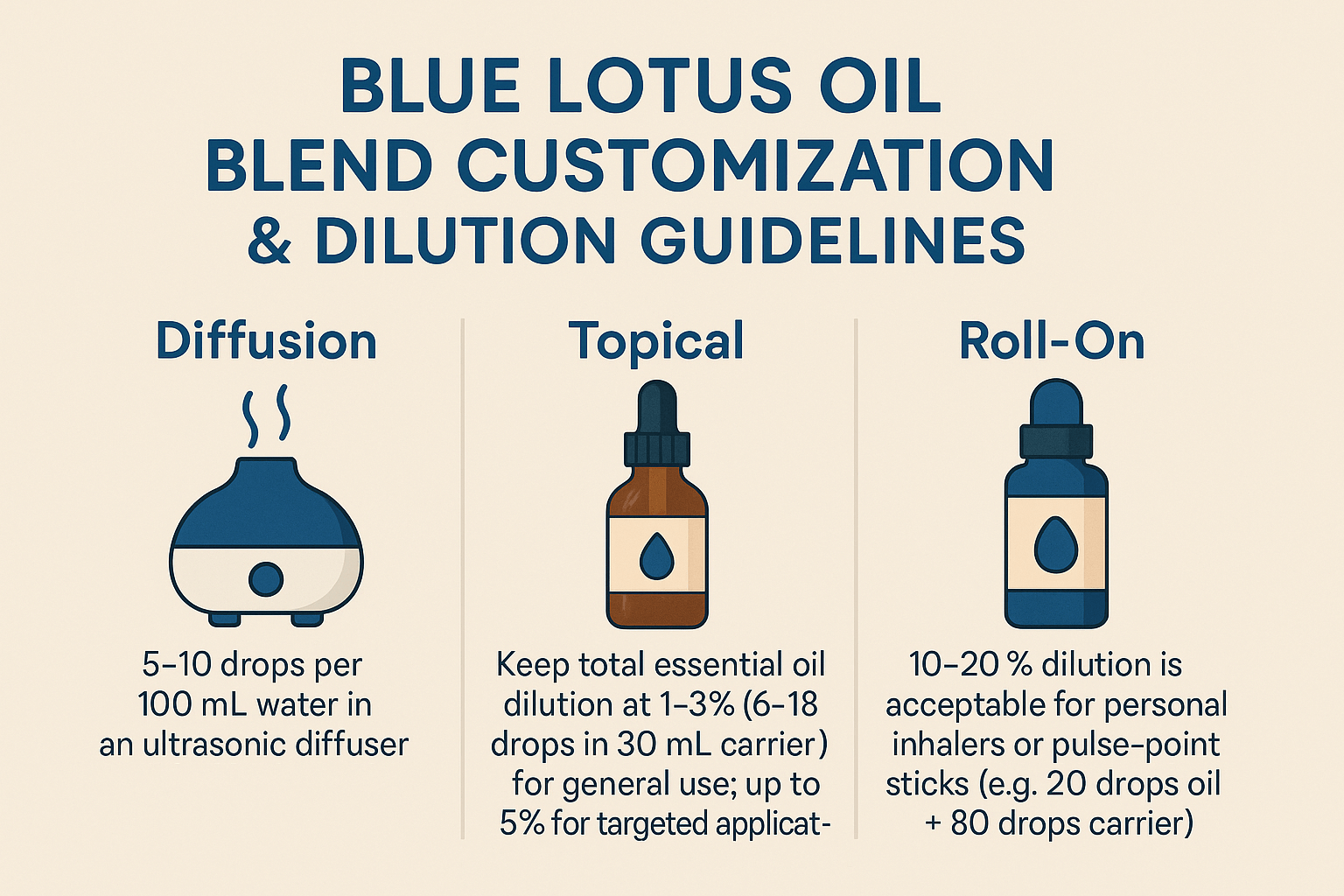
For a topical application, dilute to 2 percent in a carrier such as jojoba or fractionated coconut: roughly 12 drops of blend per 30ml carrier. Apply to the inside of the wrists, the sternum, and the back of the neck about thirty minutes before you intend to sleep. For a diffuser, 3 to 4 drops in a room-temperature ultrasonic diffuser run for twenty minutes before bed is usually enough. Do not run the diffuser through the night; habituation reduces the signalling effect.

Pure Egyptian Blue Lotus Oil (Nymphaea Caerulea). Distilled by Artisans. Bottled by hand. Made to the highest quality. Built on centuries of ancient history and decades of skilled artisanal craftsmanship. → Order Your Bottle of 100% Pure Blue Lotus Oil

Clarity: The Focus and Composure Blend

Clarity is the daytime counterpart to Midnight. It is the blend you reach for when you need to do focused work, sit down to write, or hold a difficult conversation without losing your centre. The goal here is not stimulation in the caffeine sense. It is a quieter kind of alertness: the mental equivalent of a clean desk.

What Clarity Is Doing Chemically

A Clarity blend pairs blue lotus with oils that brighten cognition without triggering sympathetic arousal: rosemary (1,8-cineole, which has modest evidence for working memory support), peppermint in small quantities (menthol, for alertness), and frankincense or bergamot as a cognitive-emotional bridge. Blue lotus in this context contributes composure. The aporphine activity nudges motivation gently upward, while the overall floral depth prevents the blend from feeling sharp or agitating, which is a common failure mode when rosemary and peppermint are used alone.

When to Choose Clarity

  • You have focused work to do and your attention keeps scattering.
  • You feel mentally foggy but not tired enough to justify a nap.
  • You are about to enter a meeting or conversation that requires composure.
  • You want to study, read, or write and need a consistent anchor state.

Clarity Protocol

Clarity works best through inhalation rather than topical application; you want it in your breathing air, not on your skin, because the effect is transient and the ritual of inhaling it is part of the cue. Use an aromatherapy inhaler (the small pocket-sized sticks with a cotton wick) loaded with 15 to 20 drops of the blend, and take three or four slow breaths at the start of a work block. Alternatively, diffuse 3 drops for fifteen minutes as you settle into a task. Avoid Clarity within four hours of sleep; the peppermint component is mildly alerting and can delay sleep onset if you are sensitive.

Ember: The Sensuality and Connection Blend

Ember is the warmest of the three intentions and the most commonly misunderstood. It is not an aphrodisiac in the marketing-copy sense, and it will not generate desire where none exists. What it does, and does reasonably well, is lower the ambient noise that often stands between people and embodied presence. Stress, distraction, and self-consciousness are the most common obstacles to intimacy; Ember addresses those, not desire itself.

What Ember Is Doing Chemically

An Ember blend pairs blue lotus with warm, resinous, and skin-friendly oils: jasmine absolute (indolic, richly floral), ylang ylang (benzyl acetate, benzyl benzoate, classically associated with relaxation of smooth muscle and sympathetic tone), and a base of sandalwood or patchouli. Blue lotus is the organising note in this blend because its own scent profile already moves from cool-floral to honeyed-balsamic over time, which mirrors the arc of a slow evening. The aporphine-nuciferine balance gives a gentle dopaminergic tone without agitation.

When to Choose Ember

  • You want to transition from work-mind to home-mind in the evening.
  • You are preparing for a shared evening or intimate time with a partner.
  • You want to feel embodied after a day spent largely in your head.
  • You are running a long bath or a slow self-care ritual and want an anchor scent.

Ember Protocol

Ember is best worn on the skin. Dilute to 2 to 3 percent in jojoba or a light body oil, and apply to pulse points: inner wrists, behind the ears, the nape of the neck, and across the sternum. For a shared space, diffuse 3 to 4 drops for twenty minutes before the space is used; the scent develops on contact with warm skin and warm air, and a slightly pre-diffused room lets the top notes settle into the heart before anyone walks in.

How to Actually Choose Your Intention Blend Tonight

The practical question is not which blend is objectively best; it is which state you want to move toward from where you currently are. Sit quietly for thirty seconds and ask two questions. First, what is the quality of my current nervous-system state: wired, scattered, heavy, guarded, flat, tender? Second, what do I want the next hour or two to feel like: rest, focus, or connection?

If the answer to the second question is rest and you are having trouble letting go, Midnight. If the answer is focus and you are scattered or foggy, Clarity. If the answer is connection, either to yourself or to someone else, and you are carrying tension, Ember. If you genuinely cannot tell, default to Midnight; most people in modern life are more sleep-deprived than they admit, and a well-rested nervous system makes better use of the other two blends the next day.

What If You Want to Blend Intentions?

It is tempting to want all three at once, but layering intention blends generally reduces their effectiveness. The nervous system reads scent as a signal; contradictory signals produce a muddled response. If you want a long evening that moves from focused work through dinner into rest, use Clarity during the work block, let the scent clear for an hour, then apply Ember for dinner and evening, and finish with Midnight at the bedside. Sequence, not superposition.

Realistic Timeframes and What to Expect

Scent-based interventions work quickly at the perceptual level and slowly at the conditioning level. You will likely notice a shift in the first session: a softening of breath with Midnight, a quieter alertness with Clarity, a warmer groundedness with Ember. These initial effects are real but modest. The larger benefit comes from consistency. After two to three weeks of using the same blend in the same context, your nervous system begins to associate the scent with the state, and the effect amplifies. This is classical conditioning applied to the olfactory-limbic pathway, and it is the single most under-utilised aspect of aromatherapy.

Do not expect dramatic results. A good intention blend moves your state by perhaps fifteen or twenty percent toward where you want to be. That is enough to matter, particularly when stacked with other supportive practices, but it is not a substitute for sleep hygiene, cognitive support, or relational work.

When an Intention Blend Is Not the Right Choice

There are a few situations in which intention blends, including the three described here, are not appropriate. Pregnancy and breastfeeding: blue lotus is avoided, and jasmine, rosemary, and peppermint each have their own contraindications in these periods. Significant psychiatric illness, particularly where medications like MAOIs, strong dopaminergic agents, or heavy sedatives are in play: blue lotus interacts with these systems and should be discussed with a clinician first. Children under twelve: dilutions and oil selections differ substantially, and 1,8-cineole-rich oils like rosemary are generally avoided in young children.

If you are using blue lotus oil to manage a condition that has a clinical name, depression, chronic insomnia, generalised anxiety disorder, sexual dysfunction with a physiological basis, the oil is a supportive adjunct, not a primary treatment. See a clinician who can assess the whole picture, and use your intention blend as part of a broader plan rather than as a stand-alone solution.

Complementary Practices for Each Intention

Midnight pairs well with a consistent wind-down ritual: dim lighting an hour before bed, screens off, warm shower, a few minutes of slow nasal breathing. The blend is a cue within a larger sequence, and the sequence matters more than any single element. Clarity pairs well with time-boxed work, a clean visual field, and water within reach. The blend marks the start of a focused block, and honouring the boundary of that block is what builds the conditioning. Ember pairs well with slow food, unhurried conversation, warmth on the skin, and the absence of screens. It is the blend most undermined by distraction; protect the space.

Frequently Asked Questions

Can I use the same base bottle of blue lotus oil to build all three blends?

Yes, and this is the usual approach. A high-quality pure blue lotus oil is the common anchor across Midnight, Clarity, and Ember. What changes is the companion oils, the carrier, and the application method.

How many drops of blue lotus go into each intention blend?

Blue lotus is typically used at low percentages within a blend, around 10 to 20 percent of the total essential-oil content, because its scent is powerful and its cost is significant. For a 10ml blend bottle at 20 percent blue lotus, that is roughly 30 drops of blue lotus alongside the companion oils, then diluted further in carrier before skin application.

Is it safe to diffuse Clarity during the workday if I have pets?

Peppermint and rosemary can irritate cats in particular. If you share space with a cat, either avoid diffusing Clarity in that space or use an inhaler stick that keeps the scent contained to your own breathing space.

How long does it take to notice the effect of an intention blend?

The initial perceptual shift is typically within one to three minutes of inhalation. The deeper conditioning benefit builds over two to three weeks of consistent use in the same context.

Can I apply Midnight or Ember to my face?

These blends are formulated for body and pulse-point use. For facial application, use a dedicated facial formulation at 1 percent dilution. The companion oils in Midnight and Ember are generally not problems for facial skin at body-blend concentrations, but they are not optimised for it either.

What if my response to a blend feels off?

Scent response is genuinely individual. If a blend feels wrong, agitating when it should be calming, flat when it should be warming, trust that signal. Adjust the ratios, replace a companion oil, or choose a different intention. There is no single right formulation.

Can I layer Ember and Midnight on the same evening?

Yes, sequentially. Ember earlier in the evening, then remove residue with a warm cloth and apply Midnight at the bedside. Avoid wearing both simultaneously; the chemistries and intentions pull in different directions.

How do I store intention blends to preserve them?

Amber or cobalt glass, cool and dark storage, tightly capped. A well-made blend with a blue lotus base and good-quality companion oils keeps for two to three years. Do not store in a bathroom; humidity and temperature swings accelerate oxidation.

Can I use these blends during yoga, meditation, or breathwork?

Yes, and they pair particularly well with those practices. Clarity suits a morning practice, Midnight suits evening restorative or yoga nidra, Ember suits partner or embodied practices. A single drop on the wrists before the practice is usually sufficient.

Are the three intentions the only options?

They are the three most useful starting points for most people. Once you understand how the base oil interacts with companion oils, you can build additional intentions for grief, courage, creative work, or ritual. Start with the three, learn their textures, then extend.

Where to Go From Here

If you are newer to this material and want the underlying chemistry and safety context in greater depth, read the complete guide to blue lotus oil before building your first blend. If you already have a bottle and you are ready to begin, pick the intention that matches where you actually are tonight rather than where you wish you were, and commit to using the same blend in the same context for two weeks. That short stretch of consistency is where the real benefit lives, and it is the difference between a pleasant scent and a genuine tool.

Pure Egyptian Blue Lotus Oil (Nymphaea Caerulea). Distilled by Artisans. Bottled by hand. Made to the highest quality. Built on centuries of ancient history and decades of skilled artisanal craftsmanship. → Order Your Bottle of 100% Pure Blue Lotus Oil

Antonio Breshears

Antonio Breshears is a renowned expert in holistic medicine and beauty, with over 25 years of research experience dedicated to uncovering the secrets of nature's most powerful remedies. Holding a degree in Naturopathic Medicine, Antonio's passion for healing and well-being has driven him to explore the intricate connections between mind, body, and spirit.

Over the years, Antonio has become a respected authority in the field, helping countless individuals discover the transformative power of plant-based therapies, including essential oils, herbs, and natural supplements. He has authored numerous articles and publications, sharing his wealth of knowledge with a global audience seeking to improve their overall health and well-being.

Antonio's expertise extends to the realm of beauty, where he has developed innovative, all-natural skincare solutions that harness the potency of botanical ingredients. His formulations embody his deep understanding of the healing properties found in nature, providing holistic alternatives for those seeking a more balanced approach to self-care.

With his extensive background and dedication to the field, Antonio Breshears is a trusted voice and guiding light in the world of holistic medicine and beauty. Through his work at Pure Blue Lotus Oil, Antonio continues to inspire and educate, empowering others to unlock the true potential of nature's gifts for a healthier, more radiant life.

Author posts

Privacy Preference Center