If you have just ordered, or are about to order, your first bottle of blue lotus oil, this guide is written for you. It covers what a good bottle should look like, how to test it when it arrives, how to dilute it safely for your skin and your diffuser, what a sensible first week of use looks like, and what you can realistically expect in the first month. The aim is simple: help you get genuinely useful value out of your first bottle of blue lotus oil rather than leave it half-forgotten on a shelf.
Quick Links to Useful Sections
- What Blue Lotus Oil Actually Is
- What Your First Bottle Should Look (and Smell) Like
- How to Test Your First Bottle at Home
- The paper strip test
- The cold test
- Skin patch test
- Understanding Dilution: The Most Important Skill
- Three Simple Rituals for Your First Week
- Ritual one: the evening wind-down diffusion
- Ritual two: the pulse-point rollerball
- Ritual three: the weekly facial oil
- What to Expect: Realistic Timeframes
- When Blue Lotus Oil Is Not the Right Choice
- Complementary Approaches for Your First Month
- Storing Your Bottle So It Lasts
- Frequently Asked Questions
- Where to Go From Here
- Begin With a Bottle You Can Trust
It is written and clinically reviewed by Antonio Breshears, ND, CCA, a Bastyr-trained naturopathic doctor and certified clinical aromatherapist. For a broader reference once you have settled into daily use, pair this starter guide with the complete guide to blue lotus oil, which covers chemistry, extraction, safety, and applications in more depth.
What Blue Lotus Oil Actually Is
Blue lotus oil is the aromatic extract of Nymphaea caerulea, the Egyptian blue water lily. Despite the common name, it is botanically a water lily rather than a true lotus, and the distinction matters because the aromatic profile and chemistry are quite different from the pink sacred lotus (Nelumbo nucifera) you may also see on the market.
Nearly every bottle sold as “blue lotus oil” is technically a solvent-extracted absolute. Steam-distilled true essential oils of Nymphaea caerulea exist but are rare and very expensive; supercritical CO2 extracts are the other premium option. Roughly 3,000 to 5,000 flowers yield a single gram of absolute, which is the main reason quality blue lotus is not cheap. If a product is being sold at a price that seems too good to be true, it usually is: most inexpensive “blue lotus oils” are fragrance oils, dilutions in jojoba or fractionated coconut, or blends with only a trace of the real material.
The compounds most frequently cited in the scientific and traditional literature include aporphine (a weak dopamine agonist), nuciferine (with weak dopamine-antagonist and 5-HT2A/2C activity), and a suite of flavonoids including apigenin, quercetin, and kaempferol. Apigenin in particular binds at the central benzodiazepine receptor, which is part of why the oil is associated with a calm, slightly euphoric, parasympathetic-leaning mood state rather than sharp sedation.
What Your First Bottle Should Look (and Smell) Like
Before you even open the bottle, look at the packaging. A serious producer will bottle blue lotus absolute in dark amber or cobalt glass, ideally with a glass dropper or a tight-sealed orifice reducer. Clear glass, plastic bottles, and bottles without a batch number or botanical name are all warning signs.
Check the label for:
- The botanical name Nymphaea caerulea, not just “blue lotus”
- Extraction method (absolute, steam distilled, or CO2)
- Country of origin (Egypt is the classical source)
- A batch number and, ideally, a best-before date
- Net volume in millilitres
When you open the bottle, the aroma should unfold in layers. Expect a cooler, slightly aquatic and green floral top note, followed by a deep honeyed-floral heart, and then a warmer, balsamic, faintly smoky base that lingers on a smelling strip for hours. A good absolute is viscous and pours slowly; it is typically a rich amber-brown to dark olive-green, not pale yellow or water-thin. A harsh alcoholic top note, a flat one-dimensional floral smell, or a perfume-like sweetness that disappears within minutes all suggest dilution or synthetic adulteration.
How to Test Your First Bottle at Home
You do not need a laboratory to do a basic sanity check. Two simple tests will catch most obvious problems.
The paper strip test
Place one drop of the oil on a clean piece of white paper or a perfumer’s blotter. A genuine absolute will leave a visible ring that darkens and holds a complex scent for at least several hours. Pure solvent carriers and fractionated coconut oil will evaporate cleanly and leave little to no lingering aroma. Fragrance oils often smell strongest in the first ten minutes and then flatten abruptly.
The cold test
Blue lotus absolute is naturally thick at room temperature and becomes noticeably more viscous, sometimes semi-solid, if you place the bottle in a cool room or the lower shelf of a fridge for thirty minutes. Warming the bottle in your palm for a minute or two should return it to a pourable state. A product that stays thin and runny through these temperature changes has almost certainly been heavily cut with a carrier oil.
Skin patch test
Before using the oil on your face or larger areas, always do a 24-hour patch test. Dilute one drop of blue lotus oil in five millilitres (roughly a teaspoon) of a neutral carrier such as jojoba or sweet almond, apply a small amount to the inside of your forearm, and leave it undisturbed. If you see no redness, itching, or rash after a day, you can proceed with confidence.
Understanding Dilution: The Most Important Skill
Blue lotus absolute is concentrated plant material. It is intended to be diluted, never applied neat to broad areas of skin. Learning to dilute properly is the single most valuable skill you can develop with your first bottle of blue lotus oil, and it will save you both money and skin irritation.
A practical rule of thumb for drops per 10 ml of carrier oil:
- 1 percent dilution (facial use, sensitive skin, daily leave-on products): around 3 drops per 10 ml
- 2 percent dilution (general body use, pulse-point rollers): around 6 drops per 10 ml
- 3 percent dilution (short-term targeted use on a small area): around 9 drops per 10 ml
For diffusion, 2 to 4 drops in a standard ultrasonic diffuser filled with water is plenty. Blue lotus is not an oil you need to push hard; it rewards restraint. A room with a gentle, just-perceptible honeyed-floral background is more pleasant and more effective than one saturated with scent.
Good starter carrier oils include jojoba (long shelf life, skin-friendly, excellent for facial blends), fractionated coconut (light, neutral, ideal for rollerballs), and sweet almond (nourishing for body blends). Avoid mineral oil and heavily refined vegetable oils, which fight the skin benefits you are trying to achieve.
Three Simple Rituals for Your First Week
Rather than try to use your first bottle in ten different ways in the first week, pick two or three simple rituals and practise them consistently. This is both the most economical and the most informative way to learn how the oil actually affects you.
Ritual one: the evening wind-down diffusion
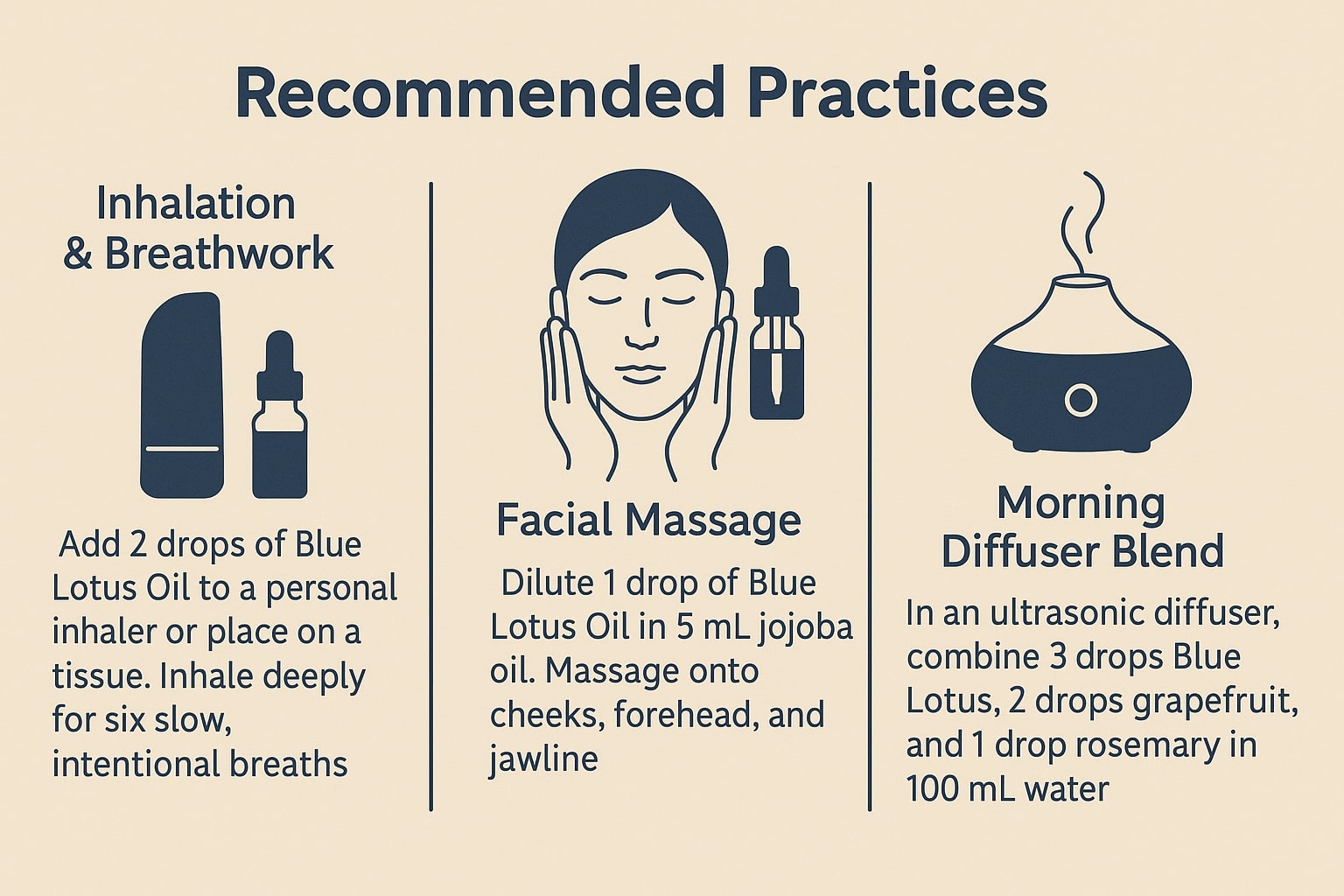
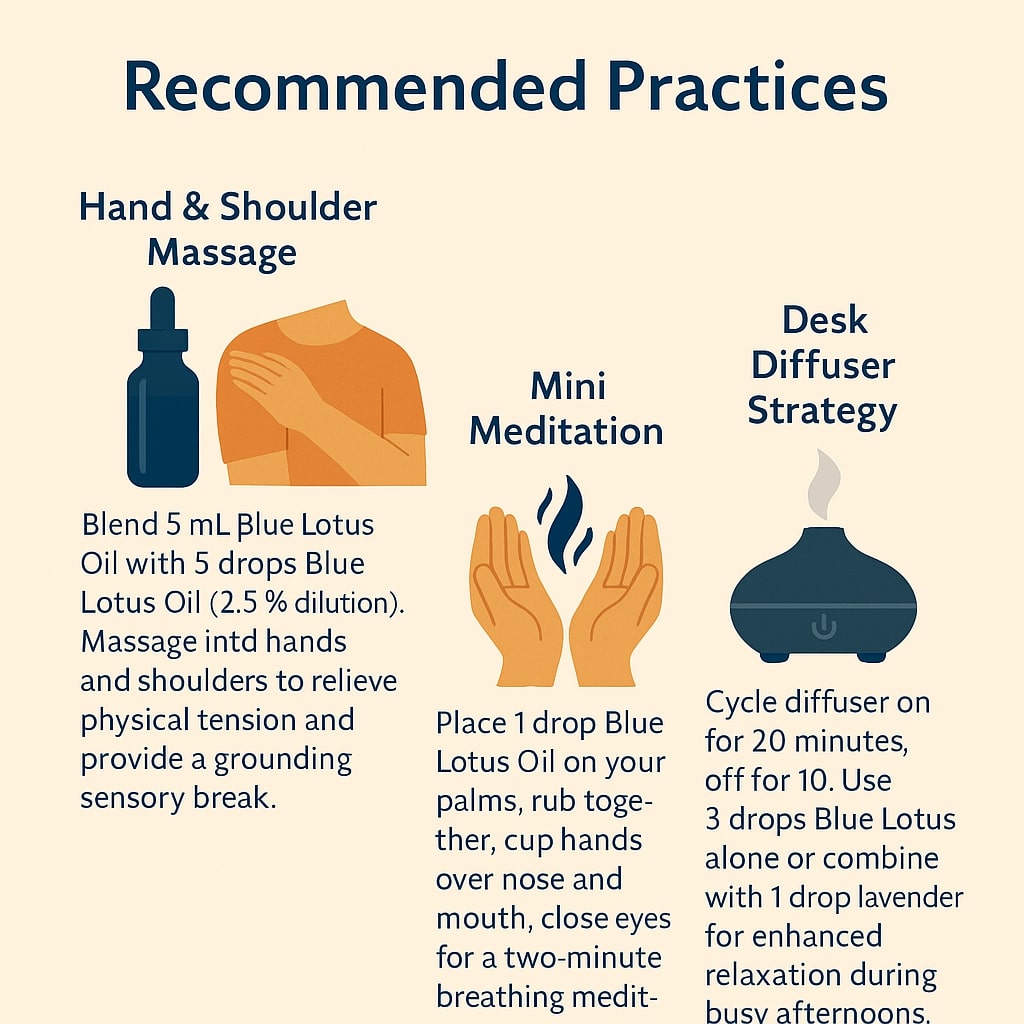
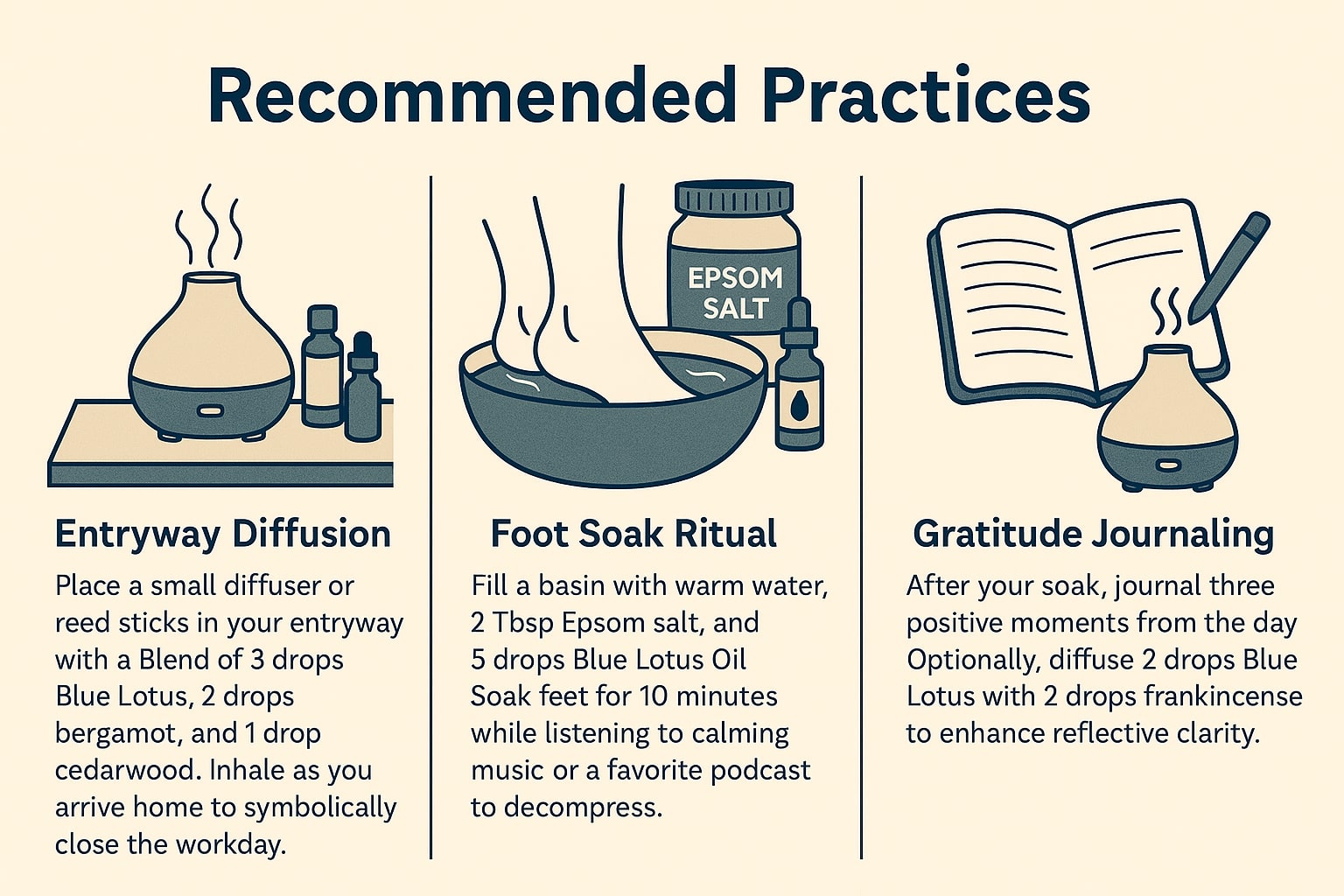
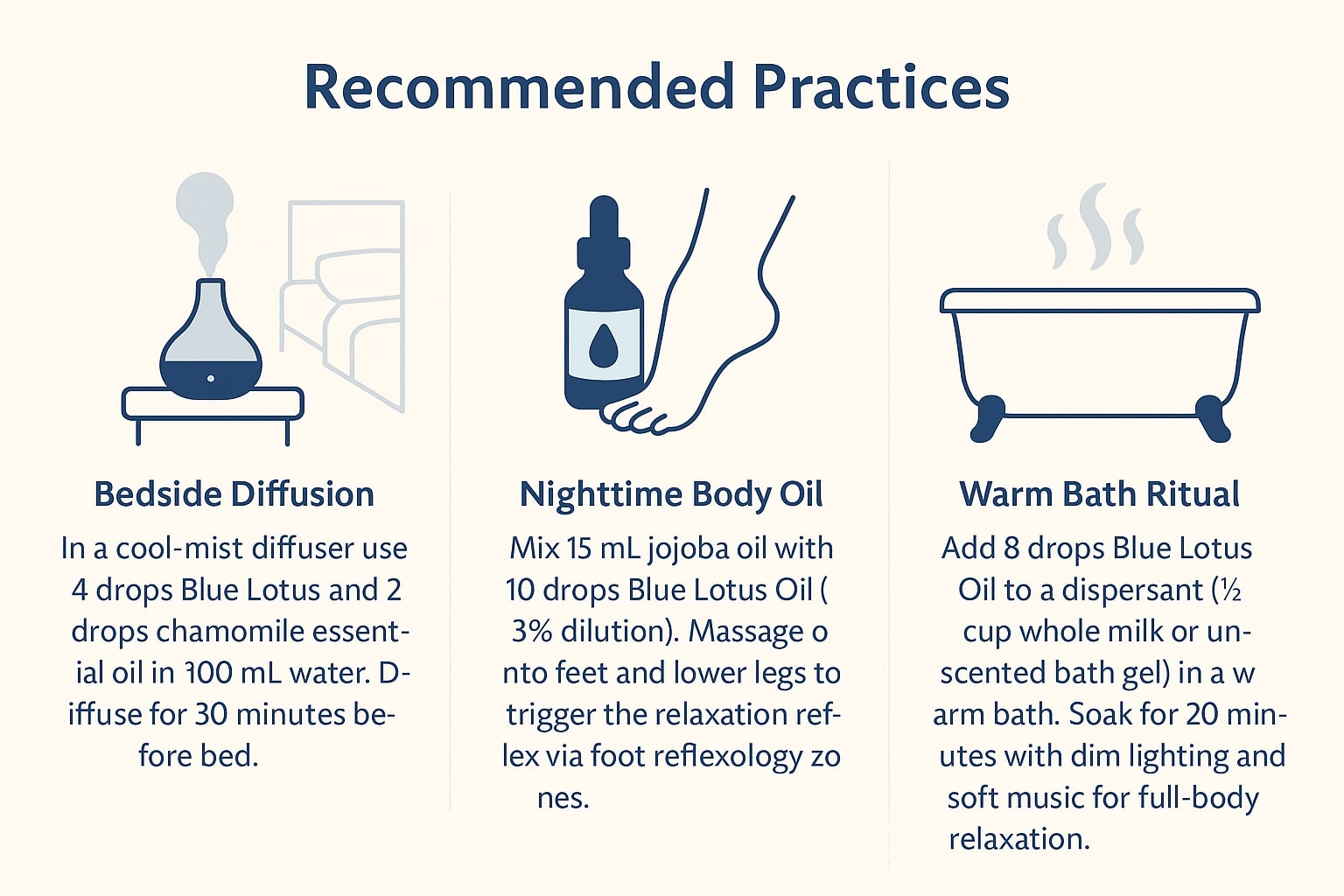
About an hour before your intended sleep time, add 3 drops of blue lotus oil to an ultrasonic diffuser with water, ideally in the room where you read, bathe, or otherwise decompress (not necessarily the bedroom itself). Let it run for 30 to 45 minutes. Many people find this nudges them into a more parasympathetic, “ready to rest” state without the grogginess of a sedative. It is not a sleeping pill; it is a signal to your nervous system that the day is winding down.
Ritual two: the pulse-point rollerball
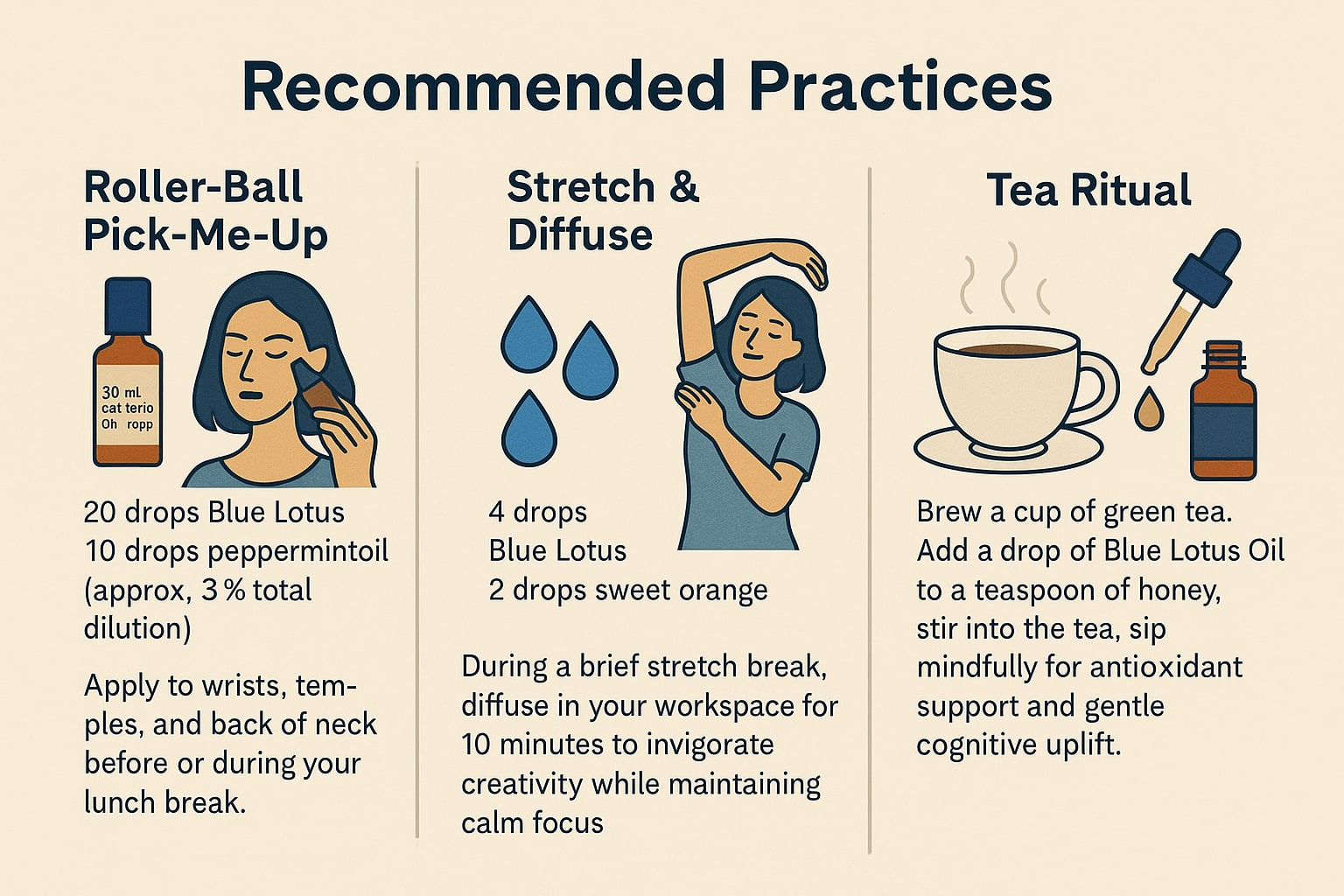
In a 10 ml roller bottle, combine 6 drops of blue lotus oil with jojoba oil to fill. Apply to your inner wrists, the sides of your neck, and the centre of your chest when you want a discreet, portable version of the oil’s mood-supportive quality. This is particularly useful for anxious commutes, difficult meetings, or the transition home from work. The warmth of the skin gently diffuses the aroma upwards, so you benefit from both olfactory and low-dose dermal exposure.
Ritual three: the weekly facial oil
Once a week, as a gentle introduction, blend 3 drops of blue lotus oil into 10 ml of jojoba (a 1 percent facial dilution). After cleansing at night, warm three to four drops of this blend between your palms, press it into damp skin, and spend a slow minute on a light facial massage. The flavonoids in blue lotus are associated with antioxidant activity, and the ritual itself, the slowing, the breath, the scent, is half the benefit.
What to Expect: Realistic Timeframes
Honest expectations matter here. Blue lotus oil is a modestly acting aromatic, not a pharmaceutical. It works best as part of a repeated practice, and its effects are more often described as “noticeably calmer” or “slightly more open” than “profoundly transformed.”
A reasonable timeline for a first bottle looks something like this:
- Week one: you learn the scent, confirm you tolerate it on your skin, and notice whether the diffusion ritual meaningfully shifts your evenings. Some people feel a subtle calm the first night; others need a week of repetition.
- Weeks two to four: if it is going to become a useful tool for you, this is usually when the mood and sleep associations consolidate. The smell itself becomes a cue your nervous system recognises.
- Months two to three: skin benefits from the facial ritual become more apparent, and you will have a clear sense of whether blue lotus deserves a permanent place in your routine.
If, after four consistent weeks, you notice essentially nothing, that is useful information too. Blue lotus is not universally responsive; some people simply do not react strongly to its chemistry, and that is not a failure of the oil or of you.
When Blue Lotus Oil Is Not the Right Choice
A responsible starter guide has to name limits clearly. Blue lotus oil is not appropriate in several situations.
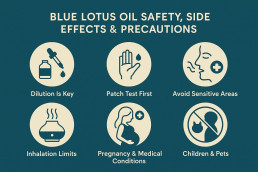
Avoid during pregnancy and breastfeeding. There is insufficient safety data on the alkaloid profile for these populations, and the cautious position is straightforward avoidance.
Use caution with certain medications. If you take dopaminergic medications (for Parkinson’s disease, for example), MAOIs, or heavy sedatives and sleep medications, discuss aromatic use of blue lotus with your prescriber before you start. The interaction risk is not dramatic in inhalation use, but the conservative path is to confirm.
Know the regulatory landscape. Nymphaea caerulea faces legal restrictions or complexity in Russia, Poland, Latvia, the US state of Louisiana, and Australia. If you are in or shipping to one of these jurisdictions, check local rules before ordering.
It is not a treatment for a diagnosed condition. If you are dealing with clinical anxiety, major depression, insomnia that has lasted months, or a skin condition that is worsening, please see a qualified practitioner. Blue lotus can sit alongside good clinical care, but it is not a substitute for it.
Sensitive skin, broken skin, or known floral allergies. If a patch test produces any reaction, stop. There are plenty of gentler aromatic options for people whose skin does not get on with absolute-type extracts.
Complementary Approaches for Your First Month
Blue lotus oil works far better when the surrounding context supports what you are asking of it. If you are using it for evening calm, a diffuser ritual will outperform itself if your lighting is also lower, screens are down, and your room is cool. If you are using it for a weekly facial, hydration, gentle cleansing, and sleep do more heavy lifting than any single oil can.
Other aromatic companions that pair well with blue lotus for beginners include:
- Lavender (for sleep and skin) as a gentle, familiar partner
- Roman chamomile (for nervous system settling) when you want something softer
- Sandalwood (for grounding) when you want to deepen the base of a blend
- Frankincense (for meditative practice and mature skin) when you want more structure
Keep early blends simple. Two or at most three oils in a blend is plenty while you are learning what blue lotus contributes on its own. Once you know its voice, blending becomes far more interesting.
Storing Your Bottle So It Lasts
A well-made blue lotus absolute, stored properly, holds its quality for three to four years. To get that kind of life out of your first bottle, store it upright, in its original dark glass container, in a cool and dark place. A drawer, a cabinet shelf, or a dedicated apothecary box all work well. Avoid bathroom shelves (humidity and temperature swings), sunlit windowsills, and warm kitchens.
Keep the cap tight. Oxidation, not time alone, is what gradually dulls an absolute. If you decant into rollerballs or face-oil bottles, make them in small batches so you are not leaving large volumes of diluted oil sitting around for months.
Frequently Asked Questions
How much blue lotus oil should I use on my first try?
Start with a single drop in a patch test diluted in a teaspoon of carrier oil, and for diffusion begin with 2 drops in a standard ultrasonic diffuser. You can always add more; you cannot take it back once it is in the bottle or on your skin.
Can I apply blue lotus oil directly to my skin?
No. Blue lotus absolute should always be diluted in a carrier oil before skin application, typically at 1 to 2 percent for facial or general use. Neat application risks irritation and wastes a concentrated material that works perfectly well at low dilutions.
Will blue lotus oil make me feel high?
Used aromatically or at sensible topical dilutions, it will not. People often describe a mild mood lift, a sense of calm, or slight euphoria at most, more of a parasympathetic softening than an intoxication. If a product is making extravagant psychoactive claims, treat that as a quality red flag.
How long should my first bottle last?
With modest daily use, perhaps a 3-drop diffusion and a few drops in a weekly blend, a 5 ml bottle can easily last two to three months. If you are building rollerballs and facial oils as well, plan on one to two months for that same size.
What carrier oil should I buy alongside my first bottle?
Jojoba is the most versatile starter carrier: long shelf life, skin-friendly, and excellent for both body and face. Fractionated coconut is a good second choice for rollerballs where you want a lighter, more neutral feel.
Can I add blue lotus oil to a bath?
Yes, but never drop it straight into the water because essential oils do not mix with water and can cause skin irritation. Pre-dilute 3 to 5 drops in a tablespoon of a dispersant such as whole milk, unscented castile soap, or a plain bath oil, then add that mixture to the bath once it is drawn.
Why does my bottle look different from a friend’s?
Natural absolutes vary by harvest, region, and batch. Small differences in colour (ranging from amber-brown to dark greenish-brown) and viscosity are normal. Large differences, a pale yellow, water-thin, overtly perfumed product beside a dark, viscous, complex one, suggest the two are not the same grade of material at all.
Is blue lotus oil safe to use around pets?
Diffusion should be done in a well-ventilated room with the door open so pets can leave if they wish. Cats in particular lack certain liver enzymes that metabolise essential oil constituents efficiently, so keep diffusion light, short, and in a space they can exit. Do not apply blue lotus oil to pets’ skin or fur.
Can I cook with or ingest blue lotus oil?
No. Absolutes are solvent-extracted aromatic materials and are not intended for internal use. If you are interested in the culinary or tea traditions around Nymphaea caerulea, those use dried flowers, not the concentrated oil.
What if I hate the smell?
It happens. Blue lotus has an unusual profile that some people read as “green and floral” and others read as “heavy and balsamic.” If the smell is genuinely unpleasant to you, forcing use is counterproductive, the whole point of aromatic practice is an aroma your nervous system welcomes. In that case, pass the bottle to a friend and explore a different aromatic entirely.
Where to Go From Here
Your first bottle of blue lotus oil is, at its best, a small and quiet teacher. Use it simply, consistently, and with honest attention to how you actually feel, and it will tell you within a month whether it deserves a lasting place in your life. Keep the rituals small. Keep the dilutions low. Keep the expectations grounded.
Once you have a month or two of real-world experience, return to the complete guide to blue lotus oil for a deeper read on chemistry, extraction methods, safety nuance, and more advanced applications. By then you will have something the guide cannot give you directly, which is your own honest sense of how this particular oil behaves in your particular life.
Antonio Breshears
Antonio Breshears is a renowned expert in holistic medicine and beauty, with over 25 years of research experience dedicated to uncovering the secrets of nature's most powerful remedies. Holding a degree in Naturopathic Medicine, Antonio's passion for healing and well-being has driven him to explore the intricate connections between mind, body, and spirit.
Over the years, Antonio has become a respected authority in the field, helping countless individuals discover the transformative power of plant-based therapies, including essential oils, herbs, and natural supplements. He has authored numerous articles and publications, sharing his wealth of knowledge with a global audience seeking to improve their overall health and well-being.
Antonio's expertise extends to the realm of beauty, where he has developed innovative, all-natural skincare solutions that harness the potency of botanical ingredients. His formulations embody his deep understanding of the healing properties found in nature, providing holistic alternatives for those seeking a more balanced approach to self-care.
With his extensive background and dedication to the field, Antonio Breshears is a trusted voice and guiding light in the world of holistic medicine and beauty. Through his work at Pure Blue Lotus Oil, Antonio continues to inspire and educate, empowering others to unlock the true potential of nature's gifts for a healthier, more radiant life.