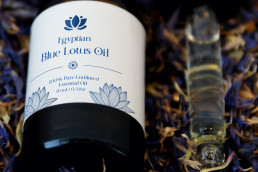
Lucid dreaming, the practice of becoming aware that you are dreaming while you are dreaming, has crossed over in the last decade from a niche pursuit into something close to mainstream interest. With that crossover has come a steady stream of questions about blue lotus oil, and whether the flower the Egyptians associated with Nefertem and prophetic sleep genuinely helps modern practitioners reach lucidity. The short answer is yes, with conditions. This article walks through what those conditions are, and how to build a practice that actually produces results.
Table of Contents
- What Lucid Dreaming Actually Is
- How Blue Lotus Oil Helps
- The Techniques That Actually Produce Lucid Dreams
- MILD (Mnemonic Induction of Lucid Dreams)
- WBTB (Wake Back To Bed)
- Reality Checks
- The Combined Protocol
- What to Expect
- Troubleshooting
- Safety
- Frequently Asked Questions
- Where to Go From Here
- Begin Your Dream Practice
It is written and clinically reviewed by Antonio Breshears, ND, CCA, a Bastyr-trained naturopathic doctor and certified clinical aromatherapist. The material that follows assumes a working familiarity with the broader oil, which our pillar on blue lotus oil for sleep and dreams provides in full.
What Lucid Dreaming Actually Is
Lucid dreaming is a specific altered state in which two things happen at once. You are in a dream, with its full sensory immersion and narrative flow, and at the same time you know that you are in a dream. The degree of lucidity varies. Some lucid dreams are brief flickers of recognition that fade within seconds. Others allow sustained conscious presence, vivid sensory detail, and deliberate interaction with the dream environment. Both are considered genuine lucidity by the research community.
The practice has a legitimate scientific literature, beginning most notably with Stephen LaBerge’s work at Stanford in the 1980s, where eye-movement signals confirmed from within a lucid dream that the dreamer was both asleep and aware. It is now studied by sleep researchers as a window into the relationship between consciousness and dream formation, and it is cultivated by tens of thousands of practitioners worldwide as a contemplative, creative, and therapeutic practice.
How Blue Lotus Oil Helps
Blue lotus is what the research and herbalist communities call an oneirogen, a substance that enhances dreams. Oneirogens do not generate dreams from nothing. They intensify the dreams you would otherwise have, making them more vivid, more emotionally textured, and more likely to be remembered on waking. This distinction is important. Blue lotus by itself will not usually produce a lucid dream. Blue lotus combined with the standard induction techniques materially raises the likelihood of lucidity, sometimes substantially.
The oil’s oneirogenic action appears to come from two sources. The alkaloid fraction, particularly aporphine and nuciferine, acts gently on dopaminergic systems that are known to be involved in REM sleep and dream content intensity. The olfactory-limbic conditioning effect, described in detail in our pillar on blue lotus oil chemistry and therapeutic properties, contributes a second, subtler mechanism: consistent use of a specific aromatic cue at bedtime creates a pre-sleep state in which the mind is primed, almost ritually, for dream work. Expectation, in the literature on dream content, is itself a significant driver of what appears in the dream.
The Techniques That Actually Produce Lucid Dreams
Three induction techniques form the core of modern lucid dreaming practice. Blue lotus supports each of them rather than replacing any of them.
MILD (Mnemonic Induction of Lucid Dreams)
MILD is LaBerge’s signature technique and the one with the strongest evidence base. The protocol: as you are falling back to sleep after a brief waking in the night, repeat to yourself the intention “next time I am dreaming, I will remember that I am dreaming”, while visualising a recent dream and imagining yourself noticing, within that dream, that it was a dream. Continue the repetition and visualisation as you drift back into sleep. The technique builds a prospective memory, a future intention that the mind carries into the subsequent REM period.
WBTB (Wake Back To Bed)
WBTB is a timing technique rather than a mental one. You set an alarm to wake you five to six hours after falling asleep, spend fifteen to twenty minutes awake in low light, then return to bed and sleep again. The period of wakefulness allows the cortex to come up sufficiently that subsequent REM sleep occurs with greater cortical activity than usual, making lucidity more accessible. Pair WBTB with MILD during the wake period, and you have the single most effective combination in the lucid dreaming literature.
Reality Checks
Reality checks are the daytime half of the practice. You cultivate the habit of questioning, several times a day, whether you are currently dreaming. Classic tests include attempting to push a finger through the opposite palm, looking at a clock or a block of text twice (in dreams, the numbers or letters typically change between glances), and pinching your nose while trying to breathe (in dreams, air often still flows through a pinched nose). The point is not to perform the check mechanically but to actually ask the question seriously each time: is this a dream? The habit carries into dreams, where performing the check produces the impossible result and triggers lucidity.
The Combined Protocol
The protocol that most reliably produces lucid dreams combines the three techniques with consistent blue lotus use.
Evening. Begin the aromatic cue thirty to forty minutes before sleep. Two to three drops of blue lotus in an ultrasonic diffuser is the starting point. For dream work specifically, a blue lotus pillow spray applied ten minutes before sleep is often more effective than a diffuser, because the scent remains close through the night. Our pillow spray recipe sets out the formulation.
Overnight. After five to six hours of sleep, wake deliberately using a quiet alarm. Spend fifteen to twenty minutes awake, in low light, reading or writing about lucid dreaming to seed the intention in a wakeful mind. Take a single inhalation of blue lotus from a tissue with a drop of diluted oil. Return to bed and run the MILD protocol as you fall back asleep, holding the intention “next time I am dreaming, I will remember that I am dreaming” in a calm, confident mental voice.
Daytime. Reality checks, three to five times a day, performed sincerely rather than mechanically. The frequency and seriousness of the daytime practice determines how readily the habit carries into the dream state.
This combined protocol typically produces a first lucid dream within two to six weeks for most practitioners. Some have their first within a night or two. Others take longer. Persistence matters more than talent.
What to Expect
The first few lucid dreams tend to be brief and fragile. The commonest failure mode is the “oh, I’m dreaming” realisation followed immediately by excitement that wakes you. This is normal and improves quickly with practice. Keeping the lucidity stable requires a calm internal posture. Many practitioners develop a grounding technique, such as rubbing the dream hands together vigorously, spinning the dream body, or focusing on a single object in the dream, to anchor the state when lucidity becomes unstable.
Dream vividness typically improves before lucidity does. If you are using blue lotus and your dreams are becoming dramatically more memorable and emotionally detailed, but you have not yet achieved lucidity, the oneirogenic effect is registering correctly. Lucidity usually follows within another week or two of continued practice. If it is still absent at the six-week mark, the issue is almost always either dream recall or the sincerity of the reality-check habit. Our companion article on blue lotus oil for dream recall addresses the first.
Troubleshooting
Four common difficulties and their remedies.
- Waking from excitement. The moment of lucidity often triggers an adrenaline response that wakes the dreamer. The remedy is to practise the grounding technique (hand-rubbing, spinning) immediately on achieving lucidity, before attempting anything else. With practice, the initial excitement settles into a quieter recognition.
- Sleep paralysis. Some WBTB and WILD practitioners experience sleep paralysis, a brief period in which the body has not yet re-mobilised after REM. This is normal, harmless, and usually resolves within a minute if you simply relax into it. It is not a reason to abandon the practice, but it can be unsettling if unexpected.
- False awakenings. You dream that you have woken up, and proceed with your morning as if awake, only to later wake for real. The remedy is simple: perform a reality check every time you wake, even when certain you are awake. In time, the habit catches the false awakening and converts it into lucidity.
- Disrupted sleep from WBTB. WBTB fragments sleep by design, and running it every night is counterproductive. Limit it to two or three nights per week, leaving other nights for consolidated sleep. Blue lotus nightly use continues through both types of night.
Safety
The practice is, on the whole, safe. A few cautions are worth repeating. WBTB should not be run every night, for reasons given above. Sleep paralysis is harmless but should be expected. Lucid dreaming is not recommended as a practice for people in an active psychiatric episode, or for those with narcolepsy or severe sleep-disordered breathing without clinician input. Dream content can be intense, and having a stabilisation strategy ready (the grounding techniques described above) matters.
On the oil itself, blue lotus is avoided in pregnancy and breastfeeding, and discussed with a prescriber before use alongside dopaminergic medications. The full safety review is in our dedicated article on blue lotus oil safety, side effects and precautions.
Frequently Asked Questions
Does blue lotus oil cause lucid dreams on its own?
Usually no. Blue lotus is an oneirogen; it intensifies dreams, makes them more vivid, and improves recall. Lucidity is a skill that develops through deliberate technique, with blue lotus as a significant supporting input rather than the cause.
How long does it take to have a lucid dream with blue lotus oil?
Most practitioners using the combined protocol (blue lotus, WBTB, MILD, daytime reality checks) achieve a first lucid dream within two to six weeks. A minority have one in the first few nights. A minority take longer. Dream vividness typically improves before lucidity does.
What is the best technique to combine with blue lotus for lucid dreaming?
WBTB paired with MILD is the most evidence-backed combination. Reality checks maintained during the day are the essential third component. Blue lotus supports all three by raising dream vividness and establishing the olfactory conditioning cue.
Can blue lotus oil cause sleep paralysis?
Blue lotus does not cause sleep paralysis directly. Sleep paralysis can occur around REM sleep, particularly with WBTB and similar induction techniques, regardless of whether an oil is used. It is harmless but can be unsettling if unexpected.
Is it safe to do WBTB every night with blue lotus?
No. WBTB fragments sleep by design and is best limited to two or three nights per week. Running it nightly leads to accumulated sleep debt and, paradoxically, worsens dream recall and lucidity over time.
How many drops of blue lotus should I use for lucid dreaming?
Two to three drops in an ultrasonic diffuser, or two to three drops dispersed in a 30ml pillow spray bottle. A further single drop, diluted in a small amount of carrier oil on a tissue, provides the overnight inhalation cue during WBTB.
Does blue lotus work better than galantamine for lucid dreaming?
They work differently. Galantamine is an acetylcholinesterase inhibitor that raises acetylcholine during REM, and is used at specific doses by experienced lucid dreamers. Blue lotus is gentler, oneirogenic rather than strongly pharmacological, and suitable for nightly use in a way galantamine is not. Some practitioners combine them; most do not need to.
Can I take a break from blue lotus and still lucid dream?
Yes. The skill, once developed, persists. Blue lotus supports the development phase and the consolidation phase, and is useful for returning to practice after a break, but lucidity does not depend on continuous use once the daytime and nighttime habits are established.
Will my non-lucid dreams become unpleasant with blue lotus?
In most cases, no. Blue lotus tends to increase dream vividness and emotional texture, which some users initially find intense. The intensity usually settles within the first week or two as the nervous system adjusts. If dreams remain disturbing, reduce the dose and focus the oil on sleep onset rather than through-night use.
Is lucid dreaming safe for mental health?
For most people, yes, and many practitioners report psychological benefits. It is not advised as a practice during active psychiatric episodes, particularly those involving dissociation or psychosis, and it is worth discussing with a clinician if you have a relevant history.
Where to Go From Here
If dream recall is your current limiting factor, our article on blue lotus oil for dream recall is the next step. If sleep onset is the issue, our companion pieces on blue lotus oil for sleep and blue lotus oil for insomnia cover that ground. For the wider context on the oil, return to our complete guide to blue lotus oil, or watch a short film or two in the video library. Everything on this site is hosted at Pure Blue Lotus Oil.

Antonio Breshears
Antonio Breshears is a renowned expert in holistic medicine and beauty, with over 25 years of research experience dedicated to uncovering the secrets of nature's most powerful remedies. Holding a degree in Naturopathic Medicine, Antonio's passion for healing and well-being has driven him to explore the intricate connections between mind, body, and spirit.
Over the years, Antonio has become a respected authority in the field, helping countless individuals discover the transformative power of plant-based therapies, including essential oils, herbs, and natural supplements. He has authored numerous articles and publications, sharing his wealth of knowledge with a global audience seeking to improve their overall health and well-being.
Antonio's expertise extends to the realm of beauty, where he has developed innovative, all-natural skincare solutions that harness the potency of botanical ingredients. His formulations embody his deep understanding of the healing properties found in nature, providing holistic alternatives for those seeking a more balanced approach to self-care.
With his extensive background and dedication to the field, Antonio Breshears is a trusted voice and guiding light in the world of holistic medicine and beauty. Through his work at Pure Blue Lotus Oil, Antonio continues to inspire and educate, empowering others to unlock the true potential of nature's gifts for a healthier, more radiant life.