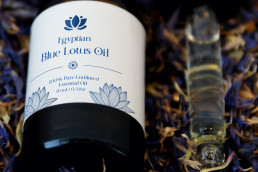
If you have arrived here wondering whether blue lotus oil for scars is worth adding to your routine, this is the honest answer you were hoping for. Blue lotus absolute is not a scar eraser, and anyone who tells you otherwise is selling a fantasy. What it can genuinely do, used properly and patiently, is support the slow process of tissue remodelling, soften the appearance of older scars, and reduce some of the inflammatory activity that keeps newer scars red and raised for longer than they should be. This article walks through the mechanism, the realistic protocol, the timeframes, and, importantly, the situations where you should choose a different tool or see a professional instead.
Table of Contents
- Understanding How Scars Actually Form
- How Blue Lotus Oil Helps With Scars
- Flavonoid-Driven Anti-Inflammatory Action
- Support for Microcirculation and Tissue Exchange
- Antioxidant Activity During Remodelling
- The Parasympathetic Piece
- How to Use Blue Lotus Oil for Scars
- The Base Formulation
- The Application Ritual
- Common Mistakes to Avoid
- What to Expect: Realistic Timeframes
- When Blue Lotus Oil Is NOT the Right Choice for Scars
- Complementary Approaches That Actually Matter
- Frequently Asked Questions
- Where to Go From Here
- Begin Your Scar Care Ritual
It is written and clinically reviewed by Antonio Breshears, ND, CCA, a Bastyr-trained naturopathic doctor and certified clinical aromatherapist. For the broader context on how this oil behaves, see The Complete Guide to Blue Lotus Oil, which covers the chemistry, extraction methods, and full safety profile referenced throughout this piece.
Understanding How Scars Actually Form
A scar is not damaged skin sitting on the surface; it is a patch of structurally different tissue your body laid down to close a wound as quickly as possible. When skin is broken, the repair cascade prioritises speed over elegance. Fibroblasts flood the area and produce collagen, but rather than the organised basket-weave pattern of healthy skin, they deposit collagen in parallel bundles. This is why scars look and feel different: they reflect light differently, they lack the usual elasticity, and they often lack melanocytes, hair follicles, and sweat glands.
Scars fall broadly into a few categories, and blue lotus oil behaves differently with each. Flat hyperpigmented or hypopigmented scars, the kind left by acne, mild burns, or superficial cuts, are the most responsive to topical oil work. Atrophic scars (those slight depressions left by cystic acne or chickenpox) respond modestly at best to any topical, because the issue is lost dermal volume rather than surface texture. Hypertrophic scars (raised, red, still within the original wound boundary) can improve with consistent massage and anti-inflammatory support. Keloids, the aggressive overgrowths that extend beyond the original wound, are a different beast entirely and require medical intervention; no essential oil will meaningfully address them.
The other point worth making is timing. A scar continues to remodel for roughly eighteen months to two years after the initial injury. This is the window in which you can meaningfully influence its final appearance. After that window closes, the tissue is essentially set, and any improvement becomes harder to achieve without clinical procedures. This does not mean older scars are hopeless with topical work, but your expectations should be calibrated accordingly.
How Blue Lotus Oil Helps With Scars
Blue lotus oil is not a dedicated cicatrisant like rosehip or tamanu, but its chemistry does offer several genuinely useful actions for scar tissue. The effect is cumulative and subtle rather than dramatic.
Flavonoid-Driven Anti-Inflammatory Action
Blue lotus absolute contains apigenin, quercetin, and kaempferol, flavonoids with well-documented anti-inflammatory activity. In the context of scars, particularly newer or still-reddened ones, this matters because prolonged low-grade inflammation is what keeps hypertrophic and post-inflammatory hyperpigmented scars looking angry for months longer than necessary. Calming that background inflammation allows the tissue to move through its remodelling phase more cleanly. This is the single most clinically relevant mechanism for scar work.
Support for Microcirculation and Tissue Exchange
Massaging any oil into scar tissue mechanically improves circulation to the area, and the carrier you choose, combined with the regular ritual of application, is often as important as the active compounds. Blue lotus has a mild vasoactive quality, and the practice of daily oil massage encourages fresh blood flow into previously underperfused scar tissue, which in turn brings in the cells and signals needed for continued remodelling.
Antioxidant Activity During Remodelling
The flavonoid fraction of blue lotus also provides antioxidant protection, which is relevant because oxidative stress during the late phases of wound healing contributes to abnormal pigmentation and stalled tissue repair. A scar exposed to sun, pollution, or inflammatory skincare will remodel more poorly than one that is kept calm and protected. Blue lotus contributes to that protective environment, though it is not a substitute for sunscreen, which is non-negotiable for anyone serious about scar improvement.
The Parasympathetic Piece
This one surprises people, but it matters. Chronic stress elevates cortisol, and elevated cortisol measurably impairs wound healing and collagen remodelling. Blue lotus oil’s well-documented parasympathetic, calming effect via its olfactory-limbic action is not directly a scar treatment, but if using it daily helps reduce your baseline stress load, you are creating a more favourable systemic environment for your skin to do its repair work. This is a genuine if indirect benefit.
How to Use Blue Lotus Oil for Scars
The protocol here is boring on purpose. Scar work rewards consistency, not intensity, and the goal is to create a daily five-minute ritual you will actually keep up for months.
The Base Formulation
For scar work, dilute blue lotus absolute at 2 to 3 percent in a carrier oil. For a 30 ml bottle, that is roughly 18 to 27 drops of blue lotus. The choice of carrier matters as much as the active. For scars specifically, the strongest carriers are:
- Rosehip seed oil: the most evidence-supported topical for scars, rich in trans-retinoic acid precursors and essential fatty acids
- Tamanu oil: traditional cicatrisant, slightly heavy and green-scented, excellent for older or stubborn scars
- Sea buckthorn oil: deep orange, use sparingly (5 to 10 percent of your blend), remarkable for pigmentation
- Jojoba: neutral, stable, a good base for sensitive skin or facial scar work
A balanced blend for scar work might be 70 percent rosehip, 20 percent jojoba, 10 percent sea buckthorn, with blue lotus added at 2 to 3 percent of the total volume. This gives you the primary scar-active carrier, a stable base, a pigmentation support, and the anti-inflammatory and antioxidant contribution of the blue lotus.
The Application Ritual
Apply the blend twice daily to clean skin. Deposit three to five drops on your fingertips and massage into the scar and the surrounding skin in small circular motions for two to three full minutes. The massage itself is not optional; it is doing meaningful work on the tissue by breaking up disorganised collagen bundles and improving local circulation. Continue this for a minimum of eight to twelve weeks before assessing results, and ideally six months for older scars.
For acne scars across a wider facial area, the same blend works as a post-cleanse facial oil used at night, applied across the full face rather than spot-treating. This approach prevents you from chasing individual marks and instead treats the underlying skin environment.
Common Mistakes to Avoid
The first mistake is impatience: giving up at week three because nothing visible has changed. Collagen remodelling does not move on that timescale. The second is applying the oil to unhealed wounds; blue lotus is for mature scars, not open or recently scabbed tissue, where it can irritate and prolong healing. The third is neglecting sun protection. UV exposure on a scar in its remodelling phase will lock in hyperpigmentation that would otherwise fade. If you are doing scar work, you must be wearing SPF 30 or higher on the area daily.
What to Expect: Realistic Timeframes
This is where honesty serves you better than marketing. Topical scar work is measured in months, not weeks. For fresh post-inflammatory marks (the red or brown spots left after an acne lesion has healed), you can reasonably expect meaningful fading over eight to twelve weeks of consistent twice-daily application. These are the most responsive because the pigmentation is superficial and the tissue is still actively remodelling.
For hypertrophic scars under a year old, expect to see reduced redness and some flattening over three to six months of daily massage with the blend. The scar will not disappear, but it can become significantly less noticeable. For older flat scars (one to five years), improvements are more modest, perhaps 15 to 25 percent visual improvement over six months, and primarily in terms of texture and colour blending rather than the scar vanishing.
For atrophic scars, keloids, and scars older than five years, topical work including blue lotus oil will not produce clinically meaningful improvement. These need professional intervention: microneedling, laser resurfacing, subcision, steroid injection, or surgical revision depending on the scar type.
When Blue Lotus Oil Is NOT the Right Choice for Scars
There are situations where you should put the bottle down and either choose something else or see a professional.
Open or unhealed wounds. Blue lotus is for mature scars, meaning fully re-epithelialised tissue. If your wound is still weeping, scabbing, or younger than three weeks, leave it alone and allow normal healing first. Applying oils too early can macerate the tissue and delay proper closure.
Keloid scars. These require medical management with intralesional corticosteroids, pressure therapy, silicone sheeting, or surgical revision. No essential oil will address the fibroblast overactivity driving keloid formation.
Pregnancy and breastfeeding. Blue lotus oil is avoided in pregnancy and breastfeeding due to insufficient safety data. If you are trying to fade stretch marks or a caesarean scar during this period, choose a safer option such as plain rosehip or sweet almond oil and revisit blue lotus later.
Known sensitivity to florals or Nymphaea species. Rare but possible. Always patch test a small amount of the diluted blend on the inner forearm for 48 hours before applying to the face or a prominent scar.
Active skin conditions in the scar area. If the scarred area is currently showing active eczema, psoriasis, or infection, treat the underlying condition first.
Complementary Approaches That Actually Matter
Scar improvement is a stack of small inputs, and blue lotus oil is one component in that stack rather than the whole strategy. The highest-yield additions to a scar protocol are:
Daily sun protection. Mentioned already but worth repeating because it is the single most important variable. An SPF 30 broad-spectrum sunscreen on scarred skin, daily, prevents the hyperpigmentation lock-in that makes scars look worse than they need to.
Silicone sheeting or gel. For raised or hypertrophic scars, silicone is the most evidence-supported non-invasive treatment available. It works by occluding the scar and modulating fibroblast activity. You can use silicone gel during the day and your blue lotus blend at night, and they complement rather than compete.
Professional microneedling. For atrophic acne scars specifically, a series of three to six professional microneedling sessions can produce the kind of textural improvement that no topical alone will achieve. Your blue lotus blend then supports the healing between sessions.
Nutritional adequacy. Zinc, vitamin C, and adequate protein intake are genuinely required for collagen remodelling. A deficient body cannot rebuild skin well regardless of what you put on top.
Stress management. Elevated cortisol slows healing. If your daily blue lotus application doubles as a mindful, calming ritual, you are hitting two targets with one action.
Frequently Asked Questions
Does blue lotus oil remove scars completely?
No. No topical oil will remove a scar completely. Blue lotus oil, used consistently in a proper carrier blend, can reduce redness, soften texture, and improve the appearance of scars over several months, but the scar tissue itself remains.
How long does it take to see results?
For fresh post-inflammatory marks, expect visible fading over eight to twelve weeks. For hypertrophic or older scars, plan on three to six months of daily twice-a-day application before meaningfully judging results.
Can I apply blue lotus oil directly on a scar without a carrier?
No. Blue lotus absolute is far too concentrated and expensive to apply neat, and doing so risks sensitisation. Always dilute to 2 to 3 percent in a carrier such as rosehip or jojoba oil.
What carrier oil works best with blue lotus for scars?
Rosehip seed oil is the single best carrier for scar work because of its own evidence base. A blend of rosehip, jojoba, and a small percentage of sea buckthorn with blue lotus added at 2 to 3 percent is a strong default formulation.
Can I use blue lotus oil on acne scars?
Yes, it works well for post-inflammatory hyperpigmentation and flat acne marks. For atrophic ice-pick or boxcar scars, topical work alone will produce only limited results and you may want to consider microneedling for meaningful textural improvement.
Can I use it on stretch marks?
It can help, particularly with the redness phase of newer stretch marks, but stretch marks are essentially scars from internal tearing of the dermis and respond only modestly to any topical. Not recommended during pregnancy or breastfeeding.
Is it safe to use on facial scars?
Yes, at 1 to 2 percent dilution for facial use, which is slightly lower than the 2 to 3 percent used on body scars. Always patch test first.
Can blue lotus oil help old surgical scars?
Surgical scars older than two years are essentially set, and improvements from any topical will be modest. However, daily massage with a blue lotus blend can still soften texture and improve colour blending over several months.
Does it help with keloids?
No. Keloids require medical management. Do not rely on essential oils for keloid treatment.
Can I combine blue lotus oil with retinol or vitamin C serums?
Yes, by layering rather than mixing. Apply water-based actives like vitamin C first, allow them to absorb, then apply your blue lotus oil blend on top. For retinol, alternate nights rather than layering in the same session to avoid sensitisation.
Where to Go From Here
If scar work is your primary reason for buying blue lotus oil, be realistic: it is a genuinely useful adjunct, not a primary treatment. Build it into a proper routine that includes a serious carrier such as rosehip, daily sun protection, and, where warranted, professional treatment for the scars topicals cannot reach. For the broader picture on how this oil behaves across skincare applications, how to judge quality, and how to store it so the flavonoid fraction remains active, The Complete Guide to Blue Lotus Oil is the reference document. Used with patience and in combination with the right carriers and habits, blue lotus oil earns its place in a scar protocol. Used with inflated expectations, it disappoints. Calibrate accordingly.

Antonio Breshears
Antonio Breshears is a renowned expert in holistic medicine and beauty, with over 25 years of research experience dedicated to uncovering the secrets of nature's most powerful remedies. Holding a degree in Naturopathic Medicine, Antonio's passion for healing and well-being has driven him to explore the intricate connections between mind, body, and spirit.
Over the years, Antonio has become a respected authority in the field, helping countless individuals discover the transformative power of plant-based therapies, including essential oils, herbs, and natural supplements. He has authored numerous articles and publications, sharing his wealth of knowledge with a global audience seeking to improve their overall health and well-being.
Antonio's expertise extends to the realm of beauty, where he has developed innovative, all-natural skincare solutions that harness the potency of botanical ingredients. His formulations embody his deep understanding of the healing properties found in nature, providing holistic alternatives for those seeking a more balanced approach to self-care.
With his extensive background and dedication to the field, Antonio Breshears is a trusted voice and guiding light in the world of holistic medicine and beauty. Through his work at Pure Blue Lotus Oil, Antonio continues to inspire and educate, empowering others to unlock the true potential of nature's gifts for a healthier, more radiant life.