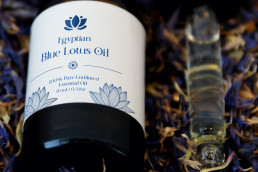
If you have been searching for blue lotus oil in San Francisco, you have probably already discovered that the Bay Area has no shortage of apothecaries, herbal shops, and botanical boutiques, yet very few of them actually carry genuine Nymphaea caerulea. This guide walks you through where to look, what to ask before you pay, and how to recognise the difference between a true Egyptian blue lotus absolute and the perfume-grade blends that fill most shelves.
Table of Contents
- What You Are Actually Looking For
- Where to Look for Blue Lotus Oil in San Francisco
- Herbal Apothecaries in the Mission and Bernal Heights
- Metaphysical and Ritual Supply Shops
- Ayurvedic and Traditional Medicine Retailers
- High-End Perfumery Boutiques in Hayes Valley and Pacific Heights
- Farmers' Markets and Herb Festivals
- What to Ask Before You Buy
- How to Spot the Difference Between Real and Fake
- Buying Blue Lotus Oil Online Versus in San Francisco Shops
- Realistic Expectations for San Francisco Buyers
- Using Blue Lotus Oil Once You Have Found It
- When Blue Lotus Oil Is Not the Right Choice
- Complementary Approaches for San Francisco Readers
- Frequently Asked Questions
- Where to Go From Here
- Pure Blue Lotus, Shipped to San Francisco
It is written and clinically reviewed by Antonio Breshears, ND, CCA, a Bastyr-trained naturopathic doctor and certified clinical aromatherapist. For wider context on the oil itself, its chemistry, and safe use, readers may want to start with the complete guide to blue lotus oil before deciding where to source it locally.
What You Are Actually Looking For
Before you set foot in a single Mission District apothecary or Hayes Valley boutique, it helps to be precise about what you want. “Blue lotus oil” is a loose commercial label that is applied to at least three very different products.
The first is a true blue lotus absolute: a solvent-extracted concentrate of Nymphaea caerulea flowers, typically amber to dark gold, viscous, with a deep honeyed-floral heart and a faintly smoky base. This is what most serious practitioners mean when they refer to blue lotus oil. It takes roughly three to five thousand flowers to produce a single gram, which is why it is expensive and why it almost never appears in large bottles at low prices.
The second is a supercritical CO2 extract, which is rarer, arguably cleaner chemically, and slightly lighter in scent. Very few Bay Area retailers stock this.
The third, and unfortunately the most common category on San Francisco shop shelves, is a blue lotus perfume blend: a small amount of absolute (sometimes none at all) dispersed in jojoba or fractionated coconut oil, often scented with synthetic floral accords. These are not useless as fragrance products, but they are not what you want if you are interested in the alkaloid and flavonoid profile that gives genuine blue lotus its calming, parasympathetic effect.
Knowing which of these three you are buying is the single most important piece of preparation before you visit any San Francisco shop.
Where to Look for Blue Lotus Oil in San Francisco
The city has a reasonably strong botanical and apothecary scene, concentrated in a few neighbourhoods. None of these are endorsements, they are simply the categories of retailer most likely to carry something close to the real thing.
Herbal Apothecaries in the Mission and Bernal Heights
The Mission District and its southern neighbours host several small apothecaries that specialise in tinctures, flower essences, and essential oils for ritual or therapeutic use. Staff tend to be reasonably well informed about sourcing, and some of them will carry a true blue lotus absolute, usually in 1 ml or 2 ml vials at a noticeably higher price point than their other florals. If a shop sells a 15 ml “blue lotus oil” for under thirty dollars, it is almost certainly a dilution.
Metaphysical and Ritual Supply Shops
Shops in the Haight, the Castro fringe, and parts of North Beach that cater to ceremonial and ritual use often stock blue lotus in some form, sometimes as dried flowers for tea or resin, sometimes as a scented oil. The scented oils here are rarely suitable for aromatherapy; they are designed for anointing candles and altars, and they frequently contain synthetic fragrance. Ask directly whether the oil is a true absolute and request to see the label and supplier.
Ayurvedic and Traditional Medicine Retailers
Several Ayurvedic clinics and specialty retailers in the Sunset and Richmond districts carry imported florals. Blue lotus is not a traditional Ayurvedic ingredient in the strict sense (the Indian lotus is Nelumbo nucifera, a different plant), but some of these shops do import Egyptian blue lotus as part of a broader aromatherapy range. Quality is variable; the better ones will happily show you a GC-MS report or at least a country-of-origin statement.
High-End Perfumery Boutiques in Hayes Valley and Pacific Heights
Niche perfumery boutiques occasionally carry single-note florals, including blue lotus. The absolute they sell is usually genuine, because perfumers genuinely need the real material to build accords, but it is almost always sold at perfumery prices and in very small quantities. This is a sensible option if you want a reference sample, less sensible if you want enough oil for a regular ritual or diffuser practice.
Farmers’ Markets and Herb Festivals
The Ferry Building market and various seasonal herb festivals sometimes host small-batch botanical vendors. Some are excellent, some are hobbyists selling relabeled bulk oils. Ask where the flowers were grown, who did the extraction, and whether they can provide any analytical documentation.
What to Ask Before You Buy
This is where most San Francisco buyers are let down, not because the shops are dishonest, but because the questions asked are too general. “Is this real blue lotus oil?” is almost always answered with “yes”, because the label technically says so. A more useful sequence of questions is:
- Is this a true absolute, a CO2 extract, or a pre-diluted blend? If it is a blend, what is the percentage of actual absolute, and what is the carrier?
- What is the country of origin of the flowers? Genuine Nymphaea caerulea is cultivated predominantly in Egypt, with smaller production in Sri Lanka and Thailand.
- Can you show me a GC-MS or COA? Reputable suppliers do not mind this question. Evasive answers are themselves an answer.
- What is the batch or lot number, and how recent is it? Absolute should ideally be used within three to four years of extraction if stored properly in dark glass.
- What colour and viscosity is the oil? A thin, clear, pale blue oil is not blue lotus absolute. The absolute is amber to dark gold and thick.
If you ask these five questions in any San Francisco shop, you will quickly separate the serious vendors from the ones who are reselling unlabelled drums of generic floral oil.
How to Spot the Difference Between Real and Fake
The sensory test is imperfect but useful. Genuine blue lotus absolute, warmed briefly between the fingers, opens with a cool, slightly aquatic floral top, settles into a rich honeyed-floral heart that is surprisingly dense, and finishes with a faintly balsamic, almost smoky base that can linger for hours. A synthetic blue lotus fragrance tends to stay bright and sweet, with no real evolution and no smoky depth.
Price is another signal, and in San Francisco it is a fairly reliable one. A 2 ml vial of genuine absolute typically costs between forty and ninety dollars depending on supplier and year. Anything significantly cheaper at that volume, without an explicit “pre-diluted in jojoba” label, is almost certainly adulterated or synthetic.
Colour is the fastest visual check. If you are sold a bottle labelled “blue lotus oil” that is actually blue, walk away. The name refers to the flower, not the oil. Real absolute is not blue.
Buying Blue Lotus Oil Online Versus in San Francisco Shops
There is a genuine trade-off here, and it is worth naming honestly. Buying in person lets you smell the oil before you commit, which is valuable for a product that varies so widely in quality. It also lets you speak directly to someone who, at a good apothecary, may genuinely know the supplier chain.
The disadvantage of buying locally in San Francisco is price and selection. Shops pay rent in one of the most expensive retail markets in the world, and they stock what moves quickly. A specialist online retailer that focuses on a single well-sourced batch of Egyptian blue lotus absolute can usually offer better price per millilitre, clearer provenance, and consistent supply.
For readers who want to understand what they are comparing across sources, the wider chemistry, sourcing, and safety material in the complete guide to blue lotus oil is a useful reference point before making a decision either way.
Realistic Expectations for San Francisco Buyers
If you walk into a random holistic shop in San Francisco expecting a reliable, well-labelled, analytically verified blue lotus absolute, you will usually be disappointed. If you walk in prepared, with the five questions above in mind, willing to leave empty-handed, and willing to pay a fair price for a small vial, you will do well. The city rewards informed buyers; it punishes casual ones.
Expect to spend between forty and one hundred dollars for a small vial of genuine absolute, or fifteen to forty dollars for a pre-diluted blend suitable for anointing and light topical use. Expect to visit two or three shops before finding one whose answers satisfy you. Expect a small learning curve on smell; your nose improves quickly once you have scented a reference sample of the real thing.
Using Blue Lotus Oil Once You Have Found It
Whether you buy locally or online, the basic use patterns are the same. A true absolute is potent and should be diluted for skin contact: roughly 1 to 2 percent for facial application, 2 to 3 percent for body, and 3 percent for targeted ritual or meditation use on pulse points. Jojoba is the preferred carrier because it is chemically stable and skin-friendly; fractionated coconut is a reasonable second choice.
For diffusion, two to four drops of absolute in a standard ultrasonic diffuser is sufficient. More is not better; the scent is deep and quickly saturates a room.
Blue lotus is not a strong sedative. It is reasonably well-attested as a gentle parasympathetic nudge, helpful for evening wind-down, meditation, and moments when the nervous system needs a quiet signal rather than a loud one. Expect a soft settling, not a pharmaceutical effect.
When Blue Lotus Oil Is Not the Right Choice
There are a few clear situations where even a genuine, beautifully sourced bottle is not appropriate. Pregnancy and breastfeeding are both on the avoidance list, given the alkaloid content and the absence of adequate safety data. People taking dopaminergic medications, MAOIs, or significant sedatives should speak to a prescribing clinician before using the oil regularly, because the aporphine and nuciferine content has theoretical interactions at those receptor systems.
Anyone looking for a clinical treatment for diagnosed insomnia, anxiety disorder, or depression should treat blue lotus as an adjunct at best, not a replacement for appropriate care. It is a genuinely useful tool within realistic expectations; it is not medication.
Complementary Approaches for San Francisco Readers
The Bay Area has a strong contemplative, yoga, and integrative medicine scene, and blue lotus oil pairs naturally with several of them. Evening breathwork, restorative yoga, and short meditation sessions all benefit from a gentle olfactory anchor, and blue lotus is one of the more effective options for that purpose because its scent profile is complex enough to hold attention without becoming intrusive.
Readers already working with acupuncturists, naturopaths, or functional-medicine clinicians in the city may find that introducing a single well-sourced aromatic into a broader protocol is more useful than chasing the oil as a standalone remedy. Context matters; the oil works best as part of a practice, not in isolation.
Frequently Asked Questions
Is blue lotus oil legal in San Francisco?
Yes. Blue lotus is legal to buy, sell, and possess throughout California, including San Francisco. The only notable US jurisdiction that restricts it is the state of Louisiana. Some international jurisdictions (Russia, Poland, Latvia) do regulate it, but no such restrictions apply in California.
What should I pay for genuine blue lotus absolute in San Francisco?
Expect forty to ninety dollars for a 2 ml vial of genuine absolute, and fifteen to forty dollars for a reasonable pre-diluted blend. Anything significantly cheaper at the same volume, without an explicit dilution disclosure, should be treated with suspicion.
Is the oil actually blue?
No. Genuine blue lotus absolute is amber to dark gold, sometimes with a slight greenish cast. “Blue lotus” refers to the flower, not the oil. Any product labelled blue lotus that is visibly blue is either dyed, synthetic, or both.
Can I find blue lotus oil at Whole Foods or similar chains in San Francisco?
Occasionally, but usually only as a pre-diluted blend rather than a true absolute. Chain retailers rarely stock the genuine material because it is expensive, slow-moving, and requires knowledgeable staff to sell well.
Is a CO2 extract better than an absolute?
Better in some respects, different in others. CO2 extracts avoid solvent residues and tend to preserve a slightly lighter scent profile. Absolutes are more widely available and have a longer track record in aromatherapy. Both can be excellent; neither is automatically superior.
How do I know the shop is not just selling me fragrance oil?
Ask to see the supplier name, country of origin, and ideally a GC-MS or certificate of analysis. Smell the oil; real absolute evolves over several hours with honey, floral, and balsamic notes. Check the colour; it should be amber to dark gold, not blue or water-clear.
Is it safe to apply undiluted to the skin?
No. Absolutes are concentrated and should be diluted to 1 to 3 percent in a carrier such as jojoba before skin contact. Neat application can cause irritation and is unnecessary for effect.
Will blue lotus oil help me sleep?
It can support the transition to sleep in a modest, parasympathetic way, especially as part of an evening ritual with dim light and breathwork. It is not a strong sedative and should not be treated as a substitute for clinical care if insomnia is persistent.
Can I buy blue lotus oil at farmers’ markets in San Francisco?
Sometimes. Quality varies significantly. Ask the five questions listed earlier in this article, particularly about country of origin, extraction method, and any available analytical documentation.
How long does a bottle last?
Properly stored in dark glass, in a cool and dark location, a blue lotus absolute typically retains its scent and therapeutic character for three to four years. Heat, light, and repeated air exposure shorten that window considerably.
Where to Go From Here
If you are prepared to shop carefully, San Francisco does have a handful of apothecaries and perfumery boutiques that stock genuine blue lotus absolute, and the experience of smelling the oil in person before buying is genuinely worthwhile. If you prefer the consistency, price, and provenance of a dedicated online supplier, that route is equally defensible, and for many readers more practical. Either way, the foundational material in the complete guide to blue lotus oil will help you judge what you have once it is in your hands.

Antonio Breshears
Antonio Breshears is a renowned expert in holistic medicine and beauty, with over 25 years of research experience dedicated to uncovering the secrets of nature's most powerful remedies. Holding a degree in Naturopathic Medicine, Antonio's passion for healing and well-being has driven him to explore the intricate connections between mind, body, and spirit.
Over the years, Antonio has become a respected authority in the field, helping countless individuals discover the transformative power of plant-based therapies, including essential oils, herbs, and natural supplements. He has authored numerous articles and publications, sharing his wealth of knowledge with a global audience seeking to improve their overall health and well-being.
Antonio's expertise extends to the realm of beauty, where he has developed innovative, all-natural skincare solutions that harness the potency of botanical ingredients. His formulations embody his deep understanding of the healing properties found in nature, providing holistic alternatives for those seeking a more balanced approach to self-care.
With his extensive background and dedication to the field, Antonio Breshears is a trusted voice and guiding light in the world of holistic medicine and beauty. Through his work at Pure Blue Lotus Oil, Antonio continues to inspire and educate, empowering others to unlock the true potential of nature's gifts for a healthier, more radiant life.