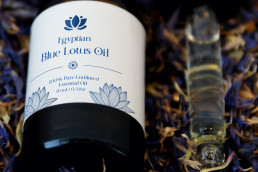
Blue lotus oil occupies an unusual place in the world of gifts and seasonal rituals. It is old enough to have been pressed into Egyptian tombs, rare enough that a single gram requires thousands of flowers, and quiet enough in its effects that it rewards ceremony rather than spectacle. That combination makes it a thoughtful gift and a genuinely useful ingredient in the seasonal rhythms of a life, the turn of the year, the long nights of winter, the opening of spring, the slower evenings of late summer. This pillar is a guide to both sides of that: how to give blue lotus oil well, and how to weave it into the moments that deserve a little more attention than the rest.
Table of Contents
- Why Blue Lotus Oil Works as a Gift
- How to Think About Gifting This Oil
- Seasonal Rituals: Why Season Matters
- Winter Rituals: The Long Dark
- Spring Rituals: Return and Renewal
- Summer Rituals: The Floral Top
- Autumn Rituals: The Turn Inward
- Specific Occasions: What Works When
- Birthdays
- Anniversaries
- Housewarmings
- Weddings and Milestones
- Grief and Recovery
- Self-Gifting
- Building a Seasonal Ritual: The Practical Framework
- Matching the Gift to the Recipient
- How to Actually Use It
- Realistic Timeframes
- What Blue Lotus Oil Does Not Do
- Safety for Gifting and Rituals
- Frequently Asked Questions
- Where to Go From Here
- A Gift Worth Giving, a Ritual Worth Keeping
It is written and clinically reviewed by Antonio Breshears, ND, CCA, a Bastyr-trained naturopathic doctor and certified clinical aromatherapist. For readers new to the material itself, the complete guide to blue lotus oil is the best place to begin; this pillar assumes you already know what the oil is and want to know how to give it, receive it, and use it meaningfully through the year.
Why Blue Lotus Oil Works as a Gift
Most gifts either say something about the giver or solve a problem for the recipient. A good gift does a third thing: it opens a small door into an experience the recipient would not have stumbled into on their own. Blue lotus oil does this well because very few people buy it for themselves, not because it lacks appeal, but because it sits outside the usual routes. It is not on supermarket shelves. It is not featured in mainstream wellness marketing. It is rare, expensive per gram, and quietly historical, the sort of thing a person might have heard of once in a museum caption and then forgotten.
When you give it, you are giving both the oil and the context. That context is what makes the gift feel considered rather than generic. A bottle of blue lotus absolute with a short note about what it is, where it comes from, and how to use it is a more personal gesture than a larger, flashier present, because it shows you thought about the person’s evenings, their skin, their stillness, their attention. That is a different kind of generosity.
The other reason it works is scent. Fragrance sits closer to memory than almost any other sensory input; the olfactory-limbic pathway bypasses much of the cognitive filtering the other senses go through. A scent given with intention becomes woven into the recipient’s memory of that period in their life. Ten years later, the smell of blue lotus may still return them to a specific winter, a specific season of grief, a specific room. Very few objects carry that kind of weight.
How to Think About Gifting This Oil
Blue lotus oil is not for everyone, and part of giving it well is recognising that. It suits people who already enjoy quiet rituals, who keep perfume rollers and candles, who take evenings seriously. It is less suited to people who dislike floral scents, who are allergy-prone to complex botanicals, or who are in a life phase (pregnancy, for example) where aromatic oils are better avoided. A gift that a person cannot use, however beautiful, becomes a small burden.
The most successful blue lotus gifts I have seen or given share a few characteristics. They are small rather than overwhelming; a 5 ml or 10 ml bottle is plenty for a first encounter. They come with a note that explains what the oil is and one or two simple ways to use it, because even confident users of essential oils often do not know what to do with a pure absolute. They are presented in a way that honours the rarity of the material, in dark glass, packaged well, not thrown into a tote bag with a dozen other items.
The occasions that suit it best tend to involve transition or reflection: birthdays that feel significant, anniversaries, housewarmings for a bedroom or meditation space, the start of a new chapter after an illness, a career change, a move. It is less well suited to thank-you gifts between acquaintances or to situations where the recipient will feel obligated to perform enthusiasm. The gift works best when the relationship is close enough that the recipient can honestly tell you whether they liked it.
Seasonal Rituals: Why Season Matters
Aromatherapy is often treated as a year-round practice with interchangeable oils, but scent actually has strong seasonal relationships. A heavy balsamic oil that feels grounding in December feels suffocating in July. A bright citrus that lifts a February morning feels thin against an August evening. Blue lotus oil is unusual in that it has a three-layered scent (cooler floral-aquatic top, honeyed-floral heart, balsamic-smoky base) that lets it shift register across seasons. In summer, the top notes lead; in winter, the base holds the room.
Seasonal ritual is not mystical. It is a practical acknowledgement that the body and mind respond differently in different light, different temperatures, different social rhythms. Using the same oil blend year-round ignores that. Building a small practice that changes with the season, perhaps one oil in rotation, perhaps three or four used in different months, aligns scent with actual experience and makes the oils themselves work harder. Blue lotus earns a place in nearly every seasonal rotation because it bridges warm and cool registers in a way few single oils do.
Winter Rituals: The Long Dark
Winter is when most people reach for blue lotus oil, and for good reason. The base notes (honeyed, slightly balsamic, with a faint smoky undertone) fit the season the way certain wines fit certain foods. In a diffuser through a long December evening, two or three drops with a base oil like frankincense or sandalwood creates the sort of atmosphere that slows conversation without killing it. It is a scent that suits candlelight and low voices.
The specific winter use I recommend most often is an evening ritual built around the transition between the active part of the day and sleep. A warm bath with a few drops of blue lotus properly diluted in a carrier, followed by a short sit with the lights low and the diffuser running, creates a consistent signal to the nervous system that the day is ending. Over a few weeks, the association builds. The oil becomes less of an active intervention and more of a cue. That is how ritual works: repetition turns the material into a signal, and the signal does the work.
Winter also suits blue lotus as a gift. The timing aligns with gift-giving seasons across most cultures, the scent suits the weather, and the context (long evenings spent indoors) gives the recipient time and space to actually use what they have been given. A small bottle wrapped well and given in early winter is likely to be used and remembered; the same bottle given in high summer may sit on a shelf for months before it gets opened.
Spring Rituals: Return and Renewal
Spring shifts the useful register of the oil. The honeyed-floral heart comes forward when the air is lighter, and the heavier base notes recede. This is the season to use blue lotus in lighter preparations: a single drop in a facial oil, a low-concentration body oil, a diffuser blend weighted toward citrus and green herbs with blue lotus as a quiet floral anchor rather than the main event.
Spring rituals tend to be about clearing rather than settling. Opening windows, washing linens, re-engaging with a practice that slipped over winter. Blue lotus works well here as a marker, a scent used deliberately when starting something new, so that the scent itself becomes associated with beginnings rather than endings. A few drops on a handkerchief tucked into a drawer of freshly washed clothes, or a dilute mist over a cleaned room, links the scent to renewal rather than to night-time slowing.
This is also a good time to revisit skincare. The skin often looks different in spring than it did in winter, and a facial oil that felt right in January may feel heavy by April. Reducing the blue lotus dilution from 2 percent to 1 percent in a lighter carrier, and using it less often, keeps the ritual intact without overloading skin that is now dealing with different weather and different light exposure.
Summer Rituals: The Floral Top
Summer brings out the aquatic, cooler top notes of blue lotus that are often masked in winter blends. This is the season for lighter applications: a personal perfume roller built on a light jojoba base, a pulse-point dab before sleep on humid evenings, a single drop on a cool cloth pressed to the back of the neck after a long day. In summer the oil reads as refreshing rather than heavy, which is the opposite of how it often functions in December.
Summer rituals should be shorter. The long, fire-lit evening practices of winter do not suit July; attention span is different, light lingers, and the body naturally wants less heat and less closure. A two-minute ritual, a mist, a pulse-point touch, a minute of slow breathing, fits the season better than a forty-minute bath. The oil still does its work; the container around it changes.
For gifting in summer, the usual occasions are weddings, graduations, and milestones rather than seasonal holidays. A blue lotus perfume roller as a wedding favour or a small bottle as a graduation gift often lands well, because the context (a new chapter) matches what the oil invites: a small ceremony around transition. Pair it with a brief handwritten note rather than elaborate packaging; summer gifts should feel light.
Autumn Rituals: The Turn Inward
Autumn is, to my mind, the season where blue lotus oil is at its most versatile. The weather is shifting, the light is changing, and the scent profile of the oil meets the air well: the base notes start to matter again without overwhelming, the heart still carries warmth, and the top notes have something to push against. This is the season to reintroduce blue lotus into the evening if it has been set aside over summer.
Autumn rituals often involve a return to journalling, reading, and practices that require sustained attention. A diffuser running low with blue lotus and a drop of cedarwood or vetiver, timed to the hour or two of the evening when focused inward work is easiest, creates a conducive atmosphere without being the point of it. The oil is a background; the work is the foreground.
It is also the season that suits significant gifting around thresholds: the end of a project, the recovery from a difficult summer, a move into a new home. The inward-turning quality of autumn gives the recipient mental space to actually engage with something new. A gift given in October is more likely to be used thoughtfully than one given in July, when everyone is outside and distracted.
Specific Occasions: What Works When
Birthdays
Blue lotus oil suits birthdays that carry weight, a decade turnover, a year marked by difficulty or transformation, a birthday following a meaningful event. It is less suited to light social birthdays where the gift is one of many and the recipient will not have time or attention for it. If you are giving it for a birthday, include a short note that treats the oil as part of a practice rather than a novelty; this frames the gift correctly.
Anniversaries
The associations of blue lotus (quiet, sensual, historical) make it well suited to anniversary gifts, particularly when paired with other elements, a small bottle alongside a silk pillowcase, or included in a box with other items meant for shared evenings. One caveat: if the recipient has never worked with essential oils, provide enough context that they understand how to use it without feeling intimidated.
Housewarmings
New homes benefit from scent-marking. A small bottle of blue lotus as a housewarming gift, accompanied by a simple diffuser or a handful of diffuser sticks, gives the recipient a way to build an olfactory identity for the new space from the start. This tends to be more useful than flowers or generic decor because it is functional.
Weddings and Milestones
For weddings, graduations, and similar milestones, smaller presentations (roller bottles, miniatures) work better than full-sized bottles. These occasions generate many gifts, and a small, thoughtful one is more memorable than a larger, more expected one. The oil also suits the ceremonial nature of these events: the idea that you are giving something small but precious, to mark something that matters.
Grief and Recovery
This is where blue lotus oil is most quietly useful and most often mishandled. A gift to someone recently bereaved or recovering from illness should not be labelled as a mood-lifter or a cure; it should be presented simply as something for quiet evenings, with no expectations attached. The oil is not a treatment for grief. It is a companion for the slow months that follow. Framed that way, it is often received with surprising gratitude.
Self-Gifting
There is nothing wrong with buying this oil for yourself at the turn of a year, at the end of a difficult period, or simply because you want to. Some of the most meaningful rituals begin as solo gestures. If you are buying it for yourself, I recommend treating the purchase with the same care you would a gift to another: a small ceremony around opening the bottle, a first use that is deliberate rather than distracted, a note or line written in a journal about what you want this chapter to look like.
Building a Seasonal Ritual: The Practical Framework
If you want to use blue lotus oil across seasons rather than as a single-season occurrence, the framework I recommend is simple: one consistent evening use, adjusted in carrier and intensity with the seasons. The consistency is what builds the ritual; the seasonal adjustment is what keeps it from becoming stale.
A workable structure looks like this. In winter, a diffuser blend with blue lotus, frankincense, and sandalwood, run for thirty to sixty minutes in the evening, paired with a bath or a short sit. In spring, a lighter diffuser blend (blue lotus, bergamot, a touch of cedarwood) for twenty to thirty minutes, perhaps during tea rather than during stillness. In summer, a roller bottle of blue lotus at 1.5 percent in jojoba, used on pulse points before sleep. In autumn, a return to the diffuser with blue lotus and vetiver for focused evening work. The quantities stay modest throughout; the oil is expensive per gram and does not need volume to do its work.
The point of a seasonal framework is not to create a rigid schedule. It is to give the practice enough structure that it survives busy periods and enough flexibility that it adapts to actual life. A ritual that requires forty minutes every evening will fail within a month. A ritual built around two or three drops in a diffuser, most evenings, most weeks, survives years.
Matching the Gift to the Recipient
Not every format suits every person. A few rough categories help with matching.
For people new to essential oils: a pre-made roller bottle (blue lotus at 1 to 2 percent in jojoba or fractionated coconut) is easier to use than a neat bottle of absolute. It removes the dilution step and gives the recipient something they can pick up and use immediately.
For experienced aromatherapy users: a small bottle of neat absolute is more useful, because they can blend it themselves and appreciate the raw material. Include a short origin note (country, extraction method, year if known) rather than usage instructions.
For people who enjoy ceremony: a presentation that includes the oil alongside a candle, a small dish, or a ceramic diffuser turns the gift into a complete invitation to a practice, rather than a single ingredient.
For the very practical: a blended product that uses blue lotus as one component, a facial oil, a pillow mist, a massage oil, is more likely to get used than a neat bottle that requires them to learn a new skill.
For the scent-sensitive or allergy-prone: consider whether the oil is the right gift at all. A small dilute sample (a single drop on a blotter card) lets them test it before you commit to a full bottle.
How to Actually Use It
Whether gifted or self-bought, the practical uses for blue lotus oil across seasons break down into a small number of reliable methods. Two to four drops in a diffuser with complementary oils, run for twenty to sixty minutes. A facial oil at 1 to 2 percent in jojoba, squalane, or a balanced blend, used sparingly. A body oil at 2 to 3 percent, reserved for deliberate occasions rather than daily use. A perfume roller at 1.5 to 3 percent for pulse-point application. A pillow mist at low concentration in distilled water with a solubiliser. Beyond that, the uses become more specific to context.
The general principle: more is not better with this oil. The absolute is concentrated, and the aroma quickly becomes cloying at high dilutions. Use less than you think you need, particularly in winter when small spaces and closed windows concentrate the scent naturally.
Realistic Timeframes
Seasonal rituals require patience. The benefit of using blue lotus oil consistently across a season is not that the individual applications suddenly become more dramatic; it is that the repetition builds an association between the scent and the state you return to during the ritual. That association takes weeks to consolidate, not days.
For an evening wind-down ritual, expect three to four weeks of consistent use before the scent itself starts to function as a reliable cue. For a seasonal marker (a scent you use only in autumn, for example), expect the association to build across years rather than months; the ritual gets stronger the third or fourth time you return to it. This is why consistency matters more than intensity. A modest ritual repeated over years compounds; an elaborate ritual done once fades within weeks.
For gifted bottles, do not expect the recipient to use them immediately or to report dramatic results. A good gift of blue lotus oil will often sit on a shelf for a few weeks before being opened, then slowly work its way into the recipient’s evenings. The feedback, when it comes, tends to be quiet: “I use it when I want a slow evening”, or “it reminds me of that winter”. That is the correct register.
What Blue Lotus Oil Does Not Do
Honest framing matters, particularly for a category that attracts both serious users and hype-driven marketing. Blue lotus oil does not do the following:
- It is not a sedative. It will not reliably put a person to sleep. It creates conditions conducive to sleep when combined with other behavioural and environmental cues, but it does not override an activated nervous system on its own.
- It is not an antidepressant. The mood-supportive effects are modest and contextual. A person in a depressive episode should not rely on blue lotus oil as a primary intervention.
- It is not a significant skincare active. It has pleasant sensory and mild antioxidant properties, but it will not replace retinoids, acids, or other evidence-based topicals for skin concerns.
- It is not a ceremonial substitute for actual ceremony. The oil supports rituals; it does not generate them. A bottle on a shelf does nothing. A bottle used deliberately, over time, within a practice, can become meaningful.
- It is not safe for everyone. It should be avoided in pregnancy and breastfeeding, and approached cautiously alongside dopaminergic medications, MAOIs, and strong sedatives.
- It is not a universally loved scent. The honeyed-balsamic base note is polarising. Some recipients will find it beautiful; others will find it too heavy. This is worth acknowledging before giving it as a gift.
Holding these limits in mind is what makes the ritual and the gift land properly. Oversold, the oil disappoints. Presented honestly, it does what it can do, which is enough.
Safety for Gifting and Rituals
A few safety considerations deserve explicit mention, because gifts and rituals often involve people other than the buyer.
Pregnancy and breastfeeding: avoid. Do not gift blue lotus oil to someone pregnant or nursing without flagging this clearly; it is kinder to choose a different gift for that recipient and return to blue lotus later.
Children: the oil is not recommended for young children. Diffuser use in a shared home should be at low concentration and in rooms where children are not sleeping.
Medications: recipients on dopaminergic medication, MAOIs, or strong central sedatives should check with a clinician before regular use. For a gift, this usually means including a brief note rather than assuming.
Dilution: always dilute before skin application. Neat application is not appropriate for this oil. If you are gifting to someone new to aromatherapy, consider pre-diluting the product or giving a ready-made roller so they cannot accidentally apply it neat.
Patch testing: a small test on the inner forearm, twenty-four hours before full use, catches most sensitivities. Include this in any note accompanying a gift to a first-time user.
Storage: dark glass, cool cupboard, away from direct sun. The oil keeps for three to four years when stored properly, so a gift does not expire quickly, but it is worth mentioning in the note.
Frequently Asked Questions
Is blue lotus oil an appropriate gift for someone who does not use essential oils?
It can be, if presented properly. A pre-made roller bottle or a diluted product is easier for a first-time user than a bottle of neat absolute. Include a short note explaining one or two simple uses and the basic safety information. Do not assume the recipient will know what to do with a raw absolute; give them a starting point.
What size bottle works best as a gift?
5 ml is ideal for most first-time gifts. It is large enough to last several months of modest use, small enough that the recipient is not overwhelmed, and the price point is reasonable. 10 ml suits closer relationships and more established users.
Can I give blue lotus oil to someone who is pregnant?
No. The oil is best avoided in pregnancy and breastfeeding. Choose a different gift for that recipient; the oil will still be there next year.
Does the scent work in all seasons, or should I rotate?
It works across all four seasons because of its layered profile, but the useful register changes. In winter it reads as warm and grounding; in summer it reads as lighter and more floral. The same bottle can serve through the year if you adjust how you use it.
What should I pair blue lotus oil with when gifting?
A simple ceramic diffuser, a beeswax candle, a silk pillowcase, a journal, or a ready-made carrier oil. The goal is to provide a complete invitation to a small ritual, not an extensive set of components the recipient has to learn to use together.
How do I build a seasonal ritual around one oil?
Pick one time of day (most commonly evening), commit to a modest practice (a few drops in a diffuser, twenty minutes of slow sitting, a brief journalling window), and adjust the carrier and blend across seasons. Consistency over months matters more than intensity in any single session.
Can I use blue lotus oil in a wedding or ceremony?
Yes, and it suits ceremonial contexts well. A small roller for each guest, a diffused ambient scent in a venue, or a personal application before a significant moment all work. Keep concentrations modest; ceremonies are often crowded, and strong scent in a small space becomes oppressive quickly.
What do I do if the recipient does not like the scent?
This happens occasionally, particularly with people who dislike floral or honeyed profiles. Tell them in advance that it is genuinely all right if they do not enjoy it. A gift that is given with no strings attached is easier to receive honestly than one that carries an expectation of enthusiasm.
How long does a bottle last in daily seasonal use?
A 5 ml bottle used three to four evenings per week at two to four drops per session will typically last four to six months. At higher frequencies or concentrations, it lasts two to three months. Properly stored, an unopened bottle keeps three to four years.
Should I tell the recipient what blue lotus oil does, or let them discover it?
Tell them plainly. Avoid the language of miracle or transformation. Describe it as a quiet, atmospheric oil suited to evenings and seasonal rituals, with historical and sensory interest. Discovery works better when the recipient knows what to expect; framing it as a mystery leads to disappointment.
Is it appropriate to gift to men as well as women?
Yes. The oil has no inherent gendering. The honeyed-balsamic base notes are often favoured by people who enjoy traditionally masculine fragrance profiles. Do not assume your male recipients will not appreciate it.
What is the most common mistake people make when gifting blue lotus oil?
Overselling it. The second most common mistake is giving too large a bottle to someone who has never used essential oils; the bottle sits unused because the recipient does not know how to start. Start small, explain briefly, leave room for the recipient to find their own relationship with it.
Where to Go From Here
If you are starting from the beginning, the complete guide to blue lotus oil is the foundational reference and covers the material itself in depth, its history, chemistry, extraction, safety, and general use. From there, the specific angles of gifting and seasonal ritual covered in this pillar will fit into a fuller picture: the oil is the substance, the ritual is the container, and the gift is the transmission of both to another person. Good gifting of blue lotus oil is really just good use of it, offered generously.
The rituals do not need to be complex. A bottle, a diffuser, a quiet hour, and a willingness to return to the practice over months and years: that is the whole architecture. What makes it meaningful is not the oil itself but the repetition, the intention, and the willingness to treat small moments as worth marking. Blue lotus oil suits that kind of attention. It does not demand it, but it rewards it.

Antonio Breshears
Antonio Breshears is a renowned expert in holistic medicine and beauty, with over 25 years of research experience dedicated to uncovering the secrets of nature's most powerful remedies. Holding a degree in Naturopathic Medicine, Antonio's passion for healing and well-being has driven him to explore the intricate connections between mind, body, and spirit.
Over the years, Antonio has become a respected authority in the field, helping countless individuals discover the transformative power of plant-based therapies, including essential oils, herbs, and natural supplements. He has authored numerous articles and publications, sharing his wealth of knowledge with a global audience seeking to improve their overall health and well-being.
Antonio's expertise extends to the realm of beauty, where he has developed innovative, all-natural skincare solutions that harness the potency of botanical ingredients. His formulations embody his deep understanding of the healing properties found in nature, providing holistic alternatives for those seeking a more balanced approach to self-care.
With his extensive background and dedication to the field, Antonio Breshears is a trusted voice and guiding light in the world of holistic medicine and beauty. Through his work at Pure Blue Lotus Oil, Antonio continues to inspire and educate, empowering others to unlock the true potential of nature's gifts for a healthier, more radiant life.