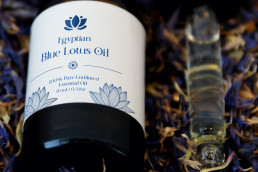
This guide is for spa founders, formulators, practitioners, and independent brand owners who want to offer pure Egyptian blue lotus oil (Nymphaea caerulea) under their own label. It covers what a blue lotus oil white label arrangement actually involves, what separates a credible programme from a repackaging operation, the documentation you should expect, realistic minimum order quantities, lead times, and the commercial and regulatory questions you need to answer before you commit. It is written for people who care about what goes in the bottle, not only what goes on it.
Table of Contents
- What a White-Label Programme Actually Is
- Who Should Consider White Label, and Who Should Not
- What a Credible Blue Lotus Oil White Label Partner Should Provide
- Formulation Options Within a White-Label Programme
- Pure Absolute
- Pre-Diluted in Carrier
- Rollerball and Retail-Ready Presentations
- Minimum Order Quantities and Pricing Structure
- Labelling, Packaging, and Regulatory Responsibility
- Timelines: From Enquiry to Finished Goods
- Quality Control: What to Ask, What to Audit
- Common Mistakes to Avoid
- When White Label Is Not the Right Choice
- Frequently Asked Questions
- Where to Go From Here
- Start With the Oil Itself
It is written and clinically reviewed by Antonio Breshears, ND, CCA, a Bastyr-trained naturopathic doctor and certified clinical aromatherapist. For broader context on the botany, chemistry, and therapeutic profile of this oil, readers may find it useful to first read the complete guide to blue lotus oil, which sits as the master reference for everything we publish on Nymphaea caerulea.
What a White-Label Programme Actually Is
A white-label programme is an arrangement in which a manufacturer produces a finished product, typically to an existing in-house specification, and allows a client brand to sell it under their own label. It differs from private label, where the client commissions a bespoke formulation, and from contract manufacturing, where the client supplies the formula and the factory simply produces it. White label sits in the middle: a known, quality-controlled product is rebranded, with limited but meaningful customisation at the label, packaging, and sometimes dilution level.
For blue lotus oil specifically, white label is attractive because the raw material is difficult to source. The flowers are seasonal, the extraction yield is tiny (three thousand to five thousand flowers per gram of absolute), and the supply chain from Egyptian growers through extraction houses to a finished, quality-tested oil is narrow and relationship-dependent. Very few brands are in a position to manage that chain themselves. A white-label partner who already owns the upstream relationships, the testing protocols, and the finished-goods inventory removes most of the risk from launching a product.
The trade-off is that you are tied to the supplier’s specification. A credible partner should publish that specification in full, so you know exactly what your customers are receiving and so your own marketing can be accurate.
Who Should Consider White Label, and Who Should Not
White label is the right structure for practitioners who want to dispense a branded oil to clients without becoming a manufacturer, for spas and treatment centres creating a signature line, for independent apothecaries curating a small range, and for wellness brands adding a botanical hero product without funding a bespoke development project. It is also a sensible way to test market demand before investing in custom formulation.
It is not the right structure if you need a proprietary formula that no one else can sell, if your volumes are very high and you need full cost control over the supply chain, or if you want a dilution, carrier, or scent profile that differs materially from the base product. In those cases, a private-label or contract-manufacturing arrangement is more appropriate, and the lead times and minimums are considerably longer.
What a Credible Blue Lotus Oil White Label Partner Should Provide
The oil itself is the thing most first-time buyers underestimate. Blue lotus is one of the more commonly adulterated florals on the market. Synthetic reconstructions, ylang dilutions, and absolutes cut with odourless carriers all circulate, and a white label partner who cannot or will not document provenance is not a partner worth signing with. The following items should be available as part of the programme, not as favours requested later:
- Certificate of Analysis (COA) for each batch, including GC/MS chromatography showing the key marker compounds expected in genuine Nymphaea caerulea absolute.
- Material Safety Data Sheet (MSDS or SDS) in the current GHS format, suitable for your jurisdiction.
- Allergen declaration itemising IFRA-listed constituents at the percentages present in the finished oil.
- Country of origin documentation tracing the flower material back to Egyptian cultivation, including, where possible, the specific growing region and season.
- Extraction method disclosure, stating clearly whether the product is a solvent-extracted absolute, a steam-distilled essential oil, or a supercritical CO2 extract. Each has a different scent, price point, and customer expectation.
- Stability data or at minimum a documented shelf-life claim (three to four years for properly stored absolute in dark glass).
- Batch numbering and traceability so that if a customer query arises, the specific lot can be identified and documentation retrieved.
If a prospective partner hesitates on any of these, treat the hesitation as information. You are the one whose name will be on the label when a customer asks what they are buying.
Formulation Options Within a White-Label Programme
Most blue lotus oil white label programmes, including ours, offer the base product in two or three forms rather than a single fixed SKU. This matters because the market is not uniform: a clinical aromatherapist dispensing to clients wants the undiluted absolute, while a spa rebranding a facial oil wants a ready-to-use dilution in a skin-appropriate carrier.
Pure Absolute
The undiluted solvent extract, typically sold in five, ten, or fifteen millilitre dark glass bottles. This is the format for practitioners, advanced hobbyists, and formulators who will dilute themselves. It commands the highest margin and the most technical scrutiny from buyers, so documentation matters most here.
Pre-Diluted in Carrier
Blue lotus absolute at five to ten percent in a cosmetic-grade carrier such as fractionated coconut, jojoba, or sweet almond oil. This is the format for spas, facial oils, and rollerball products. Lower price per millilitre, broader customer base, fewer safety questions from end users.
Rollerball and Retail-Ready Presentations
Some programmes include ten millilitre rollerballs at a two to three percent dilution, ready for retail. These suit gift markets, event sales, and brands who want a tested, compliant finished product without having to fill in-house.
Custom dilutions and carrier swaps are usually possible above a threshold quantity, but they tip the arrangement from white label towards private label, with correspondingly longer lead times.
Minimum Order Quantities and Pricing Structure
Realistic MOQs for a quality blue lotus oil white label programme start lower than most people expect, because the raw material cost is high and few partners want to hold dead stock. A typical entry point is fifty to one hundred units of a single SKU, often with tiered pricing that rewards larger commitments and mixed-case orders.
Expect cost per unit to decrease meaningfully at the two hundred and fifty and five hundred unit thresholds, and to plateau somewhere around one thousand units where the savings come more from shipping and packaging consolidation than from the oil itself. Unlike synthetic fragrances, there is no meaningful volume discount on the absolute itself beyond a point, because each kilogram still requires several million flowers.
Pricing in a credible programme is transparent. You should be able to see the landed cost per unit, the suggested retail price, the margin implied, and any label or packaging fees itemised separately. If pricing is opaque or quoted only “on application” with no published tiers, proceed cautiously.
Labelling, Packaging, and Regulatory Responsibility
This is the section first-time white-label buyers most often underestimate. When your name is on the bottle, you become the responsible person in the eyes of regulators in most jurisdictions, including the UK, EU, US, Canada, and Australia. The manufacturer supplies the oil and its documentation; you are responsible for ensuring the label, the claims, and the product’s fitness for its declared purpose comply with local law.
In practice this means:
- Accurate INCI or botanical labelling depending on whether the product is sold as a cosmetic, an aromatherapy product, or a fragrance. Nymphaea caerulea flower extract is the usual INCI entry.
- Net content, batch number, and best-before or period-after-opening marks placed as required by your jurisdiction.
- Allergen declarations where the oil contains IFRA-listed allergens above threshold concentrations.
- Claim discipline. Therapeutic claims (treats anxiety, cures insomnia, reduces blood pressure) are regulated in most jurisdictions and can reclassify your product as a medicine, with consequences. Descriptive and traditional-use language is usually safer, but check locally.
- Jurisdictional restrictions. Blue lotus is restricted or prohibited in Russia, Poland, Latvia, and the US state of Louisiana, and carries regulatory complexity in Australia. A white-label partner can supply the oil, but they cannot make your shipping and retail jurisdictions legal for you.
A good programme will flag these issues proactively and, where possible, supply label templates that meet the core requirements. It will not, and cannot, take final regulatory responsibility for products sold under your name.
Timelines: From Enquiry to Finished Goods
A realistic timeline for a first white-label order, from initial enquiry to finished goods delivered, is six to twelve weeks. It breaks down roughly as follows:
Week one to two: initial enquiry, signing of a mutual non-disclosure agreement if relevant, review of current batch COAs and samples. Expect to pay for samples; a partner who gives away unlimited free samples is either oversupplied or cutting corners upstream.
Week two to four: label artwork submission, proofing, and approval. This is where most projects stall. Artwork supplied as an editable vector file with bleed and safe-area marks already set up will move through in days. A PDF exported from a design app with missing fonts and low-resolution images will take weeks.
Week four to six: production run scheduled, labels printed and applied, bottles filled, batch tested, and documentation compiled.
Week six to eight: quality release, packing, and dispatch. International shipments add customs and freight time, particularly for destinations with botanical-import scrutiny.
Repeat orders compress this timeline considerably, often to three or four weeks, because artwork and specifications are already on file.
Quality Control: What to Ask, What to Audit
Before you commit to a first order, ask for and review a sample COA from a recent batch, a sample retail bottle with labelling you can physically inspect, and references from two or three existing white-label clients. A partner confident in their work will supply all three. If you are ordering at the higher end of the MOQ range, a site visit or video walk-through of the bottling operation is reasonable to request.
Once you are a client, spot-check incoming batches. Compare the scent against a retained reference bottle, check the COA against prior batches for drift in marker compounds, and confirm the label matches the approved artwork. Small inconsistencies are normal in a natural product. Large inconsistencies are a signal to have a direct conversation with your account manager before the next order.
Common Mistakes to Avoid
The most frequent errors in new white-label programmes are commercial rather than technical. Brands underprice the product because they have not modelled the true landed cost including shipping, duty, and marketing. They commit to too many SKUs at launch and end up with slow-moving stock of dilutions no one wanted. They make therapeutic claims on the label or in marketing copy that attract regulatory attention. And they treat the supplier as a vendor rather than a partner, which is usually fine until there is a problem, at which point it is not.
The technical errors are fewer but more damaging when they occur. Storing finished stock in warm, bright conditions degrades the oil and shortens shelf life noticeably. Using clear or coloured glass other than amber or cobalt accelerates the same problem. Filling rollerballs in a non-controlled environment introduces contamination risk. A credible white-label partner will pre-empt all of these by supplying appropriate packaging and storage guidance, and by discouraging customisations that compromise product integrity.
When White Label Is Not the Right Choice
If you need a genuinely proprietary scent profile, a specific and unusual carrier, or a blend that includes ingredients beyond blue lotus, you are no longer in white-label territory and should not try to force the arrangement to fit. Private label or contract manufacturing will cost more, take longer, and require higher MOQs, but it will give you a product that is yours in a way a white-label oil never quite is.
Similarly, if your brand positioning depends on full supply chain ownership, grower-direct sourcing, or in-house extraction, white label will not support the story. The oil you are selling was made by someone else, and authentic brand storytelling acknowledges that.
Frequently Asked Questions
What is the minimum order quantity for a blue lotus oil white label programme?
Typical entry points are fifty to one hundred units of a single SKU, with tiered pricing at two hundred and fifty, five hundred, and one thousand units. MOQs vary by presentation: pure absolute in small bottles has lower unit minimums than rollerballs or carrier-diluted facial oils.
Can I customise the dilution or carrier oil?
Within limits, yes. Most programmes offer pure absolute, a five to ten percent carrier dilution, and a retail rollerball. Requesting a bespoke dilution, a non-standard carrier, or additional botanical ingredients moves the project from white label towards private label, with longer lead times and higher minimums.
What documentation should I receive with each batch?
A current Certificate of Analysis with GC/MS data, a Safety Data Sheet in GHS format, an allergen declaration, country of origin documentation, extraction method disclosure, and a batch number traceable back to the production lot. If any of these are missing, ask for them before ordering.
Is blue lotus oil legal to sell in my country?
In most jurisdictions, yes, but there are exceptions. Russia, Poland, Latvia, and the US state of Louisiana restrict or prohibit it, and Australia applies significant regulatory scrutiny. Your white-label partner supplies the oil; you are responsible for confirming legality in every market you sell into.
Can I make therapeutic claims on the label?
Generally no, unless you are prepared to register the product as a medicine, which is a different regulatory pathway entirely. Descriptive language about traditional use, scent profile, and ritual context is usually acceptable, but specific therapeutic claims (treats anxiety, reduces blood pressure, cures insomnia) will attract regulatory attention in most markets.
How long does a first white-label order take?
Six to twelve weeks from initial enquiry to finished goods in hand, with most of the variability sitting in artwork approval. Repeat orders compress to three or four weeks once specifications are on file.
What shelf life should I put on the label?
Three to four years from fill date for pure absolute stored in amber or cobalt glass in cool, dark conditions. Carrier-diluted products inherit the shorter shelf life of the carrier, typically twelve to twenty-four months for vegetable oils. Period-after-opening marks of twelve months are a sensible default for retail presentations.
How do I verify the oil is genuine Nymphaea caerulea and not a reconstruction?
Request the GC/MS chromatogram from the batch COA and compare the marker compound profile to published references for genuine blue lotus absolute. A credible supplier will provide this without hesitation. Scent alone is not sufficient; skilled reconstructions can fool experienced noses.
Can I order samples before committing to a full run?
Yes, and you should. Expect to pay for samples at a small premium over the pro-rated unit cost; this is normal industry practice and a signal of a professionally run operation. Unlimited free sampling is usually a warning sign.
What happens if a customer has a complaint or adverse reaction?
As the brand of record, you handle the customer relationship. Your white-label partner should support you with batch documentation, ingredient disclosure, and technical advice, and should be reachable quickly for serious issues. Establish the escalation pathway before you launch, not after the first complaint arrives.
Where to Go From Here
If you are considering a blue lotus oil white label programme, the next step is to read widely on the material itself before approaching suppliers. Our complete guide to blue lotus oil covers the botany, chemistry, extraction methods, and therapeutic context in depth, and will give you the vocabulary to evaluate prospective partners critically. Once you have that grounding, request samples, review documentation, and model the full landed cost of a first order before you commit. A good white-label relationship is a long relationship; the time invested at the start pays back many times over.

Antonio Breshears
Antonio Breshears is a renowned expert in holistic medicine and beauty, with over 25 years of research experience dedicated to uncovering the secrets of nature's most powerful remedies. Holding a degree in Naturopathic Medicine, Antonio's passion for healing and well-being has driven him to explore the intricate connections between mind, body, and spirit.
Over the years, Antonio has become a respected authority in the field, helping countless individuals discover the transformative power of plant-based therapies, including essential oils, herbs, and natural supplements. He has authored numerous articles and publications, sharing his wealth of knowledge with a global audience seeking to improve their overall health and well-being.
Antonio's expertise extends to the realm of beauty, where he has developed innovative, all-natural skincare solutions that harness the potency of botanical ingredients. His formulations embody his deep understanding of the healing properties found in nature, providing holistic alternatives for those seeking a more balanced approach to self-care.
With his extensive background and dedication to the field, Antonio Breshears is a trusted voice and guiding light in the world of holistic medicine and beauty. Through his work at Pure Blue Lotus Oil, Antonio continues to inspire and educate, empowering others to unlock the true potential of nature's gifts for a healthier, more radiant life.