Blue lotus oil is genuinely useful across a wider range of applications than most aromatics, because its active profile touches the nervous system, the sleep cycle, the skin, and the emotional and contemplative dimensions of ordinary life. This article is a use-case directory. If you came here with a specific reason to consider the oil, the aim is to tell you quickly whether it is the right tool for that purpose, how it performs in that territory, and where to find the fuller protocol if you want to go deeper. It is organised by application category, with a decision framework at the end for users weighing several possible uses.
Table of Contents
- For Sleep and Dreaming
- For Anxiety, Stress, and Emotional Regulation
- For Pain and Physical Comfort
- For Women's Health and Hormonal Transitions
- For Intimacy and Ritual Use
- For Skin and Hair Care
- For Contemplative and Spiritual Practice
- For Focus and Cognitive Support
- For Daily Rituals
- How to Decide Which Application Is Right for You
- What Blue Lotus Oil Is Not Good For
- Frequently Asked Questions
- Where to Go From Here
- One Oil, Many Applications
It is written and clinically reviewed by Antonio Breshears, ND, CCA, a Bastyr-trained naturopathic doctor and certified clinical aromatherapist. For the underlying mechanism of why the oil works across this range, see our pillar on chemical composition and therapeutic properties; for the fuller treatment of each application territory, the linked pillars and cluster articles below.
For Sleep and Dreaming
Sleep and dream work are the oil’s strongest single application territory, and the one where both the ancient tradition and the modern evidence converge most cleanly. Blue lotus supports sleep through several mechanisms simultaneously: the parasympathetic shift that makes the wind-down easier, the mild GABAergic effect of the apigenin fraction that supports sleep depth, and the olfactory conditioning that (once established) makes the scent itself a reliable cue for settling toward sleep. The oil does not function like a pharmaceutical sleep medication; it works with the body’s own sleep processes rather than overriding them, which is part of why it tolerates daily use over months and years without losing effect.
Specific patterns covered in our cluster articles:
- General sleep quality: our article on blue lotus oil for sleep.
- Insomnia, including initial, middle, and terminal patterns, our article on insomnia.
- Dream recall: the oil acts as a mild oneirogen; see our article on dream recall.
- Lucid dreaming: covered in our article on lucid dreaming, with specific protocol detail.
The parent pillar for this territory is blue lotus oil for sleep and dreams. For the specific pillow-spray format that works best for overnight aromatic use, see our pillow spray recipe.
For Anxiety, Stress, and Emotional Regulation
The oil’s second-strongest territory, and the one where most new users find the most immediate value. Blue lotus works on the parts of anxiety that are physiological (the elevated sympathetic tone, the shallow breath, the muscle tension) rather than on the parts that are cognitive (the specific worries, the catastrophic thinking). This means it complements rather than replaces the cognitive-behavioural work that addresses anxiety at the thought level, and it means it works well for the kinds of anxiety that are primarily somatic or physiological in their presentation.
For stress in particular, the oil is most valuable when used preventively and rhythmically rather than only in acute moments. A daily practice pattern (morning diffuser, midday rollerball, evening wind-down) that keeps the nervous system in a regulated baseline is substantially more effective than waiting until stress peaks and then reaching for the oil reactively.
Through the olfactory-limbic, GABAergic, and conditioning pathways described in our chemistry pillar, blue lotus provides reliable support for:
- Generalised anxiety: see blue lotus oil for anxiety.
- Acute and chronic stress: covered in blue lotus oil for stress relief.
- Depressive mood, strictly as an adjunct to clinical care, see blue lotus oil for depression.
- Grief: a supportive role alongside time and the other ways grief is processed; see blue lotus oil for grief.
- Trauma recovery: as a supportive layer alongside therapy and professional support; see trauma recovery.
The parent for this territory is health and wellness benefits.
For Pain and Physical Comfort
A smaller territory, because blue lotus is not a primary analgesic and should not be treated as one, but a useful one. The oil’s contribution in this territory is indirect: the parasympathetic shift reduces the muscle-tension component of many common pain patterns, the mild anti-inflammatory flavonoid action supports topical applications, and the olfactory-limbic effect contributes a distraction-and-regulation layer that genuinely modulates the experience of pain without resolving its underlying cause.
For acute or severe pain, medical evaluation and appropriate analgesia come first; blue lotus sits alongside those interventions, not instead of them.
- Tension headaches: through stress and muscle-tone regulation; see headaches.
- Migraines, in prodrome and postdrome phases, see migraines.
- Menstrual pain: see menstrual pain.
- Muscle tension from stress, covered in muscle tension.
- Inflammation, modest topical support, see inflammation.
For Women’s Health and Hormonal Transitions
The oil’s role in this territory is worth being specific about. Blue lotus does not act hormonally. It contains no meaningful quantity of phytoestrogens, does not bind oestrogen or progesterone receptors, and does not shift hormonal levels. What it does is support the nervous-system and sleep dimensions that commonly interact with hormonal transitions: the irritability and sleep disruption of the luteal phase, the night sweats and mood reactivity of perimenopause, the emotional reactivity that accompanies the broader hormonal shifts across the reproductive lifecycle. This is a meaningful contribution within a layered approach, and it is compatible with hormone replacement therapy, hormonal contraception, and other hormonal medications.
- Premenstrual syndrome: see PMS.
- Menopause and perimenopause: see menopause.
- Women’s libido: covered in libido in women.
For Intimacy and Ritual Use
Drawing on the Egyptian banquet and Nefertem tradition, the oil has a genuine role in intimate and ritual contexts. The mechanism is practical rather than magical: intimate response requires parasympathetic dominance (the opposite of the stress-activated state most of us occupy by default in contemporary life), and blue lotus shifts the nervous system toward that parasympathetic baseline reliably. Combined with the scent-based conditioning that develops from consistent use in intimate contexts, the oil becomes a reliable cue for that state over weeks of use.
Our articles on blue lotus oil as an aphrodisiac, libido in women, and libido in men cover this territory honestly, distinguishing the real contribution (nervous-system conditions for desire and intimacy) from the overstated (chemical arousal enhancement).
For Skin and Hair Care
Blue lotus has a genuine place in skincare, though its role is more subtle than the marketing around “exotic floral oils” usually suggests. Properly diluted in a skincare-grade carrier (jojoba, argan, or rosehip depending on the skin type and goal), the oil contributes mild anti-inflammatory activity from its flavonoid fraction, a subtle skin-conditioning effect from the fatty components of the absolute, and the calming aromatic presence that supports stress-related skin patterns (which are surprisingly common, including flare-ups of eczema, rosacea, and stress-acne). It is not a miracle skincare ingredient, but it is a pleasant and useful one within a considered regimen.
- Facial skincare: see blue lotus oil for skin.
- Hair and scalp: see blue lotus oil for hair.
- DIY skincare formulations: see DIY skincare formulations.
For Contemplative and Spiritual Practice
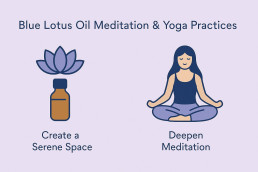
The oil’s use in ritual and contemplative practice is among the oldest dimensions of the tradition, and it remains one of the most rewarding. The Egyptian tradition of anointing before ritual sat within a broader understanding that scented oil marks the threshold between ordinary time and practice time, a distinction that continues to matter for contemporary practitioners. Blue lotus supports sitting meditation, yoga, breathwork, and the broader work of settling the nervous system for practice, both through its direct physiological effects and through the ritual-conditioning that builds over weeks of consistent use.
- Meditation and yoga: our pillar on meditation and yoga practice is the main reference.
- Spiritual benefits: covered in spiritual benefits, with appropriate epistemological humility.
- Metaphysical frameworks: see metaphysical benefits.
For Focus and Cognitive Support
A smaller but real application area, with some important caveats. Blue lotus is not a stimulant and does not produce the sharpened-attention effect of caffeine, nicotine, or pharmaceutical cognitive enhancers. What it can do is reduce the background arousal (anxiety, rumination, scattered attention) that interferes with deep work for many users. For someone whose focus problem is driven by over-arousal and mental busyness, the paradoxical calming effect of blue lotus often improves sustained attention more than a stimulant would. For someone whose focus problem is genuine cognitive-capacity limitation or clinical attention disorder, the oil is a supportive layer at best, not a primary intervention.
- Focus and attention: see focus.
- ADHD, strictly as a supportive layer alongside evidence-based interventions, see ADHD.
For Daily Rituals
Beyond specific health applications, many users build blue lotus into daily rituals that produce benefits compounding over time through the olfactory conditioning effect. The classic four-window pattern is: a brief morning diffusion while getting ready (setting the parasympathetic baseline for the day), a rollerball used at natural pause points during the working day (re-anchoring attention and calming accumulated tension), an evening wind-down session thirty to forty-five minutes before bedtime (beginning the transition to sleep), and a pillow spray at bedtime (extending the aromatic presence through the night).
This pattern works because each window reinforces the same olfactory-state association from a slightly different angle, which makes the conditioning more robust and accessible than any single window alone would. Our pillar on aromatherapy diffuser techniques covers the equipment side; our pillow spray recipe covers the bedtime format; our carrier oil pairings pillar covers the topical side.
How to Decide Which Application Is Right for You
If you are weighing several possible uses, the practical decision framework is simpler than it looks. Begin with the single most pressing concern rather than trying to address everything at once; blue lotus works best when it has a clear job to do, and the benefits of consistent use for one application tend to spill over into adjacent territories anyway (sleep support improves anxiety; stress reduction improves menstrual comfort; contemplative practice supports sleep).
Three questions to narrow the starting point. First, when does the problem show up most consistently? If it is evenings and nights, start with the sleep and dreams pillar and the pillow-spray format. If it is throughout the day, start with a rollerball and the anxiety or stress-relief protocols. If it is tied to a particular life phase (cycle, perimenopause, a difficult transition), start with that cluster article directly.
Second, is the presentation primarily physical or primarily cognitive? Physical symptoms (sleep, pain, hormonal, skin) respond to the topical and pharmacological routes more strongly. Cognitive-emotional patterns (anxiety, mood, focus, grief) respond to the olfactory-limbic and conditioning routes more strongly. The oil supports both, but the emphasis of your practice shifts accordingly.
Third, what is the timescale? Acute moments benefit from aromatic inhalation and topical rollerballs. Cumulative conditions benefit from the full daily-practice pattern sustained over three to four weeks or longer. Do not expect a single evening’s use to resolve a year’s worth of sleep disruption; do expect a three-week consistent practice to produce noticeable change.
What Blue Lotus Oil Is Not Good For
Honest about where the oil does not belong.
- Severe depression, active suicidality, or acute psychiatric crises: urgent professional care is the appropriate response, not an aromatic oil.
- Severe or unusual pain: medical evaluation is the first step, not self-directed aromatherapy.
- Acute infections, systemic illness: beyond the scope of what an aromatic can address.
- Pregnancy and breastfeeding: blue lotus is avoided during these phases.
- Young children: not used topically under five; aromatic exposure only at reduced dose for older children.
- Primary treatment for any serious condition: the oil is an adjunct and supportive practice, not a substitute for appropriate medical care.
The full safety picture is in our reference on safety, side effects and precautions.
Frequently Asked Questions
What is blue lotus oil most commonly used for?
Sleep support and anxiety and stress relief are the two most common applications, accounting for the majority of new user interest. The contemplative and ritual uses, and the cycle-linked women’s health applications, are the next most common. Skincare and hair care are smaller but real applications, typically adopted after users have established a daily practice for one of the primary indications.
Can I use blue lotus oil for multiple purposes?
Yes, and many users do. The four daily-practice windows (morning, daytime, evening wind-down, bedtime) can each target a different application, all from the same bottle of oil. The conditioning effect compounds across applications because the underlying nervous-system shift is the same; only the contextual cue changes. See our pillar on health and wellness benefits for the daily-practice framework.
Is blue lotus oil good for sleep?
Yes, very much so. This is its strongest single application, and the one with both the longest traditional record and the clearest modern evidence. Our sleep and dreams pillar covers the full protocol.
Is blue lotus oil good for anxiety?
Yes, for most common anxiety patterns, particularly the somatic and anticipatory kinds. It is less useful as a primary intervention for panic disorder, severe generalised anxiety requiring pharmacological treatment, or trauma-based anxiety, all of which warrant clinical care as the first line. See our article on anxiety.
Is blue lotus oil good for skin?
Yes, at appropriate dilution (1 to 2 percent) in a facial-grade carrier. The benefits include skin conditioning, mild anti-inflammatory support, and the general calming effect that reduces stress-related skin patterns. Not a miracle ingredient, but a pleasant and useful one in a considered skincare routine. See our article on blue lotus oil for skin.
Is blue lotus oil good for meditation?
Yes, and this is one of the oldest and best-established traditional uses. Blue lotus supports sitting meditation, yoga, breathwork, and contemplative practice broadly. The conditioning effect (scent becomes a cue for the practice state) compounds usefully over months of consistent practice-linked use. See our pillar on meditation and yoga practice.
Is blue lotus oil good for headaches?
Tension-type headaches, yes, particularly those with stress or muscle-tone components. Migraines, indirectly, through prodrome and postdrome support rather than as an acute-abortive intervention. See our headaches and migraines articles.
Is blue lotus oil good for menstrual cramps?
Yes, as part of a layered approach to primary dysmenorrhoea (cramping without an underlying condition). For secondary dysmenorrhoea (cramping driven by endometriosis, fibroids, or other pathology), the oil can still provide comfort-support but medical evaluation of the underlying cause is the primary step. See our article on menstrual pain.
Is blue lotus oil good for libido?
Indirectly, through the nervous-system conditions that allow libido to express rather than through any direct hormonal or arousal action. Persistent low libido usually has causes (stress, sleep deprivation, relationship issues, medication side effects, hormonal imbalance) that blue lotus does not resolve on its own. Our article on blue lotus oil as an aphrodisiac covers the territory honestly.
Is blue lotus oil good for dreaming?
Yes, particularly well. Blue lotus is a mild oneirogen (a substance that enhances dream vividness and recall), and it supports both dream recall and lucid dreaming with the right techniques. Most users notice a substantial deepening of dream content within one to two weeks of evening use. See our articles on dream recall and lucid dreaming.
Where to Go From Here
For the detail on any specific application, use the cluster article links above. For the underlying framework of how the oil produces these effects, see our pillar on chemical composition and therapeutic properties and our article on what blue lotus oil does. For the full introduction to the oil, our complete guide. Everything on this site is hosted at Pure Blue Lotus Oil.

Antonio Breshears
Antonio Breshears is a renowned expert in holistic medicine and beauty, with over 25 years of research experience dedicated to uncovering the secrets of nature's most powerful remedies. Holding a degree in Naturopathic Medicine, Antonio's passion for healing and well-being has driven him to explore the intricate connections between mind, body, and spirit.
Over the years, Antonio has become a respected authority in the field, helping countless individuals discover the transformative power of plant-based therapies, including essential oils, herbs, and natural supplements. He has authored numerous articles and publications, sharing his wealth of knowledge with a global audience seeking to improve their overall health and well-being.
Antonio's expertise extends to the realm of beauty, where he has developed innovative, all-natural skincare solutions that harness the potency of botanical ingredients. His formulations embody his deep understanding of the healing properties found in nature, providing holistic alternatives for those seeking a more balanced approach to self-care.
With his extensive background and dedication to the field, Antonio Breshears is a trusted voice and guiding light in the world of holistic medicine and beauty. Through his work at Pure Blue Lotus Oil, Antonio continues to inspire and educate, empowering others to unlock the true potential of nature's gifts for a healthier, more radiant life.