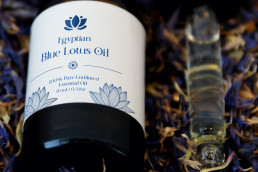
This is a practical framework, a blue lotus oil blend builder, for anyone who wants to move beyond following recipes and start formulating their own blends with intention. Whether you are making a sleep roller for yourself, a meditation anointing oil for ritual work, or a facial serum for your evening routine, the principles are the same: pick a carrier that suits your skin and purpose, choose supporting oils that complement rather than compete with the blue lotus, dilute to a percentage that matches the application, and layer your aromatics so the scent unfolds over time rather than shouting all at once.
Table of Contents
- What a Blend Builder Actually Is
- Step One: Define the Intent
- Step Two: Choose the Application Format
- Step Three: Pick the Carrier
- Step Four: Layer Your Aromatics
- Top Note Options That Work With Blue Lotus
- Heart Note Options
- Base Note Options
- Step Five: Work the Ratios
- Step Six: Test, Rest, and Adjust
- Common Mistakes When Using a Blend Builder Approach
- What to Expect From Your Finished Blend
- When Not to Formulate Your Own Blends
- Frequently Asked Questions
- Where to Go From Here
- Start With Exceptional Oil
It is written and clinically reviewed by Antonio Breshears, ND, CCA, a Bastyr-trained naturopathic doctor and certified clinical aromatherapist. For context on the oil itself, its chemistry, sourcing, and the reasoning behind the formulation principles below, see The Complete Guide to Blue Lotus Oil, which sits as the master reference for everything that follows.
What a Blend Builder Actually Is
A blend builder is not a calculator that spits out a recipe when you enter your symptoms. It is a decision tree: a set of questions you work through in sequence so the finished blend reflects your actual intent rather than a list of oils you happened to have on the shelf. The four questions that matter, in order, are what the blend is for, how it will be applied, what dilution that application calls for, and which aromatic partners genuinely support the primary effect you are after. Once you can answer those four, the rest of the blend assembles itself.
Blue lotus absolute is an unusual anchor for this kind of work because it sits somewhere between a heart note and a base note in olfactory terms, while its active chemistry, the aporphine and nuciferine alkaloids alongside apigenin and other flavonoids, makes it a mild nervine and a gentle parasympathetic nudge rather than a sedative. That positioning gives you flexibility. You can build upward from it with brighter citrus or floral top notes, or downward with resinous and woody bases, depending on whether you want the blend to lift the mood, ground the body, or slide the nervous system toward sleep.
Step One: Define the Intent
Before you open a single bottle, write down one sentence describing what the blend is supposed to do and when it will be used. “A roller I can apply to my wrists and neck before bed to help me wind down” is a useful intent. “Something relaxing” is not, because it will not tell you whether to reach for lavender or vetiver, whether to use jojoba or fractionated coconut oil, or whether the dilution should be one percent or three.
The most common intent categories are sleep and wind-down, daytime anxiety and focus, meditation and ritual, skincare and facial application, sensual and intimate use, and emotional processing or grief work. Each category has different implications for carrier choice, dilution, and supporting oils, and I will work through each below. Pick one. Blends that try to be everything tend to be nothing in particular.
Step Two: Choose the Application Format
The application format drives the dilution, and the dilution drives how much blue lotus and how much supporting oil you will use. There are five formats worth knowing, and each has a standard dilution range that keeps the blend both effective and safe.
Rollerball (10ml): one to three percent, depending on whether it is for facial pulse points (one percent), general body use on wrists and neck (two percent), or targeted use on the chest or abdomen (three percent). A ten-millilitre roller holds roughly two hundred drops of finished product, so two percent is around four total drops of essential or absolute oils.
Body oil (30ml or 50ml): two to three percent for general use. A thirty-millilitre bottle at two percent is around twelve drops of aromatic material, which gives you room to build a layered blend with top, heart, and base notes rather than a single-note oil.
Facial serum (15ml to 30ml): one percent or less. Facial skin is thinner, more reactive, and does not need the same concentration to feel the effect. At one percent in a thirty-millilitre bottle you have six drops to work with, so every drop has to earn its place.
Diffuser blend: two to four drops total into a standard water diffuser, usually with blue lotus making up one of those drops and the others filling in around it. No carrier, no dilution maths, but the same layering logic applies.
Bath oil: five to ten drops of finished blend dispersed in a tablespoon of carrier oil or unscented bath base before it goes into the water. Never drop neat essential oils directly onto bathwater; they float, they do not mix, and they can sit on the skin in concentrated patches.
Step Three: Pick the Carrier
The carrier is not just a dilutant; it is half the finished product, and in a low-dilution blend it is the majority of what touches your skin. Three carriers cover most situations.
Jojoba oil is technically a liquid wax, closely resembles the skin’s own sebum, absorbs without leaving a heavy residue, and has a long shelf life. It is the default for facial serums and for anyone with reactive or oily skin. It is also the most expensive of the common carriers, which matters when you are making larger volumes.
Fractionated coconut oil is lighter, cheaper, has an almost indefinite shelf life, and has no scent of its own, which is useful when you want the aromatic blend to speak without interference. It is excellent for rollerballs and body oils but less ideal for facial use on drier skin, where it can feel a little thin.
Sweet almond oil is richer, nourishing, and pleasant on dry or mature skin, but it oxidises faster than jojoba, so blends made with it are best used within six months. It pairs beautifully with blue lotus in massage oils and body blends where the slightly sweet, nutty undertone adds warmth.
For bath oils you can use any of the above, or an unscented dispersant base designed for water mixing. For a diffuser there is no carrier; the water in the diffuser reservoir does that job.
Step Four: Layer Your Aromatics
Traditional perfumery thinks in three layers: top notes, which you smell first and which fade fastest; heart notes, which emerge as the top notes lift and form the body of the scent; and base notes, which sit underneath everything and linger longest on the skin. A well-built therapeutic blend uses the same structure, because the layering not only produces a more interesting and persistent scent but also means the nervous system receives different aromatic and chemical signals across the hour after application rather than a single flat note that fades to nothing in ten minutes.
Blue lotus absolute occupies an unusual position: the initial impression is floral-aquatic and cooler than you might expect, the heart is deeply honeyed and floral, and the base is quietly balsamic and faintly smoky. This means you can use blue lotus as the anchor and build around it, or you can use it as the heart and frame it with other top and base notes.
Top Note Options That Work With Blue Lotus
For brightening and lifting: bergamot (calming citrus, bergapten-free if you will be in sunlight), sweet orange (cheerful, food-safe, gentle), or neroli (floral-citrus, excellent for anxiety).
For clarity and focus: petitgrain (green, calming but alert), pink grapefruit (uplifting without being sharp), or a small amount of lavender (which sits between top and heart and softens transitions).
Heart Note Options
For relaxation and sleep: Roman chamomile (apigenin-rich, synergistic with blue lotus), true lavender (linalool and linalyl acetate, the workhorse of calming blends), or geranium (floral, balancing, good for hormonal context).
For sensuality and warmth: rose absolute (expensive but extraordinary with blue lotus), jasmine absolute (intensely floral, use sparingly), or ylang ylang (sweet, rich, can tip into cloying if overdone).
Base Note Options
For grounding: sandalwood (woody, meditative, excellent with blue lotus for ritual work), cedarwood (drier, more astringent, good for focus), or vetiver (earthy, deeply grounding, use in very small amounts).
For resinous depth: frankincense (meditative, subtly lifting, pairs beautifully with blue lotus in spiritual contexts), myrrh (darker, more medicinal), or benzoin (sweet, vanilla-like, slightly smoky).
Step Five: Work the Ratios
A good starting ratio for a three-note therapeutic blend is roughly three parts top note, two parts heart note, and one part base note. Blue lotus, because it straddles heart and base, can be treated as either depending on what else is in the blend. If you are using it alongside a traditional base like sandalwood or vetiver, count it as a heart note. If the only base in the blend is the blue lotus itself, use it as your base and build up from there.
Here is a worked example. A two percent sleep rollerball in a ten-millilitre jojoba base works out to roughly four drops of aromatic oils total. A reasonable breakdown: two drops lavender (heart, dominant), one drop Roman chamomile (heart, supporting), and one drop blue lotus absolute (base, anchoring). That is a simple, effective, and defensible blend. You could add a single drop of sweet orange for lift and push it to three percent, but for bedtime application the cleaner, sleepier profile of the three-oil version usually works better.
For a meditation anointing oil at three percent in a ten-millilitre jojoba base, you have around six drops to work with. Two drops frankincense, two drops sandalwood, one drop blue lotus, and one drop bergamot gives you a properly layered blend with clear top, heart, and base structure, and the blue lotus sits in the heart where it carries emotional openness without dominating.
Step Six: Test, Rest, and Adjust
Once you have mixed your blend, cap it, label it with the date and composition, and leave it for at least twenty-four hours before judging it. Essential oil blends mature. The sharp edges of individual oils round off, and the final scent can be quite different from the first impression. This is especially true when blue lotus absolute is involved, because its honeyed, slightly smoky base takes time to marry with the other oils.
After twenty-four to forty-eight hours, test the blend on your wrist or inner forearm and observe it over the course of an hour. If the top note vanishes in ten minutes and you are left with a flat middle, add a small amount of citrus or petitgrain. If the base feels thin and the scent does not linger, add a drop of sandalwood or benzoin. If the whole thing feels cloying or heavy, you have probably overdone the heart; next batch, reduce the florals or add more top note.
Common Mistakes When Using a Blend Builder Approach
The first mistake is using too many oils. A blend of four or five well-chosen oils is almost always better than a blend of ten, because each oil you add dilutes the others and muddies the scent profile. Start with three, move to four if the intent genuinely calls for it, and only go to five for complex perfumery work.
The second is ignoring the carrier. A beautiful blend of oils dropped into a heavy, scented, or oxidised carrier will feel wrong on the skin regardless of how well the aromatics are balanced. Buy small bottles of fresh, high-quality carrier oils and replace them every six to twelve months.
The third is over-diluting or under-diluting without thinking about it. Facial application at three percent will feel too strong and may irritate. General body application at half a percent will feel like nothing. Learn the ranges for each application and stick to them unless you have a specific reason to deviate.
The fourth is skipping the patch test. Even with oils you have used before, a new blend is a new combination, and a small patch test on the inner forearm twenty-four hours before full use is the sensible way to catch a reaction before it becomes a problem.
What to Expect From Your Finished Blend
A well-built blue lotus blend should do three things. First, it should smell good to you specifically, because aromatic preference is deeply personal and a blend you dislike will not work no matter how therapeutically coherent it is. Second, it should produce a noticeable shift in how you feel within five to fifteen minutes of application, whether that is a softening of anxiety, a deepening of breath, or a gentle pull toward sleep. Third, it should last. A blend that fades in ten minutes has not been built with enough base-note structure, and you will find yourself reapplying constantly rather than letting it work.
Realistic expectations matter. Blue lotus is a modestly effective nervine, not a sedative. A well-built blend will support your intent, but it will not override poor sleep hygiene, unmanaged chronic stress, or clinical depression. Use it as one element in a wider practice, not as a standalone intervention.
When Not to Formulate Your Own Blends
If you are pregnant or breastfeeding, work with a qualified aromatherapist rather than building your own blends, because the safety data on many essential oils in pregnancy is either limited or genuinely cautionary. If you are on dopaminergic medications, MAOIs, or heavy sedatives, the same applies: the interactions are not well mapped and the stakes are higher than a DIY approach warrants. If you have reactive skin, eczema, or known essential oil sensitivities, start with pre-formulated blends from a trusted source and only move to DIY once you understand how your skin responds to each oil in isolation.
Frequently Asked Questions
How many drops of blue lotus should go in a typical blend?
For a two percent blend in a ten-millilitre roller, blue lotus usually makes up one drop out of four total. For a three percent blend, one to two drops out of six. Because blue lotus absolute is expensive, using it as a supporting note rather than the dominant oil makes both aromatic and practical sense.
Can I blend blue lotus with lavender for sleep?
Yes, and it is one of the most reliable sleep combinations. One drop blue lotus, two drops lavender, one drop Roman chamomile in ten millilitres of jojoba gives you a clean, effective bedtime roller at two percent.
Does the order I add the oils matter?
Not significantly for the therapeutic effect, but many aromatherapists add base notes first, then heart, then top, and finally the carrier, which lets the heavier oils disperse into the lighter ones. It is more ritual than chemistry, but the ritual is part of the craft.
How long do blue lotus blends last once mixed?
In a jojoba base, six to twelve months if stored in dark glass, cool, and out of direct light. In fractionated coconut oil, up to two years. In sweet almond oil, four to six months before the carrier begins to oxidise. Label your blends with the date you made them.
Can I use blue lotus in a facial serum?
Yes, at one percent or less. In a thirty-millilitre jojoba base, that is about six drops total. A reasonable facial formulation might be two drops blue lotus, two drops frankincense, and two drops geranium or rose, giving you a calming, slightly anti-inflammatory evening serum.
What should I avoid blending blue lotus with?
Avoid pairing it with oils that will dominate it olfactorily, like peppermint, eucalyptus, or tea tree, because the subtle floral character will be completely overridden. Also avoid combining it with other sedating oils at high concentrations, especially if you are using the blend during the day.
Can I make a blend for children?
Blue lotus is not well studied in paediatric use, and the standard clinical aromatherapy guidance is to avoid absolutes and exotic florals in blends for children under twelve. Use better-studied oils like lavender, Roman chamomile, or mandarin for that context.
How do I know if my blend is balanced?
Apply a small amount to your inner wrist and smell it immediately, at ten minutes, at thirty minutes, and at an hour. If you can identify different aromatic phases across that time, the blend is layered. If it smells the same at ten minutes as it does at sixty, or if it disappears entirely, the structure needs adjusting.
Should I use a digital scale or drop counts?
For personal blending, drop counts are accurate enough. For selling blends or for clinical work, a 0.01g digital scale and formulation by weight is more precise and more reproducible. Beginners should stick with drops until the principles are internalised.
Can I substitute absolutes for essential oils in a blend?
Yes, but absolutes tend to be more concentrated aromatically, so use them at roughly half the drop count you would use for a steam-distilled essential oil of similar character. Blue lotus is almost always an absolute, which is why one drop goes further than you might expect.
Where to Go From Here
Once you have built a few blends and observed how they perform, the framework becomes second nature and the decision tree collapses into intuition. You will find yourself reaching for specific carriers, specific supporting oils, and specific dilutions without conscious thought, because the reasoning behind each choice has become part of how you think about formulation. For the deeper chemistry of blue lotus and why it behaves the way it does in a blend, return to The Complete Guide to Blue Lotus Oil, which covers the alkaloid profile, the flavonoid content, and the olfactory-limbic mechanism in full.

Antonio Breshears
Antonio Breshears is a renowned expert in holistic medicine and beauty, with over 25 years of research experience dedicated to uncovering the secrets of nature's most powerful remedies. Holding a degree in Naturopathic Medicine, Antonio's passion for healing and well-being has driven him to explore the intricate connections between mind, body, and spirit.
Over the years, Antonio has become a respected authority in the field, helping countless individuals discover the transformative power of plant-based therapies, including essential oils, herbs, and natural supplements. He has authored numerous articles and publications, sharing his wealth of knowledge with a global audience seeking to improve their overall health and well-being.
Antonio's expertise extends to the realm of beauty, where he has developed innovative, all-natural skincare solutions that harness the potency of botanical ingredients. His formulations embody his deep understanding of the healing properties found in nature, providing holistic alternatives for those seeking a more balanced approach to self-care.
With his extensive background and dedication to the field, Antonio Breshears is a trusted voice and guiding light in the world of holistic medicine and beauty. Through his work at Pure Blue Lotus Oil, Antonio continues to inspire and educate, empowering others to unlock the true potential of nature's gifts for a healthier, more radiant life.