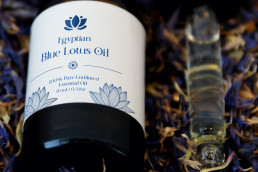
If you have been researching where to buy blue lotus and you are weighing up blue lotus oil vs Mountain Rose Herbs, you are almost certainly comparing two quite different things rather than two versions of the same product. Mountain Rose Herbs is a large, well-regarded American herbal supplier offering dried blue lotus flowers and, at times, tinctures or extracts; Pure Blue Lotus Oil is a single-focus apothecary producing one product, a concentrated Egyptian Nymphaea caerulea absolute. This article lays out what each actually offers, when one is a better fit than the other, and how to choose honestly based on what you want the plant to do.
Table of Contents
- What Mountain Rose Herbs Actually Sells
- Quality and sourcing
- What Pure Blue Lotus Oil Offers Instead
- Blue Lotus Oil vs Mountain Rose Herbs: Head to Head
- Product form
- Concentration
- Intended use
- Consistency
- Price per effective dose
- When Mountain Rose Herbs Is Genuinely the Better Choice
- When Pure Blue Lotus Oil Is the Better Choice
- What to Look for in Either Supplier
- What to Expect from Each in Real Use
- Safety Notes That Apply to Both
- Frequently Asked Questions
- Where to Go From Here
- Choose A Dedicated Blue Lotus Apothecary
It is written and clinically reviewed by Antonio Breshears, ND, CCA, a Bastyr-trained naturopathic doctor and certified clinical aromatherapist. For a broader framework on what blue lotus is and how it works, see The Complete Guide to Blue Lotus Oil, which covers chemistry, extraction, and safety in detail.
What Mountain Rose Herbs Actually Sells
Mountain Rose Herbs is an Oregon-based bulk herb company founded in the 1980s. They are known in the herbalist community for a broad catalogue of dried botanicals, loose teas, tinctures, carrier oils, and a smaller range of essential oils. Their reputation rests on organic sourcing, fair-trade partnerships, and transparent supplier relationships. They are, essentially, a generalist: they stock hundreds of herbs and oils, and blue lotus is one of many items on the shelf.
When they offer blue lotus, it is typically as dried whole or cut-and-sifted flowers (*Nymphaea caerulea*), sometimes sourced from Egypt or Sri Lanka. Availability fluctuates because the plant is harvested seasonally and the supply chain is narrow. At various points they have also stocked blue lotus tinctures or glycerites. What they do not reliably carry is a concentrated blue lotus absolute or essential oil suitable for aromatherapy dilution.
This matters. Dried flowers and an absolute are not interchangeable. The flowers are used for tea, for cold maceration in wine, or occasionally for smoking blends, and they deliver a gentle, diffuse effect rooted largely in the water-soluble alkaloids and flavonoids that come out in a hot or alcoholic infusion. An absolute, by contrast, is the concentrated aromatic fraction: roughly 3,000 to 5,000 flowers distilled down into a single gram. It is used in tiny amounts, diluted into a carrier, and its mechanism is dominated by the olfactory-limbic pathway and topical absorption rather than oral intake.
Quality and sourcing
Mountain Rose Herbs’ sourcing standards are genuinely good for a supplier of their size. They publish certificates of analysis on many products, pursue organic certification where possible, and have a recognisable sustainability ethic. For someone buying dried chamomile, nettle, or calendula, they are a sensible default choice. Their blue lotus flowers, when in stock, are usually clean, whole, and clearly labelled, though they can vary in colour and aroma batch to batch, as any wild-harvested seasonal botanical will.
What Pure Blue Lotus Oil Offers Instead
Pure Blue Lotus Oil is not a general herb supplier. The catalogue is one product: a concentrated Egyptian blue lotus absolute, extracted from Nymphaea caerulea flowers, bottled in dark glass, and sold with full attention to a single plant. This is a specialist’s position rather than a generalist’s, and it shapes everything downstream.
The oil itself is an absolute, produced through solvent extraction to capture the heat-sensitive aromatic compounds that steam distillation tends to damage or miss. It is thick, deep amber to brown-green, and carries the characteristic blue lotus scent profile: a cool floral-aquatic top, a deep honeyed-floral heart, and a quietly balsamic, almost smoky base. A single bottle represents thousands of hand-harvested flowers, which is why the cost per millilitre is considerably higher than most essential oils.
Where Mountain Rose Herbs gives you the raw flowers to do with as you wish, Pure Blue Lotus Oil gives you the finished aromatic concentrate intended for diffusion, dilution into a carrier for skin application, or use in perfumery and ritual formulations. The two products answer different questions.
Blue Lotus Oil vs Mountain Rose Herbs: Head to Head
Framed directly, the comparison between blue lotus oil vs Mountain Rose Herbs comes down to five variables: product form, concentration, intended use, consistency, and price per effective dose.
Product form
Mountain Rose Herbs primarily sells dried flower material. Pure Blue Lotus Oil sells a concentrated aromatic absolute. If you want tea, smoking blends, or a cold-infused wine in the historical Egyptian style, dried flowers are the right starting material. If you want aromatherapy, topical use, perfumery, or ritual anointing, an absolute is what you need.
Concentration
One gram of absolute contains the aromatic yield of thousands of flowers. You cannot reach that concentration from dried botanical at home without industrial equipment and a great deal of solvent. If potency per drop matters to you, particularly for work on mood, sleep, or sensual ritual, the absolute is simply a different tier of material.
Intended use
Dried flowers lean toward internal preparations (tea, tincture, wine) and traditional smoke-blend uses. An absolute leans toward external and olfactory use: diffused into a room, blended at 1 to 2 percent into a face serum, worn as perfume, massaged at 2 to 3 percent into the body. These overlap a little in their emotional and nervous system effects, but the routes of administration and the experiences differ meaningfully.
Consistency
Dried herbal material varies by harvest, year, storage, and supplier. This is not a fault; it is simply the nature of botanicals. A single-product apothecary focused on one plant tends to invest more heavily in consistent extraction, batch testing, and finished-product quality control, because there is nowhere to hide an off batch when it is the only thing on offer.
Price per effective dose
Per gram, dried flowers are much cheaper than absolute. Per dose of aromatic effect, the picture reverses. A diffuser blend uses 2 to 4 drops of absolute. A face serum uses perhaps 6 to 10 drops in 30 millilitres of carrier. A bottle of absolute, used at these rates, lasts many months. A tea or smoke blend, by contrast, burns through dried flowers quickly and delivers a more diffuse, less targeted effect. Which is the better value depends entirely on what you are trying to do.
When Mountain Rose Herbs Is Genuinely the Better Choice
Mountain Rose Herbs is the right call in several specific situations, and it is worth naming them plainly rather than pretending one supplier fits every use.
If you want to make blue lotus tea in the traditional way, simmering dried petals with hot water, perhaps adding a little honey and sipping in the evening, dried flowers are the only sensible material. You cannot make tea from an absolute; it is not water-soluble in any meaningful way, and the solvent residue and concentration are both wrong for oral use.
If you want to make a cold-infused blue lotus wine, following the Egyptian historical practice of steeping flowers in wine for several days to extract the alkaloids into alcohol, you need whole dried flowers. This is an old and genuinely interesting preparation, and dried material from a reputable herb supplier is appropriate.
If you want to build herbal smoking blends with mullein, damiana, mugwort, or similar base herbs, blue lotus petals fold in well, and dried flowers are what the format requires.
If you are primarily an herbalist who buys thirty different botanicals across the year and wants a single trusted bulk supplier for all of them, Mountain Rose Herbs’ catalogue breadth is a real advantage. You are buying a relationship with a supplier, not just a single plant.
When Pure Blue Lotus Oil Is the Better Choice
The case for a concentrated absolute is equally specific.
If you want aromatherapy, using blue lotus through a diffuser to shift the mood of a room, to wind down an anxious evening, or to support a meditation practice, you need the concentrated aromatic compounds rather than dried flowers. An absolute diffuses effectively at 2 to 4 drops in a standard ultrasonic unit; dried flowers do not volatilise their aromatics efficiently without burning, which changes the chemistry and fills the room with smoke rather than scent.
If you want topical application, blending blue lotus into a face serum, a body oil, a bath ritual, or a pulse-point rollerball, an absolute diluted into a carrier is the correct vehicle. You cannot achieve this from dried flowers without a home infusion, which yields a fraction of the concentration and a very different aroma.
If you are interested in perfumery, blue lotus absolute is a classical natural heart note, and it behaves predictably when blended with sandalwood, frankincense, rose, or jasmine. Dried flowers are not usable in alcohol-based fine fragrance.
If you value single-focus quality, where the entire operation is organised around one plant and one finished product, a dedicated apothecary is structurally more likely to deliver consistency than a generalist carrying hundreds of SKUs.
What to Look for in Either Supplier
Whatever you ultimately buy, certain markers of quality apply across both categories.
Look for the correct botanical name, Nymphaea caerulea, clearly printed on the label. Blue lotus is frequently confused with blue water lily species from other regions or, worse, substituted with the pink or white lotus (Nelumbo nucifera), which is a different plant entirely with different chemistry.
Look for country of origin. Egyptian material is the traditional reference standard, though Sri Lankan and Thai material can also be genuine and well-produced. A supplier that cannot tell you where the plant was grown is a supplier to avoid.
Look for extraction method on oil products. An absolute will say so; a CO2 extract will say so; a steam distillate will say so. Vague terms like “essential oil” without further detail are a flag to ask questions.
Look for batch or lot information and a realistic shelf life. A blue lotus absolute stored in dark glass, cool and dark, holds its character for roughly 3 to 4 years.
Look for honest pricing. Blue lotus is expensive to produce because the yield per flower is tiny. A suspiciously cheap “blue lotus essential oil” is almost always diluted, adulterated, or mislabelled.
What to Expect from Each in Real Use
The experience of using dried flowers from a herb supplier is gentle and cumulative. A cup of blue lotus tea in the evening produces a soft relaxation, a slight warming of mood, and perhaps a more vivid dream layer if taken consistently for several nights. It is pleasant rather than dramatic, and the effect varies with dose, steeping time, and individual sensitivity.
The experience of using a concentrated absolute is more targeted. Diffused at 3 drops in a small room, the scent fills the space within a few minutes and shifts the atmosphere in a way that is easy to recognise after regular use. Applied at 1 percent in a facial serum, the aroma sits quietly on the skin, warming up over an hour, and the skin-conditioning effect of the flavonoids builds over weeks. Worn at 2 percent on pulse points before sleep, it pairs well with a slow evening routine and seems to ease the transition into rest for many people.
Neither product is a strong sedative. Neither is a substitute for clinical care where genuine anxiety, insomnia, or mood disorders are present. Within realistic expectations, both are genuinely useful for the purposes they are suited to.
Safety Notes That Apply to Both
Blue lotus in any form should be avoided in pregnancy and while breastfeeding, as the alkaloid profile has not been adequately studied in these populations. People taking dopaminergic medications, MAOIs, or strong sedatives should consult their prescriber before using either dried flowers or absolute, because aporphine and nuciferine interact with dopamine and serotonin receptors in ways that, while generally mild, are not zero.
Blue lotus is legally restricted in Russia, Poland, Latvia, and the US state of Louisiana, and the regulatory situation in Australia is complex. Check your local laws before ordering from any supplier.
For topical use of the absolute, patch test on the inner forearm before wider application, and do not exceed 2 to 3 percent dilution on body skin or 1 to 2 percent on the face.
Frequently Asked Questions
Is Mountain Rose Herbs a good source of blue lotus?
For dried blue lotus flowers, yes, when they have it in stock. They are a reputable bulk herb supplier with good sourcing standards. They are not typically a source of concentrated blue lotus absolute for aromatherapy use.
Can I make blue lotus oil from Mountain Rose Herbs flowers?
You can make a home infused oil by steeping dried flowers in a carrier such as jojoba for several weeks, but this yields a gentle macerate, not a concentrated absolute. The aroma and potency are a small fraction of what solvent or CO2 extraction produces industrially.
Which is stronger, dried flowers or absolute?
Per gram, the absolute is dramatically more concentrated, roughly 3,000 to 5,000 flowers per gram of absolute. Per cup of tea or per smoke blend, dried flowers deliver a different but meaningful effect through different routes of administration.
Why is blue lotus absolute so much more expensive?
Because the yield is tiny. You need thousands of hand-harvested flowers to produce a gram of absolute, and the extraction process itself is labour-intensive. Cheap “blue lotus essential oil” at commodity prices is almost always adulterated or misidentified.
Is the blue lotus at Mountain Rose Herbs the same plant as yours?
When correctly labelled as Nymphaea caerulea, yes, it is the same species. The difference is the form (dried flowers vs concentrated absolute) and the intended use, not the plant itself.
Can I use blue lotus absolute in tea?
No. An absolute is not water-soluble in any meaningful way, and it contains residual solvent traces that are fine for external aromatic use but not appropriate for oral intake. Use dried flowers for tea.
Can I combine the two in the same routine?
Yes, comfortably. A cup of blue lotus tea in the evening and a diffuser running blue lotus absolute in the bedroom is a reasonable pairing for someone who wants both the oral and olfactory experience. Keep doses modest and observe how you respond.
Which supplier should I choose if I only want one?
If your interest is tea, tincture, smoke blends, or general herbalism with many botanicals, Mountain Rose Herbs fits. If your interest is aromatherapy, topical use, perfumery, or ritual anointing with a single, concentrated product, a dedicated blue lotus apothecary fits.
How long does an absolute last compared to dried flowers?
A blue lotus absolute stored in dark glass, cool and dark, holds its character for roughly 3 to 4 years. Dried flowers are best used within 12 to 18 months of purchase, after which aroma and alkaloid content slowly decline.
Can I trust online reviews of either supplier?
Generally, yes, though with the usual caveats. Look for reviews that describe the actual product experience (colour, aroma, texture, effect) rather than vague enthusiasm or complaint. A review that says “smelled exactly as expected, deep honeyed floral with a smoky base” is more informative than five stars and a single sentence.
Where to Go From Here
If you have decided that dried flowers are what you need, Mountain Rose Herbs is a reasonable starting point, and you can explore teas, tinctures, and smoke blends from there. If you have decided that a concentrated absolute for aromatherapy, topical, or perfumery use is the better fit, a dedicated apothecary focused on one plant will serve you better than a generalist catalogue. For the full context on what blue lotus is, how it is extracted, and how to use it safely, The Complete Guide to Blue Lotus Oil is the best single reference to start with before committing to either route.

Antonio Breshears
Antonio Breshears is a renowned expert in holistic medicine and beauty, with over 25 years of research experience dedicated to uncovering the secrets of nature's most powerful remedies. Holding a degree in Naturopathic Medicine, Antonio's passion for healing and well-being has driven him to explore the intricate connections between mind, body, and spirit.
Over the years, Antonio has become a respected authority in the field, helping countless individuals discover the transformative power of plant-based therapies, including essential oils, herbs, and natural supplements. He has authored numerous articles and publications, sharing his wealth of knowledge with a global audience seeking to improve their overall health and well-being.
Antonio's expertise extends to the realm of beauty, where he has developed innovative, all-natural skincare solutions that harness the potency of botanical ingredients. His formulations embody his deep understanding of the healing properties found in nature, providing holistic alternatives for those seeking a more balanced approach to self-care.
With his extensive background and dedication to the field, Antonio Breshears is a trusted voice and guiding light in the world of holistic medicine and beauty. Through his work at Pure Blue Lotus Oil, Antonio continues to inspire and educate, empowering others to unlock the true potential of nature's gifts for a healthier, more radiant life.